


October 13, 2026
Your Winning Ecommerce Marketing Strategy for Sustainable Growth
An ecommerce marketing strategy isn't just a list of tactics. It's the complete game plan you'll use to find, win over, and keep customers coming back to your online store. Think of it as a blueprint that connects everything—SEO, paid ads, email, social media—so all your efforts pull in the same direction toward sustainable growth.
Building Your Foundation for Ecommerce Growth
Before you spend a single dollar on an ad or schedule your first email campaign, you need to lay a solid foundation. This is where so many brands go wrong. They jump straight to picking popular channels without a clear plan, and the results are predictably messy.
A strong foundation isn't about doing everything; it's about doing the right things. It's about building a system that attracts the right kind of people, shows them why they should buy from you, and turns them into repeat customers. Getting this right cuts through the noise and focuses your energy on what actually moves the needle.
This is the stage where you set real, measurable goals tied directly to your business outcomes. Forget vague targets like "get more sales." We're talking specifics:
- Boost customer lifetime value (CLV) by 20%
- Slash cart abandonment rates by 15%
- Increase average order value (AOV) with smart upsells
Why a Data-First Approach Is Everything
Every single decision—from how you segment your audience to the marketing channels you choose—has to be backed by data. An upfront, data-first audit is non-negotiable because it swaps guesswork for insight. This is how you ensure you’re investing in measurable growth, not just busywork that feels productive but delivers zero impact.
For any business serious about long-term success, this means building a modern data-driven marketing strategy from day one.
The flow is actually pretty straightforward when you visualize it.
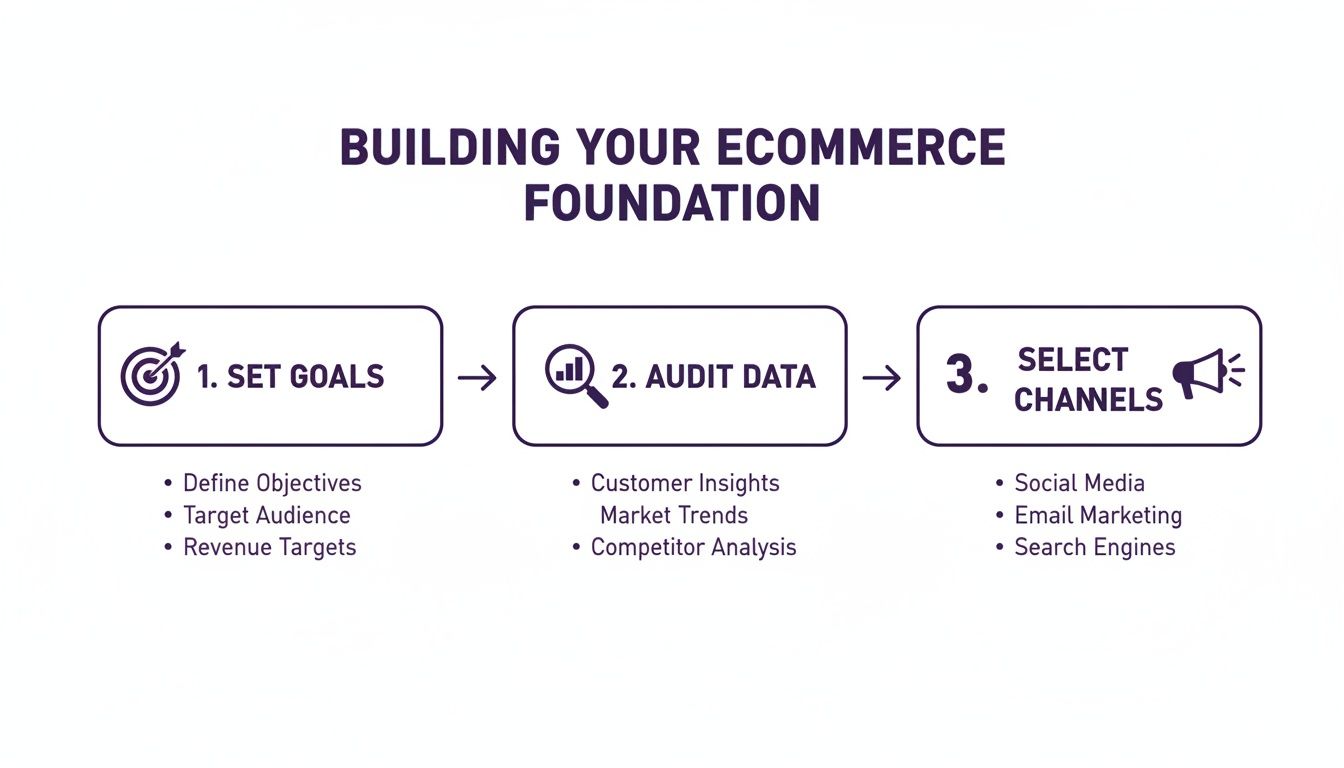
The core idea is a cycle: set clear goals, dig into your data to see what's really happening, and then pick your channels. It's a simple but powerful loop of planning, analyzing, and acting.
And the opportunity is massive. Global ecommerce sales recently topped $6.3 trillion, with online shopping now making up over 20% of all retail. A sharp strategy is your only ticket to carving out a piece of that pie.
A winning strategy isn't about being everywhere. It's about being on the right platforms with the right message for the right customer. This initial planning prevents you from burning through your budget and maximizes your return from the get-go.
To help you map this out, here’s a quick look at the essential pillars of a modern ecommerce plan.
Core Components of a Modern Ecommerce Strategy
| Component | Objective | Key Metric |
|---|---|---|
| Data & Analytics | Understand customer behavior and campaign performance. | Conversion Rate, CLV, ROAS |
| Customer Segmentation | Group customers by behavior to personalize messaging. | Repeat Purchase Rate, AOV |
| Channel Mix | Reach customers at different stages of their journey. | Customer Acquisition Cost (CAC) |
| Creative & CRO | Optimize messaging and user experience to drive action. | Click-Through Rate (CTR), Add-to-Cart Rate |
| Retention & Loyalty | Encourage repeat purchases and build brand affinity. | Churn Rate, Customer Lifetime Value (CLV) |
These components are interconnected; strengthening one almost always lifts the others.
Getting the technology right is also a huge piece of the puzzle. If you're weighing your options, our ecommerce platform comparison guide breaks it all down. This foundational work ensures every dollar you spend is an investment in predictable, long-term success.
Auditing Your Market and Defining Your Ideal Buyer

Any powerful ecommerce strategy is built on intelligence, not guesswork. Before you can sell anything effectively, you have to know exactly who you’re selling to and what you’re up against. It all starts with a no-nonsense audit of your performance and a deep dive into the competitive landscape.
This isn’t about creating massive reports that collect dust. It’s about digging up actionable insights that will shape every single decision you make, from the channels you pick to the ad copy you write. The goal is simple: move from guessing what might work to knowing what will.
Uncovering Your Performance Baseline
First things first, you need a crystal-clear picture of where you stand right now. This internal audit is your baseline—the "you are here" marker on your growth map that you'll measure all future success against.
Start by digging into your core data to answer a few critical questions:
- Website Analytics (Google Analytics 4): Where is your traffic actually coming from? Which pages are people sticking to, and where are they bailing?
- Past Campaign Results: Look back at the last year. What were your best and worst-performing marketing campaigns? Get specific with metrics like Return on Ad Spend (ROAS), Cost Per Acquisition (CPA), and click-through rates.
- Sales Data: Who are your top 10% of customers? What are they buying, how often, and what’s their average order value?
When you answer these, patterns start to emerge. You might find your organic search traffic converts way better than your paid social ads, telling you it's time to double down on SEO. Or maybe one product category is a magnet for repeat purchases, which is a screaming signal to build a targeted loyalty campaign around it.
Analyzing the Competitive Landscape
With your own data dialed in, it’s time to look outward. A competitor analysis isn’t about copying what everyone else is doing; it’s about understanding their playbook so you can find your own unique advantage. You’re looking for their strengths, their weaknesses, and—most importantly—the gaps you can exploit.
Pick two or three of your closest competitors and focus your analysis on these key areas:
- Traffic Sources: Use a tool like Semrush or Ahrefs to see where their traffic is coming from. Are they all-in on paid search, or do they have a massive organic footprint?
- Top Content & SEO: What keywords are they owning? Are blog posts, guides, or videos driving their traffic and engagement?
- Ad Strategy: Where are they spending their ad dollars—Facebook, Instagram, Google Shopping? Pay close attention to the messaging and offers they’re pushing.
This kind of intelligence is gold. If you spot a competitor totally ignoring a high-intent keyword cluster, that’s a green light for your SEO team. If their ads constantly hammer a "free shipping" offer, you know that’s a key selling point in your market.
Creating Actionable Customer Personas
This is the final—and most crucial—piece of the puzzle: defining your ideal buyer. Forget generic demographic profiles like "women aged 25-40." That’s useless. An effective ecommerce strategy demands nuanced, behavior-driven customer personas.
Forget broad generalizations. A truly actionable persona captures motivations, pain points, and buying triggers. It’s the difference between knowing who your customer is and knowing why they buy.
To build these, you need to mix quantitative data with real human insights:
- Customer Surveys: Just ask! Send a survey to existing customers about their challenges, what they value, and why they picked you.
- Purchase History: Analyze what different segments buy. Do some people only buy on sale, while others grab new arrivals at full price every time?
- Site Behavior: Use heatmaps and session recordings to watch how people navigate your site. What are they searching for? Which pages do they spend the most time on?
This process turns abstract data into real, tangible profiles. For example, you might identify "Deal-Seeker Dana," who lives for discount codes and only shops during major sales. Marketing to her requires timely promotions and in-your-face value.
Then there’s "Convenience-Driven Chris," who cares more about fast shipping and easy returns than the price tag. His customer journey needs to be absolutely frictionless, with premium shipping options front and center. Getting this foundation right ensures every marketing dollar you spend is talking to the right person with the right message.
Picking the Right Marketing Channels for Maximum ROI
You can't be everywhere at once. Trying to be is just a fast track to a drained budget and results that feel… diluted. A winning ecommerce strategy isn't about being on every platform; it's about being on the right ones.
Strategic channel selection means matching your brand and your products to the places where your ideal customers already are. It goes way beyond just picking the most popular channels. This requires a hard look at your business goals and the real-world behaviors of your customer personas.
Every channel speaks its own language. A fashion brand chasing Gen Z will feel right at home on TikTok and Instagram, leaning on influencer collabs and short-form video to spark trends. But a B2B store selling specialized industrial parts? They'll get far better returns from hyper-targeted LinkedIn ads and deep-dive SEO content that answers complex technical questions.
The Four Pillars of Your Channel Mix
Think of your marketing channels like a balanced investment portfolio. Each one has a specific job to do, and the real magic happens when they all work in harmony. Your goal is to create a smart blend of these four pillars, putting your resources where they’ll make the biggest impact.
Here are the core categories you’ll be working with:
- Organic Channels (SEO & Content): This is your long-game. By creating genuinely useful blog posts, guides, and optimizing your site, you attract high-intent customers who are actively searching for what you sell.
- Paid Channels (PPC & Social Ads): This is your accelerator. Paid ads on platforms like Google or Facebook get you in front of specific audiences fast, letting you test offers and drive immediate sales.
- Email Marketing: This is your direct line. Email is perfect for nurturing leads, announcing new products, and winning back abandoned carts—all without an algorithm getting in the way.
- Retention Channels (Loyalty Programs & Community): This is how you turn a single sale into a long-term customer. Things like loyalty programs, SMS updates, and private community groups transform one-time buyers into repeat customers and advocates.
A classic mistake is treating these channels like they exist in separate vacuums. The best strategies weave them together. An SEO-driven blog post can be promoted with paid social ads, which then capture email signups for a long-term nurture sequence. It’s a flywheel.
Building a Cohesive Multi-Channel Strategy
An effective approach makes sure every channel supports the others, creating a seamless experience for your customer from start to finish. This takes careful planning and knowing how people hop between platforms during their buying journey. For a deeper look at how the pieces fit together, you can check out our guide on multi-channel marketing fundamentals.
The explosive growth of mobile commerce has made this integration non-negotiable. Smartphones now drive nearly 80% of retail website visits and are on track to account for 44% of all U.S. ecommerce sales. Every single channel in your mix must be built for a mobile-first world.
This mobile-centric behavior is changing the game. With 53% of Americans shopping weekly via social media and a staggering 82% discovering products there, channels that prioritize short-form video and live streams are becoming essential for many brands.
Here’s how this might look for two very different businesses:
Scenario 1: A Direct-to-Consumer Coffee Subscription Box
- Primary Focus: Instagram & Facebook Ads. This is where they’ll showcase the lifestyle and unique coffee blends.
- Supporting Channels: SEO-focused blog content ("Best French Press Brewing Methods," "Fair Trade vs. Direct Trade") to catch organic search traffic.
- Retention: A killer email marketing flow with personalized reorder reminders and exclusive deals for subscribers.
Scenario 2: A Niche Hobby Shop Selling Model Train Sets
- Primary Focus: Google Shopping Ads and long-tail SEO. They need to attract enthusiasts actively hunting for specific parts and kits.
- Supporting Channels: A YouTube channel with detailed product reviews, how-to tutorials, and layout builds to establish themselves as an authority.
- Retention: A private Facebook group where customers share projects, plus a points-based loyalty program to reward repeat purchases.
By picking your channels strategically and making them work together, you put your budget where it will have the greatest impact. You build a powerful system that guides customers from that first moment of discovery all the way to becoming loyal, repeat fans.
Turning Clicks into Customers and Customers into Fans

Alright, you've done the homework. You know who you're talking to and where to find them. Now for the fun part: execution.
This is where your strategy moves from the whiteboard to the real world. We're talking about crafting campaigns that don't just get seen, but actually drive sales and create customers who stick around.
The goal here is a seamless experience that feels personal and genuinely helpful at every step. It’s a mix of killer creative, obsessive optimization, and smart retention tactics that get the most out of every single customer you bring in.
Writing Ad Copy That Actually Connects
Good ad copy isn't about listing features. It's about tapping into the real motivations of your customers—the stuff you figured out when you built your personas.
For instance, don't just say, "Our hiking boots have waterproof Gore-Tex." Think about "Adventurous Alex," who's terrified of soggy socks ruining a weekend hike. Speak directly to him: "Conquer any trail with confidence. Our boots keep your feet bone-dry, guaranteed."
See the difference? You just went from a feature to a solution. That small shift is everything.
Your ad copy should feel like the answer to a question your customer is already asking. When you use their language and solve their specific problem, your ads stop being annoying interruptions and start feeling like a friend's recommendation.
If you want to go deeper on this, check out this guide on e-commerce advertisement strategies that actually convert.
Getting More "Yes" with Conversion Rate Optimization
Getting people to your site is just step one. Conversion Rate Optimization (CRO) is the science and art of turning those visitors into buyers.
Think of it this way: even tiny tweaks here can have a massive impact on your revenue. And your product pages are the perfect place to start. They need to do more than just show off a product; they have to build trust and answer questions before a customer even thinks to ask them.
A few things that are non-negotiable:
- High-Quality Visuals: I'm talking multiple, high-res photos and videos showing the product from every angle and, ideally, in use.
- Compelling Descriptions: Tell a story. Go beyond the specs and explain the benefits. How will this make their life better?
- Obvious Calls-to-Action (CTAs): That "Add to Cart" button should be big, bold, and impossible to miss.
- Social Proof: Plaster customer reviews, ratings, and testimonials everywhere. Let happy customers do the selling for you.
And don't forget the checkout. This is where so many sales die. Every extra field, every confusing step, is another reason for someone to bail. Aim for a ridiculously smooth, one-page checkout that screams "safe and easy" with security badges and clear shipping info.
The engine behind all good CRO is A/B testing. It's simple: create two versions of something—a headline, a button color, a product photo—and show each version to different groups of visitors. Let the data tell you what works. This removes the guesswork and lets your customers guide your decisions.
Let Your Customers Do the Marketing with UGC
One of the most authentic and powerful tools you have is User-Generated Content (UGC). These are the real-deal photos, videos, and reviews from your actual customers.
UGC acts as powerful social proof. It's one thing for you to say your product is great; it's another thing entirely for a potential customer to see someone just like them loving it.
Get the ball rolling by creating a branded hashtag or running a photo contest. When customers tag you in a post, you're not just getting free marketing material—you're building a community and making that customer feel like part of the brand.
Build a Retention Machine with Email Automation
Here's a fact: getting a new customer costs way more than keeping one you already have. This is why a solid retention plan is the backbone of any lasting ecommerce brand, and email automation is its powerhouse.
These automated sequences, or "flows," are emails that get sent automatically based on what a customer does. They deliver the perfect message at the perfect time, all without you lifting a finger.
Automated Flows You Absolutely Need:
- Welcome Series: Someone just subscribed. Don't leave them hanging! Send a series of emails introducing your brand, showing off best-sellers, and maybe offering a little something to nudge them toward that first purchase.
- Abandoned Cart Recovery: A painful 70% of shopping carts get abandoned. A simple, automated email sent a few hours later reminding them what they left behind can bring back a huge chunk of that lost revenue.
- Post-Purchase Follow-Up: The journey isn't over after the sale. Send a "thank you," provide tracking info, and ask for a review. This makes them feel good about their purchase and keeps the conversation going.
- Re-Engagement Campaigns: For customers who've gone quiet, a friendly "we miss you" email with a special offer can be just the thing to bring them back.
By focusing on both conversion and retention, you stop chasing one-off sales and start building a sustainable growth machine that keeps customers coming back for more.
Measuring Success with Data That Actually Matters
Here’s a hard truth: if you can't measure your ecommerce marketing, you can't improve it. It’s that simple. Too many brands get sidetracked by vanity metrics—likes, impressions, follower counts—that look good on a report but tell you nothing about whether you're actually growing.
To make smart, data-backed decisions, you have to get obsessed with the numbers tied directly to revenue and profit. This means building a solid analytics framework that cuts through the noise and shows you what's working and what's just wasting your budget.
This is how you stop reacting to performance and start proactively shaping it.
Beyond Vanity Metrics: The KPIs That Drive Growth
Your goal is to build a dashboard of Key Performance Indicators (KPIs) that tells the real story of your business's health. Forget the fluff. These are the numbers that should guide every strategic move you make.
Here are the non-negotiables:
- Customer Acquisition Cost (CAC): The total cost to get one new customer. If it costs you $50 to acquire someone and their first purchase is only $40, you’ve got a leaky bucket.
- Customer Lifetime Value (CLV): This forecasts the total revenue you can expect from a single customer over their entire relationship with your brand. It's the ultimate report card for loyalty.
- Conversion Rate: The percentage of visitors who take a desired action, like making a purchase. Bumping this up even slightly can have a massive impact on your bottom line.
- Average Order Value (AOV): The average amount spent every time a customer checks out. Pushing this number up is one of the fastest ways to grow revenue without needing more traffic.
Tracking just these four metrics will put you light-years ahead of competitors chasing likes. For a deeper dive, check out our guide on measuring digital marketing performance.
To keep these critical metrics front and center, it helps to organize them clearly.
Essential Ecommerce KPIs to Track
Here’s a quick breakdown of the most critical metrics for measuring the success of your ecommerce marketing strategy. This isn't just data; it's the heartbeat of your business.
| KPI | What It Measures | Why It's Important |
|---|---|---|
| Customer Acquisition Cost (CAC) | Total marketing & sales spend divided by new customers acquired. | Directly measures the cost-effectiveness of your marketing campaigns. |
| Customer Lifetime Value (CLV) | The total projected revenue a single customer will generate. | Highlights the long-term value of your customers and guides retention efforts. |
| Conversion Rate (CR) | The percentage of website visitors who complete a purchase. | A direct indicator of your site's effectiveness and user experience. |
| Average Order Value (AOV) | The average amount customers spend per transaction. | Shows how much customers are buying in a single order; increasing it boosts revenue. |
| Return on Ad Spend (ROAS) | Revenue generated for every dollar spent on advertising. | Measures the profitability and efficiency of your paid advertising channels. |
| Cart Abandonment Rate | The percentage of shoppers who add items to their cart but don't buy. | Pinpoints friction in your checkout process that's costing you sales. |
Focusing on these KPIs will give you a clear, actionable picture of your performance, moving you beyond guesswork and into strategic growth.
Understanding How Customers Find You With Attribution Models
One of the biggest puzzles in ecommerce is figuring out which channels get credit for a sale. A customer might see a Facebook ad, click a Google search result a day later, and then finally buy after opening a promo email. So, which channel was the winner?
This is where marketing attribution comes in. It’s the framework for assigning value to each touchpoint in that journey.
Don't fall into the trap of giving 100% of the credit to the last click. That’s like giving the game-winning trophy only to the player who scored the final point, ignoring the assists, blocks, and passes that made it happen.
There are a few ways to slice this:
- First-Touch Attribution: Gives all the credit to the very first interaction. This is great for understanding which channels are best at building initial awareness.
- Last-Touch Attribution: The default for many platforms (and often misleading). It gives all credit to the final touchpoint before the sale. Simple, but it ignores the entire journey that came before.
- Multi-Touch Attribution (e.g., Linear, Time-Decay): These models are far more sophisticated, spreading credit across multiple touchpoints. A linear model gives equal credit to each step, while time-decay gives more weight to the interactions closer to the sale.
The right model depends on your business, but shifting toward a multi-touch view will give you a much more realistic picture of how your channels work together.
Building Your Custom KPI Dashboard
You don't need a crazy-expensive system to start tracking what actually matters. The right free tools can be incredibly powerful.
Google Analytics 4 (GA4) is your foundation. It's where all your website and app data lives. Set up custom events to track everything from "add to cart" clicks to video views, and you'll get a granular look at how people behave on your site.
Once that data is flowing, use a tool like Looker Studio (formerly Google Data Studio) to bring it to life. Looker Studio lets you pull data from GA4, Google Ads, and countless other sources into one clean, visual dashboard. This becomes your mission control, letting you monitor your core KPIs at a glance and make quick, data-driven tweaks to your strategy.
Bringing Your Strategy to Life with a Roadmap and Budget
Alright, let's get down to business. A strategy without a plan is just a nice idea floating around. This is where all that research, those customer deep dives, and your channel choices finally come together into a concrete plan of attack.
This is how you turn ambitious goals into a real timeline with real numbers attached. It’s the difference between just doing marketing and methodically building a growth engine. We're talking about being deliberate with your time and money to squeeze every last drop of value from your efforts.
Phase Your Initiatives with a Marketing Roadmap
Look, you can't do everything at once. No one can. A phased roadmap is your best friend here—it helps you prioritize what will actually move the needle right now, without getting completely overwhelmed.
The goal is to stack some early wins. These build momentum and often fund the bigger, more ambitious projects down the line. I like to think about it in quarters.
Your first year might break down something like this:
- Quarter 1 (The Foundation): Focus on the high-impact, low-cost stuff first. This is the perfect time to nail down your SEO basics—think optimizing product pages and kicking off a simple blog. At the same time, get your essential email automations running, like a solid welcome series and a cart abandonment flow.
- Quarter 2 (The Expansion): With your organic and email engines humming, it’s time to pour some fuel on the fire. This is when you can start layering in paid acquisition. Dedicate this quarter to launching your first paid social campaign on a platform like Instagram, using those customer personas you already built.
- Quarter 3 (The Optimization): Now you’ve got data. Use what you've learned from your paid campaigns to sharpen your targeting and get more creative. Start A/B testing your landing pages and experiment with different offers to see what really clicks with your audience and boosts that conversion rate.
A roadmap isn't carved in stone; it's a living, breathing document. The trick is to prioritize the things that unlock the next stage of growth, creating a domino effect of wins that build on each other.
How to Allocate Your Marketing Budget
With a roadmap in hand, you can finally assign dollars with purpose. No more guesswork. There are a couple of straightforward models that work well for most ecommerce brands.
Picking Your Budgeting Model
- Percentage-of-Revenue: This is the simplest method. You just dedicate a fixed percentage of your total revenue to marketing. For most ecommerce brands, this falls somewhere between 5-15%. It’s clean, simple, and ensures your spending scales as you grow.
- Goal-Based (or Objective-Based): This is a bit more strategic. You work backward from a specific goal. For instance, if you want to acquire 1,000 new customers and you know your target Customer Acquisition Cost (CAC) is $25, then your budget for that goal is $25,000. Simple as that.
Once you land on a total number, you can slice it up across the channels in your roadmap.
A startup in Q1 might put 70% into content and SEO and 30% into email tools. Contrast that with a growing brand in Q3, which might allocate 50% to paid ads, 30% to content, and 20% to retention marketing.
This final step is what gives you the confidence to manage your strategy, knowing that every dollar is tied to a specific outcome.
Answering Your Top Ecommerce Strategy Questions
When you're building an ecommerce marketing plan from the ground up, a lot of questions come up. It's easy to get stuck in the weeds. Let's clear up some of the most common questions we hear from founders and marketing managers so you can move forward with confidence.
What’s the Real Difference Between Ecommerce Marketing and Digital Marketing?
It's a classic question, but the distinction is important. Think of digital marketing as the entire universe of online promotion for any business, service, or brand. It's the big picture.
Ecommerce marketing is a specialized slice of that universe. It uses the same channels—social, search, email—but its sole focus is on driving sales for an online store. Success isn't just about clicks or traffic; it's measured by hard ecommerce metrics like conversion rate, average order value (AOV), and customer lifetime value (LTV). It's all about turning browsers into buyers.
How Do I Figure Out My Marketing Budget?
There’s no magic number here, but most successful ecommerce brands use one of two models.
Percentage of Revenue: This is the most straightforward way. You dedicate a set percentage of your total revenue—usually somewhere between 5% and 15%—to marketing. The beauty of this approach is that your budget naturally scales as your business grows.
Goal-Based Budgeting: This one's a bit more strategic. You start with a specific goal and work backward. For example, if your goal is to acquire 1,000 new customers and you know your target Customer Acquisition Cost (CAC) is $25, then your budget for that campaign is set at $25,000. Simple as that.
How Long Does SEO Actually Take to Work?
Let's be blunt: SEO is a long game. It's an investment, not a quick fix. You might see some small wins and ranking bumps in the first few months, but real, meaningful results—the kind that bring in consistent, high-intent organic traffic that actually converts—typically take 6 to 12 months of dedicated work.
SEO is like planting a tree. You won't get shade tomorrow, but with consistent care, you'll build a powerful, self-sustaining asset that pays dividends for years. Unlike paid ads, it doesn't just disappear the moment you stop paying.
At Frozen Crow Inc., we transform these questions into actionable strategies. Our team builds and executes data-driven marketing plans that deliver measurable growth, from boosting conversions to increasing customer lifetime value. Start with a free marketing audit today.


