


August 20, 2026
Digital Marketing Audit Services for Better ROI
Think of a digital marketing audit as a deep, professional diagnosis of your entire online presence. It goes way beyond a simple checklist to uncover what’s actually working, what’s burning cash, and where your biggest growth opportunities are hiding.
What a Digital Marketing Audit Actually Is
Imagine your business is a high-performance car. You can feel it’s not running quite right—maybe it’s guzzling fuel (your ad spend) or just not picking up speed (traffic) like it used to. A digital marketing audit is like having a master mechanic pop the hood and run a full diagnostic on every single system, from the engine (your website) to the GPS (your SEO strategy).
This isn't about pointing fingers or finding blame. It’s all about getting a clear, unbiased look at your digital footprint to understand the true health of your marketing efforts. An audit answers the tough questions that surface-level reports and vanity metrics always seem to miss.
Moving Beyond Simple Checklists
A lot of businesses mistake a real audit for those free online tools that spit out a generic, automated report. While those can be a starting point, they barely scratch the surface. A professional audit service brings something far more valuable to the table: strategic interpretation. It’s about connecting the dots between all the different data points to tell the real story of your performance.
A real digital marketing audit doesn't just list problems. It delivers a strategic roadmap with actionable fixes tied directly to your business goals. It turns confusing data into a clear plan for growth.
This is exactly why the demand for these services is skyrocketing. The global auditing services market, which includes these kinds of specialized digital reviews, was valued at USD 250.51 billion in 2023 and is on track to hit USD 310.03 billion by 2029. That growth shows just how critical expert analysis has become for any business serious about getting a real return on its online investment. You can dig into the full auditing services market report for more on these trends.
The Core Purpose of an Audit
At the end of the day, a digital marketing audit gives you a 360-degree view of your strategy. It’s the foundational step you should take before you pour more money into marketing or make a major strategic change.
A solid audit helps you do three critical things:
- Identify Strengths and Weaknesses: Pinpoint which channels are actually driving results and which ones are just draining your budget with nothing to show for it.
- Uncover Hidden Opportunities: Find untapped keywords, new audience segments, or content gaps your competitors have completely missed. This is where you find your edge.
- Align Marketing with Business Goals: Make sure every dollar you spend and every action you take is pushing you closer to what really matters—whether that’s more revenue, better leads, or a stronger brand.
By delivering this level of insight, a professional audit clears the way for smarter, more efficient, and way more profitable marketing.
Breaking Down the Core Audit Components
A proper digital marketing audit isn't a single, sweeping glance at your online presence. Think of it more like a specialized mechanic running diagnostics on a car—they don't just check the engine. They look at the transmission, the electrical system, and the brakes individually to get a complete picture of the vehicle's health.
This deep-dive approach is what separates a truly valuable audit from a surface-level report. By breaking the process into distinct parts, an agency can apply focused expertise to each area, uncovering critical insights that would otherwise be missed. These individual analyses then come together to create a single, actionable roadmap for growth.
This is all about connecting your current performance to your future strategy and uncovering real opportunities.
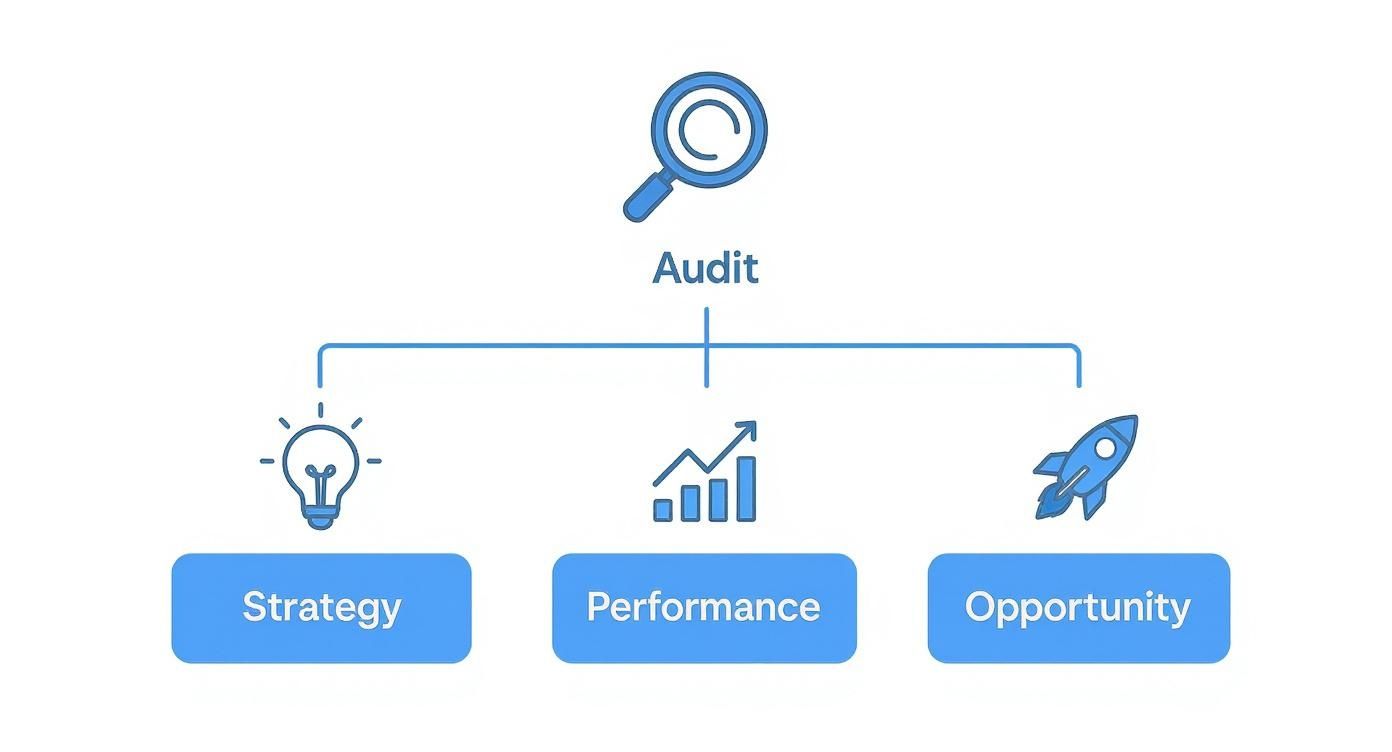
As you can see, a good audit isn't just about looking backward. It’s about using that data to find strategic advantages and new ways to win.
To give you a clearer picture, here’s a breakdown of the key areas we examine in a comprehensive audit. Each component answers a different set of critical questions about your business's online health.
| Audit Component | Focus Area | Key Questions Answered |
|---|---|---|
| SEO Audit | Organic Search Visibility | Are you visible on Google for the right searches? What's holding your rankings back? |
| Paid Media Audit | Advertising ROI & Efficiency | Is your ad spend actually generating revenue, or is it being wasted on the wrong clicks? |
| Website & UX Audit | User Journey & Conversion | Is your website easy to use, or is it chasing potential customers away? |
| Analytics & Tracking | Data Integrity & Measurement | Can you trust your data? Are you tracking the metrics that actually matter for growth? |
Each of these deep dives provides a piece of the puzzle, and when combined, they show exactly where you stand and what you need to do next.
The Search Engine Optimization (SEO) Audit
For most businesses, the SEO audit is the bedrock of the entire analysis. It's all about your visibility on search engines like Google—the key to attracting a steady stream of high-intent traffic without paying for every single click. It’s a multi-part investigation into how well search engines can find, understand, and rank your website.
An SEO audit digs into three main areas:
- Technical Health: This is the "under the hood" check. We’re looking for things like slow page speed, broken links, clunky mobile performance, or crawl errors that stop search engines from properly indexing your site. A single technical glitch can make entire sections of your website invisible to Google.
- On-Page and Content Analysis: Here, the focus shifts to what's actually on your pages. Are you targeting the right keywords? Does your content genuinely answer the questions your customers are asking? We also look for content gaps where your competitors are ranking, but you aren't.
- Off-Page Authority: This part is all about your backlink profile—the network of other websites linking to yours. The audit assesses the quality and relevance of these links. A strong profile acts as a vote of confidence, signaling to search engines that you're a trustworthy authority in your space.
The Paid Media and PPC Audit
While SEO is the long game, paid media is your tool for immediate, targeted visibility. A Paid Media audit scrutinizes your ad campaigns on platforms like Google Ads or social media to make sure every dollar is pulling its weight. Wasted ad spend is one of the most common—and costly—problems we uncover.
This audit answers the tough questions. Are you bidding on the right keywords? Is your ad copy compelling enough to get people to click? And most importantly, are those clicks actually turning into customers? The goal is to plug leaks in your ad budget and funnel that money into campaigns that deliver a measurable return.
A Paid Media audit isn't about spending less; it's about spending smarter. It identifies precisely where your budget is being wasted and where it can be reinvested for maximum impact on your bottom line.
By optimizing campaign structures, targeting, and ad creative, businesses often see a massive improvement in lead quality and a sharp drop in their customer acquisition cost (CAC).
The Website and User Experience (UX) Audit
Think of your website as your digital storefront. You could have a brilliant SEO strategy and a perfectly tuned ad campaign driving traffic, but if the site itself is confusing or frustrating to use, that potential customer is gone in seconds. A Website and UX audit examines that user journey from the moment someone lands on your page to the moment they convert.
This analysis focuses on:
- Navigation and Site Structure: How easily can people find what they’re looking for? A confusing menu or a messy page layout is a recipe for a high bounce rate.
- Conversion Pathways: Are your calls-to-action (CTAs) clear and compelling? We trace the exact steps a user takes to buy something or fill out a form, pinpointing any friction that causes them to drop off.
- Mobile Experience: With over half of all web traffic coming from mobile devices, a clunky mobile site is a huge liability. We make sure your site is responsive and works flawlessly on any screen size.
The Analytics and Tracking Audit
This final piece is arguably the most important because it validates everything else. An Analytics and Tracking audit ensures your measurement tools, like Google Analytics, are set up correctly. Without accurate data, you're just guessing.
This audit verifies you're tracking the right metrics, that your conversion goals are configured properly, and that there are no data integrity issues throwing off your numbers. Solid tracking is the foundation for making smart strategic decisions and proving the ROI of your marketing efforts.
If you want to go even deeper, this ultimate website auditing checklist offers a great step-by-step look at what a full review covers.
The Real-World Impact on Your Bottom Line
A detailed audit report is great, but its real value isn't just in the PDF. It's measured in the tangible results that follow—the kind you can take to the bank. A digital marketing audit connects the dots between abstract data points and your company's financial health, finally answering the one question every business leader asks: "What's our return on this investment?"
The goal is to turn those findings into measurable improvements that directly impact your bottom line. We're talking about lowering your customer acquisition cost (CAC), boosting the lifetime value of each customer, and making sure every single marketing dollar is pulling its weight. It's about turning insights into profit.

From Audit Findings to Financial Gains
Picture this: your business is unknowingly burning $5,000 every month on a Google Ads campaign targeting keywords with zero purchase intent. Sure, it gets clicks, but those visitors never, ever convert. A paid media audit would spot this wasted spend in a heartbeat.
By reallocating that budget to a high-performing campaign—one the audit also uncovered—you could flip a $60,000 annual loss into a powerful revenue driver. This isn't just about plugging leaks; it's about reinvesting that money where it can actually fuel growth.
Here’s how these audit recommendations often play out in the real world:
- Uncovering Technical SEO Flaws: We've seen simple mistakes, like a bad
robots.txtfile, make a company's best-selling product pages completely invisible to Google. Fixing it can unleash a wave of organic traffic and sales that were previously going straight to competitors. - Optimizing Conversion Pathways: A UX audit might find that a clunky, three-step checkout process is causing 60% of users to abandon their carts. Streamlining it to a single page could recover a massive chunk of lost revenue almost overnight.
- Refining Content Strategy: What if you're missing content that answers the final questions customers ask right before they pull out their credit card? An audit can identify these gaps, and creating that content captures high-intent traffic, leading to more qualified leads.
Quantifying the Return on Investment
These aren't just hypotheticals; they’re the bread and butter of a thorough analysis. The financial impact can be staggering. We've seen companies completely transform their trajectory by committing to the audit's roadmap.
A professional digital marketing audit acts as a financial multiplier. It doesn't just identify problems; it pinpoints the highest-impact opportunities, turning inefficient spending into a powerful engine for revenue growth.
The numbers back this up. Some businesses report a 72% increase in monthly recurring revenue and a 30% reduction in marketing spend within the first year of acting on audit findings. It’s also common for clients to start generating 40 or more qualified leads per month, even in tough markets, simply by aligning their strategy with data-driven insights.
Focusing on What Truly Matters
At the end of the day, every audit finding should trace back to a core business metric. Whether it's climbing the search rankings, making ad spend more efficient, or boosting lead quality, the end goal is always to strengthen your financial position. A well-executed audit gives you the clarity to stop guessing and start making decisions based on solid evidence.
You can only manage what you measure, and a big part of that is knowing how to measure marketing ROI accurately. An audit provides the clean data and strategic direction needed to do just that, ensuring your marketing function becomes a proven and reliable source of business growth.
How To Choose The Right Audit Partner
Picking someone to audit your digital marketing is a huge decision. It directly affects the quality of the insights you get and, ultimately, the results you'll see. Not all digital marketing audit services are built the same. You've got everything from cheap, automated tools that spit out generic reports to true strategic partners who hand you a genuine roadmap for growth.
Think of it like this: you can use a health app on your phone, or you can see a specialist doctor. The app gives you basic numbers, like your heart rate. But the specialist? They interpret those numbers, figure out what's really going on, and create a personalized plan to get you healthy. Your business deserves that same expert diagnosis.
The goal isn't just to get a report. It's to find a partner who digs past the surface-level data to deliver actionable insights that actually line up with your specific business goals.
Look For A Customized Diagnostic Process
A one-size-fits-all audit is a massive red flag. Your business is unique—you have your own audience, your own competitors, and your own definition of success. A good audit partner starts by understanding what that success looks like for you, not by just plugging your website into some generic software.
Before you sign anything, grill them on their process. Their first questions should be about your business, not just a sales pitch for their services.
Here are a few questions you should definitely ask:
- How are you going to tailor this audit to our specific industry and customers?
- What's your process for understanding our main business goals before you even start the analysis?
- Can you show me the exact tools and manual review steps you use?
A partner who's all about a custom approach is way more likely to give you insights that are actually relevant and useful. They should be able to tell you exactly how they'll adapt their SEO, paid media, and UX analysis to where you sit in the market.
Prioritize Strategic Analysis Over Data Dumps
This is the single biggest thing that separates a mediocre audit from a great one: the quality of the strategic analysis. Honestly, anyone can run a report that lists technical SEO errors or ad campaign click-through rates. The real magic comes from a partner who can look at that data, connect the dots between different channels, and turn it all into a prioritized action plan.
A great audit partner doesn't just hand you a 100-page report full of problems. They deliver a clear, concise roadmap that tells you exactly what to do first, what will have the biggest impact, and why.
Look for a provider whose final report focuses on the "so what?" behind the data. For every single finding, there should be a clear explanation of why it matters to your bottom line and a concrete recommendation on how to fix it or take advantage of it. This focus on strategy is what turns an audit from a boring homework assignment into a real catalyst for business growth.
Evaluate Their Track Record And Post-Audit Support
Finally, look at their past work and what they plan to do for you in the future. A reputable agency won't be shy about its history. They should be ready to share case studies or client testimonials that prove they can deliver real, measurable results.
But their job shouldn't end the second they email you the final report. The switch from analysis to actually doing the work is where a lot of businesses get stuck. A true partner will offer solid post-audit support to help you through that critical phase.
To make it easier, we've put together a simple checklist to help you compare potential digital marketing audit services providers.
Vendor Selection Checklist
This checklist will help you cut through the noise and figure out which provider can deliver the strategic value you're looking for.
| Evaluation Criteria | What to Look For | Red Flags to Avoid |
|---|---|---|
| Depth of Strategy | They translate data into a prioritized action plan tied to your ROI. | They provide a long list of technical issues with no context or prioritization. |
| Customization | They ask deep questions about your business goals and industry first. | They offer a fixed-price, one-size-fits-all package without a discovery call. |
| Post-Audit Support | They offer clear options for implementation support or follow-up consulting. | The relationship ends the moment they deliver the final report. |
Choosing an audit partner is really an investment in getting clarity and direction for your marketing. If you focus on finding someone who offers a custom approach, strategic depth, and has a proven track record, you'll be well on your way to turning complex data into a clear path toward sustainable growth.
AI and the Future of Marketing Audits
The world of marketing analysis isn't just changing; it's getting a massive upgrade thanks to artificial intelligence (AI) and machine learning. These aren’t just shiny new buzzwords. They are fundamentally changing what a digital marketing audit service can deliver. Instead of replacing the human expert, AI acts as a powerful sidekick, letting us dig through mountains of data and pull out insights at a speed that was once pure science fiction.
Think of it this way: A traditional audit is like having a master mechanic listen to your car's engine, using decades of experience to diagnose a problem. An AI-powered audit gives that same mechanic an advanced diagnostic computer that analyzes every single vibration, temperature reading, and performance stat in real time. The mechanic’s judgment is still what matters most, but the tools they're using make their work faster, deeper, and way more accurate.
Supercharging Data Analysis and Spotting Patterns
The biggest immediate win with AI is its raw power to chew through massive datasets in minutes. A human analyst could spend days poring over website traffic data to spot a faint trend in user behavior. An AI tool can nail it almost instantly, flagging complex patterns that point to a hidden goldmine or a critical flaw you’d otherwise miss.
For instance, AI algorithms can:
- Pinpoint Weird User Behavior: Instantly detect that users from a specific city on a particular phone model are dropping off at one exact step in your checkout process.
- Find Predictive Connections: Discover that customers who read one specific blog post are 300% more likely to buy something within a week—a connection that’s almost impossible to spot in standard reports.
- Automate Tedious Technical Checks: Run a constant, vigilant watch over your site for tricky SEO issues like hreflang conflicts or broken schema markup that could be quietly killing your search visibility.
This isn't some far-off future; it's happening right now. Projections show that by 2025, 46% of marketers will be using AI for their market research, and 44% will have it optimizing their campaigns. As these 2025 digital marketing trends show, this tech is quickly becoming the standard for anyone serious about performance.
From Looking Backward to Predicting the Future
Maybe the most profound shift AI brings to marketing audits is moving from reactive problem-solving to proactive, predictive strategy. A traditional audit is great at telling you what went wrong last quarter. An AI-powered audit, however, uses all that historical data to tell you what's likely to happen next.
The future of the digital marketing audit isn't just about finding what's broken. It's about using intelligent systems to predict what's going to break and identifying the biggest growth opportunities before they're obvious.
This changes the entire conversation. The deliverables from an audit become much more forward-looking. Instead of a report that says, "This ad campaign didn't perform well," an AI-enhanced report can say, "Based on market sentiment and what your competitors are doing, if you move 15% of your ad budget to this new channel, we project a 25% ROI increase over the next six months."
The best digital marketing audit services today are the ones that blend irreplaceable human experience with this incredible technology. The future isn't about machines taking over; it's about smart strategists using even smarter tools to deliver the kind of deep, valuable insights that actually grow a business.
Turning Your Audit into an Action Plan
An exhaustive audit report is packed with data, but data alone doesn't drive growth. Its real value is unlocked when you turn all those findings into a clear, actionable game plan. After all, a world-class audit is useless if it just collects digital dust in your inbox.
Think of the audit as a highly detailed map of where you are right now, complete with terrain warnings and hidden opportunities. The action plan is the turn-by-turn GPS that guides you to your destination: measurable business growth. It’s the bridge between knowing what’s wrong and actually doing something about it.

Prioritizing for Maximum Impact
Let's be real: not every recommendation carries the same weight. The secret to a killer action plan is smart prioritization. We like to sort every single finding based on two simple factors: its potential impact on your goals and the effort it will take to get it done.
This simple matrix instantly creates a hierarchy for what to tackle first:
- Quick Wins (High Impact, Low Effort): This is the low-hanging fruit. Think of things like fixing broken conversion tracking or rewriting a few stale Google Ads. They deliver a noticeable boost right away without draining your resources. We always tackle these first.
- Major Projects (High Impact, High Effort): These are the big, game-changing initiatives—like a full website redesign or a comprehensive content strategy overhaul. They demand serious planning and investment but promise the biggest long-term payoffs.
- Fill-in Tasks (Low Impact, Low Effort): These are the smaller "nice-to-have" improvements. They won't revolutionize your business, but they're worth doing. We typically schedule these around the higher-priority items.
- Reconsider (Low Impact, High Effort): These are the time-sucks. They require a ton of work for minimal return. Honestly? It's often best to put these on the back burner indefinitely or just scrap them.
An action plan is more than a to-do list; it's a strategic framework for allocating your resources where they will generate the greatest return, ensuring your investment in digital marketing audit services becomes a catalyst for sustained growth.
By organizing the audit findings this way, you create a practical, phased roadmap. You get immediate momentum from the quick wins while methodically chipping away at the larger projects. It’s a structured approach that makes sure every action you take is deliberate, measurable, and directly tied to giving you an edge over the competition.
Common Questions About Marketing Audits
Even after laying it all out, a few key questions always pop up when businesses start thinking about a digital marketing audit. Getting these answers straight is what helps you see the real value behind a deep-dive review.
Let's tackle the most common ones we hear.
How Often Should We Get a Marketing Audit?
This is a big one, and the answer isn't one-size-fits-all. It really depends on how fast your business is moving. Think of it like a check-up with your doctor: you go for a full physical once a year, but you might check your own blood pressure or weight more often. The same logic works here.
We recommend a deep, comprehensive digital marketing audit annually. This gives you a full year's worth of data to dig into, setting a solid baseline for the next twelve months of planning.
But you shouldn't just set it and forget it for a year. That’s why we also push for smaller, more focused check-ins every six months. This could be a quarterly technical SEO review or a bi-annual paid media audit. This keeps you agile and lets you react quickly to market shifts, new competitor moves, or sneaky algorithm updates without falling behind.
What Is the Difference Between a Free Tool and a Professional Audit?
You've probably seen them—the dozens of free online audit tools. They can be handy for flagging obvious, surface-level problems. But relying only on them is like using a cheap code reader to diagnose a serious engine problem. The tool spits out a symptom—like "oxygen sensor error"—but it has no idea why it’s happening or what the smartest, most cost-effective fix is.
A free tool gives you raw, uninterpreted data. A professional digital marketing audit service provides strategic interpretation, competitive context, and a prioritized action plan tailored specifically to your business goals.
A professional audit brings in the one thing a tool can't: human expertise. An experienced analyst connects the dots between a technical SEO flaw, your sagging conversion rates, and your bottom-line revenue goals. It turns a scary-long list of problems into a clear, step-by-step roadmap for growth.
How Much Do Digital Marketing Audits Cost?
The price tag for a professional audit can vary quite a bit, mostly depending on the scope and complexity. A small business with a simple website and a couple of marketing channels is going to look a lot different than a massive e-commerce company with a sprawling digital footprint.
Generally, you can expect the cost to range from a few thousand dollars for a focused audit on one area (like just SEO or just Google Ads) to well over $10,000 for a comprehensive, everything-included analysis of your entire online presence. What you're paying for is the time and expertise required to deliver insights that actually move the needle.
Ready to see what's really going on with your marketing? Frozen Crow Inc. offers a complimentary initial marketing audit to pinpoint your biggest opportunities. Start your free audit today and get a clear plan for growth.


