


August 20, 2026
Digital Marketing Audit Services for Clear ROI
Think of your company’s digital marketing like a high-performance engine. When it’s new, it runs smoothly. But over time, things get misaligned, parts wear down, and you start burning through fuel without getting the speed you used to. You’re still moving, but you’re leaving power, efficiency, and a lot of money on the table.
This is where a digital marketing audit comes in. It’s the master mechanic for your marketing engine.
The Mechanic for Your Marketing Engine
An audit puts your entire online operation up on the lift for a full-scale, unbiased inspection. It’s not just a quick glance under the hood. It’s a systematic, data-driven deep dive into every single component—from your SEO and paid ads to your website’s user experience—to find out what’s actually working, what’s flat-out broken, and where your biggest opportunities are hiding.
Instead of guessing why sales have stalled or why your competitors seem to be pulling ahead, an audit hands you a clear blueprint for action. The whole point is to stop the guesswork, eliminate wasteful spending, and get every marketing dollar pulling its weight.
What’s the Real Purpose of a Marketing Audit?
At its core, an audit is about one thing: gaining clarity and control. It’s built to answer the tough business questions that get buried in the day-to-day chaos of running campaigns. The insights you get from a professional audit empower you to make smarter, more confident decisions backed by real data. A solid grasp of Marketing Operations (MOps) is a huge part of this, since the audit’s goal is to fine-tune the very systems that drive your results.
Specifically, a good audit aims to:
- Find the Leaks: Pinpoint the exact campaigns, channels, or tactics that are burning through your budget without delivering any real results.
- Uncover Hidden Gold: Discover new keywords, untapped audience segments, or content angles that your competitors are missing.
- Maximize Your ROI: Make sure your marketing spend is directly tied to your bottom line. (We break down exactly how to do this in our guide on how to calculate marketing ROI).
- See Where You Really Stand: Benchmark your performance against industry standards and your top competitors to get an honest look at your position in the market.
The true value of an audit isn't just finding problems. It's about getting a prioritized, actionable roadmap that turns vague worries into a concrete plan for real, sustainable growth.
It’s no surprise that demand for digital marketing audit services is climbing. With the global digital ad market projected to smash $786.2 billion by 2026, businesses can’t afford to fly blind. Just this year, the market hit $667 billion, which makes a thorough audit non-negotiable if you want to get the most out of every dollar you spend in such a crowded space.
What’s Actually Inside a Marketing Audit?
A real digital marketing audit isn't just some automated website scan that spits out a generic list of problems. It’s more like a series of specialized diagnostic tests, with each one digging into a critical part of your marketing engine. A doctor wouldn’t just check your heart rate and call it a full physical, right? In the same way, a quality audit dives deep into specific areas to build a complete, honest picture of your online health.
These individual deep dives are designed to work together. They show you how strengths in one channel might be covering up weaknesses in another, or how one nagging issue could be causing problems across the board. Understanding these pieces demystifies what digital marketing audit services actually deliver.
This diagram breaks down the fundamental structure of an audit—it all starts with your main business goal and flows down into data assessment and, finally, a strategic roadmap.
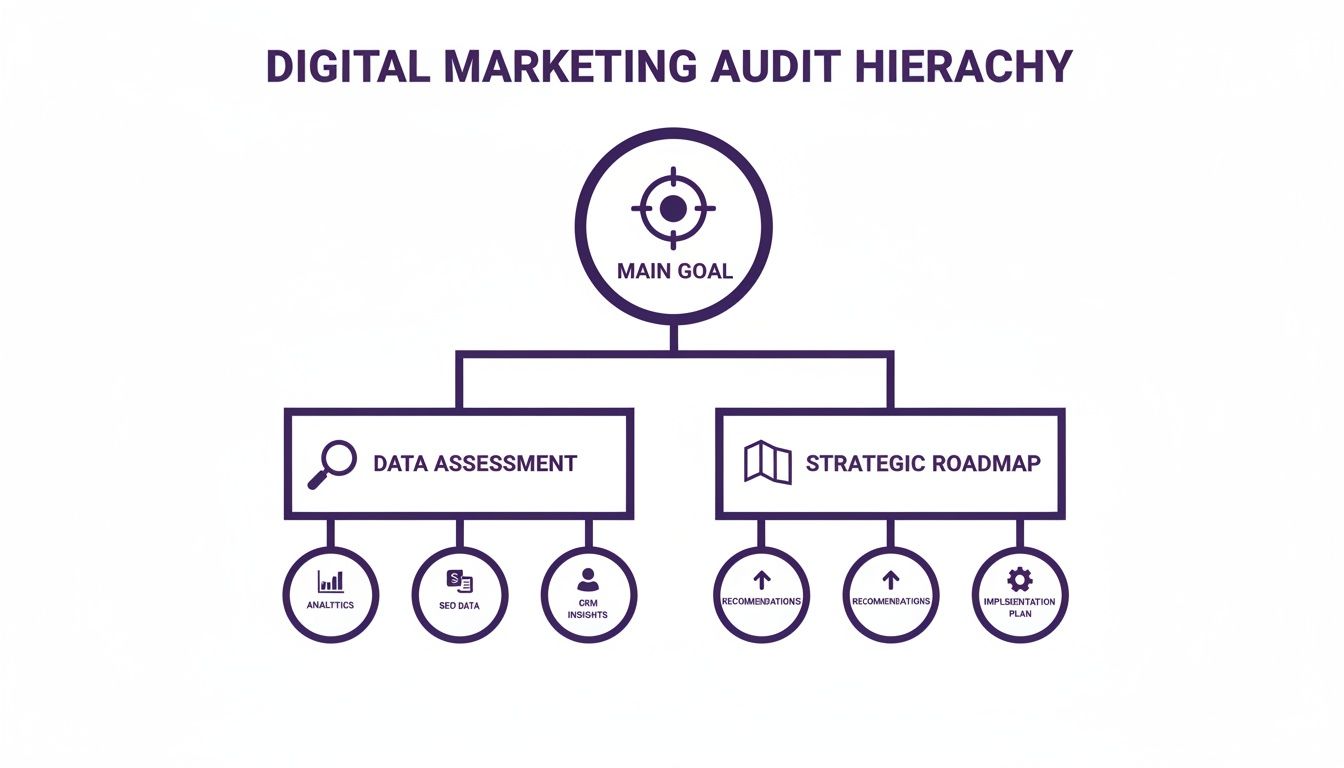
As you can see, a successful audit isn’t just about finding data. It’s about turning that data into a clear, actionable plan that gets you closer to your ultimate objective.
Search Engine Optimization (SEO) Audit
Your SEO is the foundation of your online visibility. An SEO audit looks at how easily search engines like Google can find, understand, and rank your website. This goes way beyond just looking at keywords; it’s a full technical and strategic review of your entire digital footprint.
Here’s what that typically involves:
- Technical SEO Health Check: Think of this as checking the wiring and plumbing of your site. We look for issues like slow page speeds, broken links, clunky mobile experiences, and crawl errors that stop search engines from properly indexing your pages.
- On-Page SEO Analysis: This is all about your content. The audit checks if your page titles, meta descriptions, headings, and actual copy are optimized for the right keywords and, just as importantly, if they give users what they’re looking for.
- Off-Page SEO & Backlink Profile Review: A huge part of your site's authority comes from who links to it. An audit combs through your backlink profile, separating the high-quality, authoritative links from the toxic or spammy ones that could be tanking your rankings.
A solid SEO audit makes sure your website isn't just online—it's actively competing for valuable organic traffic.
Paid Media and PPC Audit
Paid ads can be a rocket ship for growth, but they can also become a black hole for your budget if they aren't managed with precision. A Pay-Per-Click (PPC) audit gets into the nitty-gritty of your ad accounts on platforms like Google Ads to make sure you're getting the best possible return on every dollar.
Key areas we investigate include:
- Account & Campaign Structure: Is everything organized logically? A messy account structure is a classic sign of wasted ad spend and makes it nearly impossible to optimize anything effectively.
- Keyword Targeting & Quality Score: Are you actually bidding on the keywords your ideal customers are searching for? We evaluate keyword relevance, your use of negative keywords, and your Quality Score—a critical metric Google uses to determine your ad rank and cost-per-click.
- Ad Copy & Landing Page Relevance: Great ads need great copy and a smooth journey from click to conversion. This part of the audit checks if your ad's promise matches the landing page experience, which has a direct impact on whether people buy or bounce.
The whole point of a PPC audit is to plug budget leaks, find out what’s working, and scale it up to maximize your return on ad spend (ROAS).
Content and Social Media Audit
Your content and social media are the voice of your brand. This audit figures out if that voice is consistent, engaging, and actually moving people closer to becoming customers. It’s about looking past vanity metrics like likes and shares to measure real business impact.
The process usually involves:
- Content Performance Review: We analyze which blog posts, videos, or guides are pulling in the most traffic, engagement, and conversions. It also helps spot "content gaps"—topics your audience is dying to know about that you haven’t covered yet.
- Audience Engagement Analysis: This is where we figure out which social platforms are actually worth your time. An auditor will look at engagement rates, follower growth, and whether your content is truly connecting with your target audience.
- Brand Messaging & Consistency: We make sure your tone of voice and core message are the same everywhere, from your website's homepage to your latest Instagram post.
An audit of your content strategy reveals if you are simply creating noise or building a valuable resource that attracts and retains customers.
This holistic approach helps sharpen your content plan so it directly supports your business goals. When combined, these individual audits come together to give you a complete, 360-degree view of what's really going on with your marketing.
The Audit Process and What You Get
Ever wonder what actually happens during a digital marketing audit? It can feel like a black box. You hand over access to your accounts, cross your fingers, and wait a couple of weeks hoping for a miracle.
But a real audit isn't a mystery. It's a transparent, structured process designed to take you from a place of confusion to one of total clarity.
It all kicks off with a call to get everyone on the same page about your business goals. This isn’t just a formality—it’s how we make sure our recommendations are tied directly to your growth, not just some generic "best practices" checklist. After that, you’ll grant access to the important stuff like Google Analytics, your ad accounts, and your website backend.

From Data to Diagnosis: The Timeline
Once we have access, the real work begins. The first phase is all about gathering the intel. This usually takes 2-3 days as we pull historical metrics and performance data from every channel you want us to look at. This raw information is the bedrock for everything that follows.
With the data in hand, we move into the deep analysis phase, which typically lasts another 3-5 days. This is where our experts really dig in, connecting the dots between different channels to spot patterns, find wasted spend, and uncover those hidden opportunities you've been missing.
To make sure things run smoothly, it's always smart to get your house in order first. This audit preparation checklist is a great resource for getting your accounts and team ready for the deep dive.
Your Final Deliverable: A Strategic Roadmap
The most important part of any of the best digital marketing audit services is what you get at the very end. A great audit deliverable isn't a 100-page report loaded with confusing charts and technical jargon. It’s a strategic roadmap built for action.
A truly valuable audit doesn't just tell you what's broken. It hands you a prioritized, step-by-step plan to fix it, showing you exactly where to focus your resources for the biggest impact.
Think of this final report as your guide to smarter marketing. It translates all that complex data into clear, actionable insights that your entire team can understand and, more importantly, get behind.
Key Components of an Actionable Audit Report
While the specifics will vary based on your needs, a high-quality audit report should always include a few core elements. These pieces work together to give you a complete picture of where you are now and a clear path forward.
Here’s what you should expect to see:
- Executive Summary: A short, high-level overview of the most critical findings and top-priority recommendations. It’s built for the busy decision-maker who needs the key takeaways in five minutes or less.
- Prioritized Recommendations: This is the heart of the report. Instead of a massive, overwhelming to-do list, you’ll get recommendations grouped by effort and impact—things like "Quick Wins" and "High-Impact Projects." This lets you tackle what matters most, first.
- Competitive Analysis: A no-nonsense look at where you stand against your top 2-3 competitors. This section benchmarks your performance across key channels, showing you where they’re winning and where you have a chance to pull ahead.
- Detailed Findings by Channel: For every area we audit (SEO, PPC, Content, etc.), you'll get a dedicated section breaking down the specific findings, the data that backs them up, and the thinking behind each recommendation.
Ultimately, the whole point of an audit is to empower you. You should walk away with a crystal-clear understanding of your marketing's strengths and weaknesses, armed with a concrete, prioritized plan to drive real growth.
How Audit Services Are Priced
Figuring out what a digital marketing audit costs is a huge step in budgeting for one. There’s no one-size-fits-all price tag here. Instead, the cost really depends on how deep you need the analysis to go. Think of it like a car inspection: a quick look under the hood is one thing, but a full diagnostic that checks every sensor and system is a completely different ballgame.
The final price tag comes down to a few key factors. The biggest one is usually the number of marketing channels you need audited—like SEO, paid ads, and social media. A complex e-commerce business running ads across three different platforms is going to need a much more intensive audit than a local service company with a simple website.
Common Pricing Models Explained
Most agencies stick to a few standard ways of pricing their audit services. Each one is built for different business needs and project sizes, so knowing the difference helps you pick the right approach for your goals.
You’ll typically see these billing structures:
- Flat-Rate Project Fee: This is the go-to for most comprehensive audits. You get a single, upfront price for a clearly defined scope. It’s predictable, with no surprises.
- Hourly Consulting Rate: This is perfect for smaller, more focused audits or if you just need some ongoing advice. It gives you the flexibility to bring in a specialist to look at one specific thing, like your Google Ads account structure.
- Monthly Retainer: Sometimes an audit is bundled into a larger, ongoing marketing contract. You might start with a deep-dive audit and then get smaller, quarterly health checks to make sure your strategy stays on the right track.
The goal isn’t to find the cheapest option. It’s about finding the pricing model that actually lines up with what you want to achieve and gives you the best shot at a real return.
We can break down these common structures to see what might fit your situation best.
Comparing Audit Pricing Models
This table gives a quick overview of how agencies structure their pricing and which model works best for different scenarios.
| Model | How It Works | Best For |
|---|---|---|
| Flat-Rate Project Fee | A single, fixed price for a pre-defined scope of work. | Businesses needing a comprehensive, one-time audit with clear deliverables and a predictable budget. |
| Hourly Consulting Rate | Billed by the hour for the time spent on analysis and reporting. | Quick, targeted reviews of a specific channel (like an ad account) or for ongoing strategic advice. |
| Monthly Retainer | Included as part of an ongoing marketing services agreement. | Companies looking for continuous performance monitoring and regular strategic adjustments over the long term. |
Ultimately, the right model depends on whether you're looking for a one-off strategic blueprint or an ongoing partnership to keep your marketing sharp.
What Is a Realistic Budget for an Audit?
So, what should you actually plan to spend? While prices are all over the map, you can get a good idea of a realistic budget. A proper audit is an investment—it’s designed to stop you from wasting money and to find new ways to grow. The price reflects that expert analysis.
Most professional audits fall somewhere between $1,000 and $5,000 and usually take one to four weeks to complete, covering everything from SEO to paid ads and analytics. The ROI can be massive. It’s not unusual for businesses to see a 72% increase in monthly recurring revenue after putting audit recommendations into practice.
This often goes hand-in-hand with a 30% reduction in marketing spend and generating over 40 quality leads per month. It just goes to show how powerful a good audit can be for driving both efficiency and growth. You can discover more about these outcomes and how they are achieved through in-depth analysis.
At the end of the day, you have to see the cost of a digital marketing audit as an investment, not just another expense. The insights you gain can stop you from burning tens of thousands of dollars on strategies that were never going to work, making that upfront cost a smart move for long-term profit.
DIY Audits vs. Hiring a Professional Agency
One of the biggest questions we hear is whether a business should run its own marketing audit or bring in an agency. At first glance, the DIY route seems like a no-brainer. You save some money, and your team gets a hands-on lesson in digital analysis. It feels like a win-win.
And for a small business with a simple marketing setup and someone on staff with the time and basic know-how, a DIY audit can be a decent place to start. It’s a great way to catch the most obvious problems and get comfortable with your own data. But that’s usually where the road ends.
The Power of an Outside Perspective
Here’s an analogy: a DIY audit is like taking your own blood pressure at home. It gives you a snapshot, a general sense of your health. A professional digital marketing audit service is like going to a clinic for a full diagnostic workup with a team of specialists.
They see things you’re conditioned to miss. An internal team is just too close to the campaigns they’ve spent months or years building. They have biases, blind spots, and are often stuck in the "we've always done it this way" mindset. An agency walks in with a crucial, unbiased eye.
An agency’s greatest asset isn't just their expertise; it's their objectivity. They aren't emotionally invested in past decisions, allowing them to identify uncomfortable truths and strategic blind spots that an internal team might miss.
That fresh perspective is often the key to smashing through a performance plateau.
Deep Expertise and Serious Tools
Beyond just being objective, professional agencies bring two other massive advantages to the table: serious expertise and powerful tools. Their teams live and breathe this stuff every single day, working across dozens of industries and solving complex problems you might only see once a year. They know instantly which metrics are just for show and which ones actually put money in the bank.
Agencies also shell out for enterprise-level analytics and auditing software that’s usually way too expensive for a single company’s budget. These tools dig deeper, pull more accurate competitor data, and run diagnostics that free tools can't even dream of. It’s the difference between a doctor using a stethoscope and one using an MRI. For example, a proper deep-dive into your paid campaigns needs more than a quick look, which is where a specialized Google Ads audit proves its worth.
Making the Right Call for Your Business
So, how do you decide? The choice between DIY and hiring a pro really boils down to three things: resources, expertise, and complexity.
- Resources: Do you really have someone who can dedicate 20-40+ hours to a deep-dive audit without letting their main job suffer?
- Expertise: Is your team genuinely up-to-date on SEO, PPC, analytics, UX, and content strategy? The digital world changes fast.
- Complexity: A local pizza shop has very different needs than a national e-commerce brand juggling thousands of SKUs and multiple ad platforms.
As your business gets more complex, the need for a professional audit stops being a luxury and becomes a strategic necessity. The global market for auditing services is expected to grow by a massive $113.4 billion by 2028, largely because companies need expert help to optimize performance. This trend shows just how many businesses are turning to outside experts to get an edge. You can learn more about the trends driving the auditing market and see why it's becoming the standard.
At the end of the day, a DIY audit can give you a basic check-up. But a professional digital marketing audit service delivers the specialist’s diagnosis you need to achieve peak performance and real, sustainable growth.
How to Choose the Right Audit Partner
Picking the right partner for your digital marketing audit is every bit as important as the audit itself. You're not just looking for a data dump; you need a strategic roadmap for growth. That means finding a team with the right mix of expertise, tools, and a genuine understanding of your unique business challenges.

The market for these services is huge—valued at $23.6 billion in 2024 and expected to climb to $36.5 billion as digital marketing gets more complex. With that growth comes a lot of specialized firms, making it critical to choose wisely. You can dig into more insights on the audit services market on Technavio. Your goal is to find an agency that doesn't just point out problems but gives you clear, actionable ways to fix them.
Vetting Potential Audit Agencies
A solid vetting process is what protects your investment and ensures you end up with a partner who can deliver real value. Don't just skim their homepage. You need to dig into their track record and see how they actually work. A great agency will be totally transparent and happy to show you what they're capable of.
Start your evaluation by looking at these key areas:
- Industry-Specific Experience: Have they worked with businesses like yours before? An agency that already gets your industry's quirks will understand your audience, competitors, and specific hurdles, which leads to much sharper insights.
- Case Studies and Testimonials: You need to see proof of past success. Case studies should spell out the problems they found, the solutions they put in place, and the real-world results they delivered for other clients.
- Tools and Technology: Ask what’s in their toolkit. Professional agencies invest in serious, enterprise-level software for deep analysis—the kind that provides far more accurate data than any free online scanner.
This initial homework will help you build a solid shortlist of agencies. For a deeper dive on this, check out our guide on how to choose a marketing agency.
Critical Questions to Ask
Once you have your shortlist, it’s time to start talking. The questions you ask now can reveal everything about an agency's strategic thinking and whether they'd be a good partner. Get past the price tag and focus on their process and what happens after the audit.
A great audit partner acts like a true consultant. They don't just hand you a report and walk away; they make sure you understand the findings and have a clear, prioritized plan for implementation.
Show up to the conversation ready with questions that test their strategic chops:
- How do you prioritize recommendations? A massive to-do list is paralyzing. A good partner will break down action items by impact and effort, showing you exactly where to focus first for the biggest wins.
- What does post-audit support look like? Do they offer follow-up calls to walk you through the report? Will they stick around to help your team implement the changes?
- Can you show me a sample audit report? This is the best way to get a feel for the quality, clarity, and level of detail you can expect in their final deliverable.
Choosing the right partner turns a digital marketing audit from a simple expense into a powerful investment in your company’s future.
A Few Common Questions We Get About Digital Marketing Audits
Even after walking through the process, a few key questions always seem to pop up when a business is thinking about a professional digital marketing audit. Getting these sorted out helps clear up any final fuzzy spots and builds confidence that you're making a smart investment.
Let's tackle a few of the most common ones we hear.
How Often Should My Business Get a Marketing Audit?
Think of a full-blown audit as the annual physical for your marketing. A comprehensive, deep-dive audit is something you should do at least once a year. That timing is perfect for taking a hard look at your overall strategy, reacting to big shifts in the market, and making sure your long-term goals still make sense.
But of course, your marketing doesn't just happen once a year. That's why we also recommend smaller, more focused "health checks" every quarter. These mini-audits might zoom in on specific areas, like your PPC campaigns or on-page SEO, to catch small issues before they snowball into big problems and allow you to make quick, smart adjustments.
An annual audit sets the grand strategy, while quarterly check-ins keep the engine tuned up. This rhythm keeps you agile and stops you from wasting money all year long.
This approach prevents you from waiting 12 months to fix something that’s been broken since January.
What Specific Tools Are Used During an Audit?
A real professional audit runs on a toolkit that’s light-years beyond the free stuff you can find online. The exact stack changes from one agency to the next, but we all rely on a mix of powerful platforms to get the complete picture of what's going on.
Here are a few of the workhorses:
- For SEO: You can't do a real audit without platforms like Ahrefs, SEMrush, or Screaming Frog. They're crucial for digging into technical issues, analyzing your backlink profile, and seeing what keywords your competitors are ranking for.
- For Analytics: Google Analytics is the starting point, but specialized tools like Hotjar or Crazy Egg give us heatmaps and session recordings to see how people actually behave on your site.
- For Paid Media: We live inside the native tools from Google Ads and Meta, but we also lean on competitive intelligence software like SpyFu to get a peek at what your rivals are up to with their ad spend.
These are enterprise-level tools. The data they provide is just deeper and more accurate than anything else out there.
Does an Audit Guarantee Better Results?
An audit itself doesn’t guarantee a thing. It’s the action you take based on the audit’s findings that gets you results. A great audit delivers a clear, prioritized roadmap that points you straight to your biggest growth opportunities and areas where you're wasting money. It takes all the guesswork out of the equation.
But the ultimate success hinges on your team's commitment to actually implementing the recommendations. The agencies that drive the best results don't just hand over a fancy report and walk away. They stick around to offer support and help guide the implementation. Think of it as a partnership—the audit is the blueprint, and the execution is where the building gets done.
Ready to stop guessing and start growing with a strategy that's actually based on data? The team at Frozen Crow Inc. offers a free, no-obligation marketing audit to uncover your hidden opportunities. Get your complimentary analysis and start your journey to better ROI today at https://frozencrow.com.


