


August 20, 2026
What Is a Digital Marketing Audit Service?
A digital marketing audit service is a complete health check for your entire online presence. It's designed to dig deep, uncover what’s really working, find the hidden opportunities for growth, and pinpoint where your budget is being wasted.
Ultimately, it’s a data-driven roadmap designed to stop the bleeding and maximize your return on every dollar spent.
What Is a Digital Marketing Audit
Think of your marketing like a high-performance car. When it's new, it runs perfectly. But over time, things get misaligned, parts wear out, and fuel efficiency drops. A digital marketing audit service is like hiring a master mechanic to run full diagnostics on every single system.
They’ll get under the hood to see exactly what’s underperforming and, more importantly, why.
This is way more than a simple checklist. It's a systematic, top-to-bottom examination of your marketing goals, the channels you're using, and the results you're actually getting. The entire point is to get an honest look at what’s driving real value versus what’s just noise. For many businesses, it’s the first real step toward building a marketing plan that delivers predictable, measurable growth.
Moving From Guesswork to Strategy
Too many businesses run on gut feelings and assumptions. They think their social media is doing well, or that their SEO is "good enough," but they don't have the hard data to back it up. A professional audit swaps that guesswork for stone-cold clarity.
It’s built to answer the tough questions you've been asking:
- Where are our biggest, untapped growth opportunities?
- How do we honestly stack up against our top three competitors?
- Which marketing channels are bringing in the most valuable customers?
- Are there technical glitches on our website silently killing our performance?
A digital marketing audit is a vital first move for any business serious about growth. It's an especially crucial resource for anyone looking for an essential guide on marketing for small business. The simple truth is that modern marketing is a data game, and companies that use structured audits consistently outperform those that don't.
A great audit ensures every piece of your digital machine—from your website's code to your customer emails—is aligned with your business objectives. The data is clear: operating with audited marketing goals leads to smarter campaigns and better use of your resources.
At the end of the day, an audit transforms your marketing from a random collection of tactics into a cohesive, high-impact growth engine. You can learn more about the fundamentals in our article to see how all the pieces connect.
What a Comprehensive Audit Actually Covers
A real digital marketing audit service is so much more than a simple checklist. It's a deep dive, a full-scale investigation into your entire online presence. Think of your business like a high-performance engine. An audit is the diagnostic check that gets under the hood, examining every single part—from SEO and ad spend to your website's user experience—to see how they're all working together.
We're not just looking at surface-level numbers. This process is about pulling apart each component to understand its true contribution. It's the difference between knowing what happened and uncovering the why behind your performance, which is where smart, strategic decisions are born.
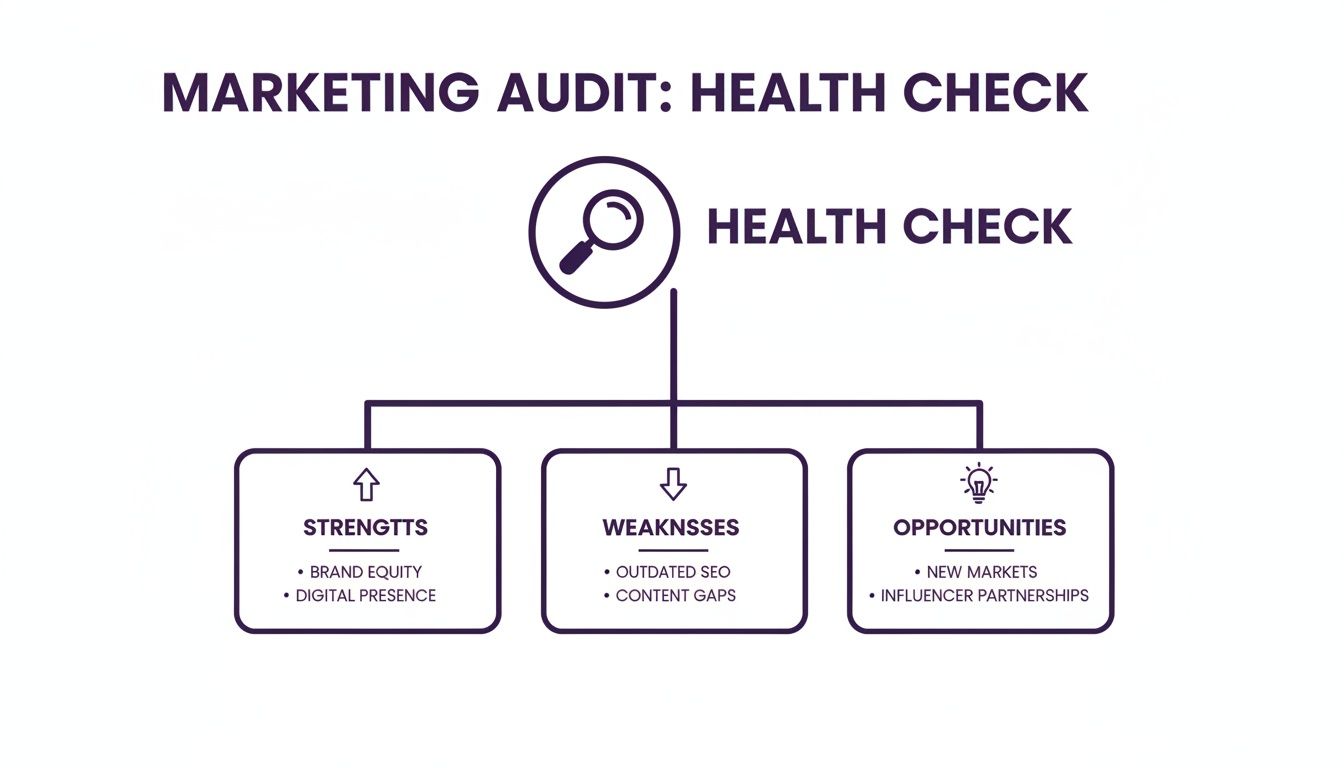
The visual below illustrates how an audit acts as a health check, pinpointing strengths, weaknesses, and—most importantly—new opportunities for growth.
This kind of systematic review is how we build a clear, actionable plan instead of just guessing what to do next.
To get a better sense of what this looks like in practice, here are the key areas we dissect. Each component gets its own focused review, but the real magic happens when we connect the findings across all of them.
Key Focus Areas in a Digital Marketing Audit
| Audit Component | Primary Objective | Example Metrics Reviewed |
|---|---|---|
| SEO | To assess and improve organic visibility and technical website health. | Organic traffic, keyword rankings, backlink profile, crawl errors, page speed. |
| Paid Media (PPC) | To evaluate ad spend efficiency and maximize return on investment. | Return on Ad Spend (ROAS), Cost Per Acquisition (CPA), Click-Through Rate (CTR). |
| Content & Social | To analyze content effectiveness and audience engagement. | Engagement rate, reach, content-driven conversions, social media referrals. |
| Analytics & CRO | To ensure data accuracy and identify conversion friction points. | Conversion rate, bounce rate, goal completion tracking, user journey funnels. |
| User Experience (UX) | To understand how users interact with your site and improve usability. | User session recordings, heatmaps, mobile-friendliness, navigation paths. |
| Tech Stack | To review the tools and platforms powering your marketing efforts. | Tool integration, data flow, cost vs. benefit analysis, platform utilization. |
By looking at each of these areas, we build a complete 360-degree view of your marketing operations.
Search Engine Optimization (SEO) Audit
Your SEO is the foundation of your online visibility. This part of the audit moves way beyond simply checking keyword rankings. We're digging into your site's technical health, the relevance of your on-page content, and the authority you've built through backlinks.
We're after the answers to some critical questions:
- Can search engines even find and index your most valuable pages?
- Is the content you're creating actually matching what your ideal customers are searching for?
- How does your domain authority stack up against the competitors you're trying to beat?
A deep dive here reveals if you're building a sustainable presence that will pay dividends for years or just throwing content at the wall and hoping something sticks.
Paid Media and PPC Audit
Pouring money into Google Ads or social media advertising without a regular, critical review is just gambling. A Paid Media audit scrutinizes every single dollar you spend.
We assess everything from campaign structure and ad performance to budget allocation and the landing pages you're sending traffic to. The end goal is to nail down your true Return on Ad Spend (ROAS) and Customer Acquisition Cost (CAC), turning your ad budget from a blind expense into a predictable, growth-driving investment.
Content and Social Media Audit
Your content and social media channels are the voice of your brand. This audit asks: Is that voice consistent? Is it engaging? And most importantly, is it actually helping your business grow? We look at the performance of your blog posts, videos, and social updates to see what truly connects with your audience.
We analyze engagement rates, follower growth, and how well your content moves people from casual browsers to paying customers. The objective is to transform your content strategy from a simple publishing calendar into a powerful lead-generation engine. A proper audit will explore a wide range of digital marketing performance metrics and measure them against your core business objectives.
A professional audit doesn’t just show you data; it tells you a story. It connects the dots between your website’s loading speed, your ad campaign’s click-through rate, and your company’s bottom line, creating a unified strategy for growth.
Analytics and Conversion Rate Optimization (CRO)
None of this matters if your data is wrong. An audit is worthless without a solid foundation of accurate tracking. The analytics review makes sure your tools—like Google Analytics 4—are set up correctly to capture reliable information you can actually trust.
Once we know the data is clean, the CRO audit kicks in. We meticulously trace the user journey on your website to find all the friction points that are killing your sales. We look at everything from confusing navigation and button placement to clunky checkout processes, hunting for opportunities to turn more of your hard-won visitors into customers.
The Audit Process Step by Step
So, what actually happens when you sign up for a digital marketing audit service? It’s not some mysterious black box where you just hand over the keys and cross your fingers. Think of it more like a structured, collaborative journey designed to bring total clarity to your marketing and light up the path forward.

When you understand the process, the whole thing feels less like a leap of faith and more like a transparent partnership. We can break the entire audit down into four distinct, logical phases. Each step builds on the last, culminating in a comprehensive and genuinely actionable final report.
Phase 1: Discovery and Goal Setting
First thing's first: we need to get aligned. Before we even peek at a single piece of data, we have to understand your business—inside and out. This initial phase is a deep dive into your specific objectives, your biggest headaches, and what success really looks like for you.
We'll work together to get answers to the big questions:
- Are you laser-focused on generating more high-quality leads?
- Is the main goal to build brand awareness in a new market?
- Do you need to improve customer retention and lifetime value?
This isn’t just a formality; it’s the most critical step of all. Without clear, measurable goals, the audit is just a data-dump with no direction. This phase ensures the entire analysis is framed around the outcomes that will actually move the needle for your business.
Phase 2: Data Collection and Access
Once we’ve defined the finish line, it’s time to gather the raw materials. This is where we request and gain secure, read-only access to your various marketing platforms and analytics tools.
This step is handled with the utmost security and confidentiality. The goal is simply to collect the necessary data points from sources like Google Analytics, your ad platforms, SEO tools, and social media accounts to build a complete picture of your performance.
The data collection phase is systematic, not random. We pull historical performance data, review campaign setups, and export key reports. This comprehensive dataset becomes the foundation for all the heavy lifting that comes next.
Phase 3: Deep Dive Analysis
Here’s where the real detective work begins. Our team of specialists meticulously combs through the data we collected, hunting for trends, patterns, anomalies, and—most importantly—hidden opportunities. This isn't just about reporting the numbers; it's about interpreting what they mean for your business.
For example, we might find a direct link between a low conversion rate on your website and a specific technical SEO issue. Or we might connect high ad spend to a single, underperforming landing page that’s been flying under the radar. We benchmark your performance against key competitors and industry standards to give you the context you need to see the full picture.
Phase 4: Strategic Reporting and Roadmap
Finally, we pull all our findings together into a report that’s clear, digestible, and ready for action. A good digital marketing audit service never just hands over a dense spreadsheet and disappears. Instead, we present a strategic roadmap.
This roadmap outlines our findings, prioritizes recommendations based on impact and effort, and gives you a step-by-step plan for implementation. This final deliverable is your guide to growth. It’s built to empower your team with the insights and direction needed to make smarter marketing decisions, optimize your budget, and start hitting the goals we set back in phase one.
How to Turn Audit Results Into Action
An audit report packed with data is a powerful tool, but it’s completely useless if it just gathers dust on a server somewhere. The real magic of a digital marketing audit service isn't in the data itself—it's in turning that data into a clear, prioritized action plan. This is the moment a massive spreadsheet transforms into your strategic roadmap for growth.
The goal isn't to bury you in numbers but to give you a clear path forward. A good agency presents its findings in a way that everyone, from the marketing team on the ground to the C-suite, can immediately grasp. This usually kicks off with a high-level executive summary that calls out the most critical issues and spells out their direct impact on the business.
From Data Points to Strategic Priorities
The best audit reports I've seen use scoring systems to cut through the noise. Think of it like a simple traffic light system—Red, Yellow, and Green—applied to every part of your marketing. This visual shorthand instantly shows you where the biggest fires are burning and where you can afford to hold back.
This approach helps you prioritize what to tackle first by weighing two simple factors:
- Impact: How much will fixing this actually move the needle on your goals?
- Effort: How much time and how many resources will it take to get it done?
By plotting each recommendation on an impact vs. effort matrix, you can instantly spot the "quick wins"—the fixes that deliver the biggest results for the least amount of work. This is how you stop being just busy and start being productive, focusing on the tasks that will actually drive the business forward.
A great audit deliverable doesn’t just tell you what's wrong; it shows you where to start and why it matters. It’s the bridge between analysis and tangible improvement.
A Real-World Example in Action
Let's say your audit comes back with a glaring red score for 'Mobile User Experience'—a painful 35/100. A solid report doesn't just stop there. It connects that poor score directly to a high bounce rate on mobile and a dismal mobile conversion rate, which you can now see is costing you an estimated $15,000 in lost sales every month.
The recommendation isn't some vague advice like "improve the mobile site." Instead, it's a specific, prioritized task list:
- High Priority Task: Implement a simplified, one-page checkout process for mobile users.
- Expected Outcome: Increase mobile conversion rate by 20% within 90 days.
- Required Resources: 40 hours of web development time.
This is how a professional audit turns an abstract finding into a concrete, revenue-driving project. It gives you a step-by-step plan that ties a specific problem to its financial impact, making it incredibly easy to get buy-in from stakeholders and take decisive action.
Connecting the Audit to Your Bottom Line
Let's be honest: an audit isn't just a report card for your marketing. It's a direct investment in your company's financial health, and the only question that really matters is, "What's the ROI?" A proper digital marketing audit service doesn't just give you abstract data; it connects every single finding directly to your bottom line.
Think of it as finding financial leaks you never even knew you had. We often discover things like 20% of a client's ad spend is being funneled into campaigns with nearly zero conversions. By simply reallocating that budget to top-performing channels, you don't just stop wasting money. You actively fuel what's already working, which immediately starts lowering your customer acquisition costs.

These insights empower you to make smarter, data-backed decisions that get the most out of every single marketing dollar.
From Cost Center to Profit Driver
The real power of an audit is its ability to flip the script on your marketing—turning it from a necessary expense into a predictable, revenue-generating machine. It does this by pinpointing high-impact opportunities that boost both efficiency and your bank account.
The financial wins usually fall into a few key areas:
- Improved Lead Quality: By sharpening your targeting and messaging, you start attracting prospects who are actually ready to buy. This makes your sales team's job a whole lot easier.
- Higher Conversion Rates: Sometimes, the smallest friction points kill sales. Fixing something like a clunky mobile checkout can directly translate to more finished transactions.
- Increased Customer Lifetime Value (CLV): Uncovering hidden opportunities in your email and content strategy helps you keep customers around longer and encourages repeat business.
It’s all about making sure your marketing efforts are directly contributing to growth. If you want to get into the weeds on this, our guide on measuring digital marketing performance is a great place to start.
Leveraging AI for a Competitive Edge
A modern audit also looks at how prepared you are to adopt new technologies, especially artificial intelligence. It identifies exactly where you can implement AI for things like automation and personalization to give you a serious leg up on the competition. Imagine using AI-powered segmentation and automated lead nurturing—it can slash your operational costs.
We’re not just guessing here. Research shows that implementing AI-powered flows can lead to a 34% decrease in cost per lead. Even better, AI-influenced purchases have shown 32% higher close rates. You can find more on these digital marketing trends on WSI World.
By flagging these kinds of opportunities, an audit gives you a clear road map. It’s not just about cutting costs; it’s about hitting the accelerator on revenue growth and cementing your spot in the market.
How to Choose the Right Audit Partner
Picking a digital marketing audit service isn't just about hiring a vendor. It’s about finding a strategic partner who’s as invested in your long-term growth as you are. The goal isn't just a fancy report; it's a genuine collaboration that moves the needle.
A great partner brings a fresh, objective perspective that’s hard to get from inside the company. They’ve seen what works (and what doesn't) across dozens of industries, allowing them to spot patterns and opportunities your team might be too close to the work to see. Plus, they usually have access to enterprise-grade tools that dig much deeper than the standard software most businesses use.
Key Qualities to Look For
When you’re talking to potential agencies, you need to look past the sales pitch and hunt for real proof of their expertise. A transparent, collaborative approach isn't just nice to have—it’s essential.
Here’s what to zero in on:
- Proven Experience: Have they worked in your industry before? Ask for case studies or testimonials. A partner who already gets the nuances of your market is a huge advantage.
- Transparent Process: They should be able to walk you through their entire audit methodology without skipping a beat, from how they gather data to how they present the final roadmap.
- Strategic Depth: Are they just talking about technical metrics, or are they connecting their findings to your actual business goals, like revenue and ROI? You need someone who sees the big picture.
Understanding Modern Challenges
The marketing world doesn't sit still. With major shifts like new privacy regulations and the death of third-party cookies, the old playbook is officially out the window. Your partner has to be an expert at navigating these new realities.
For instance, we worked with a healthcare client who, based on our audit, shifted their entire focus to a first-party data strategy. The result? A 27% year-over-year jump in qualified leads. To learn more about these evolving trends, you can explore top digital marketing insights on Astoundz.com.
A true audit partner doesn't just deliver a report and walk away. They give you a clear, actionable roadmap and stick around to help you navigate it. They win when you win.
Choosing the right agency is a big decision, and we want to help you get it right. We put together a detailed guide to walk you through the process. Check out our post on how to choose a digital marketing agency to make sure you find the perfect fit.
Common Questions We Hear About Digital Marketing Audits
It's natural to have a few questions, even after seeing what a full-blown digital marketing audit can do. Let's tackle some of the most common ones we hear from businesses getting ready to dig in.
How Often Should We Be Doing This?
For most companies, a deep-dive audit is something you'll want to do annually. Think of it like an annual check-up—it keeps your strategy healthy and aligned with all the little (and big) shifts in the market and search engine algorithms.
That said, if you're in a cutthroat industry or just went through a major change like a website overhaul, stepping that up to a semi-annual audit is a smart move.
We also see a lot of businesses get value from quarterly "mini-audits" on specific channels, like their paid ads or SEO. This helps them stay nimble and tweak performance on the fly.
Can't I Just Do This Myself?
You absolutely can, and there are plenty of free tools out there that will flag some surface-level issues. But a professional digital marketing audit service brings a few things to the table that a DIY approach just can't match.
An agency or consultant gives you three key advantages:
- An outsider's perspective: We're not tangled up in internal politics or old habits. We see things with fresh eyes.
- Better tools: We invest in enterprise-level software that digs much deeper than the free stuff.
- Cross-industry experience: We've seen what works (and what doesn't) across hundreds of businesses. This pattern recognition helps us spot complex issues that aren't obvious at first glance.
A self-audit might tell you that you have a fever, but a professional audit is like getting a full diagnostic from a specialist who can pinpoint the cause and write the right prescription.
Is an SEO Audit the Same as a Full Marketing Audit?
Not at all—though it's an easy mistake to make. An SEO audit is just one critical piece of a much larger puzzle. It's laser-focused on how your website shows up and performs in organic search results.
A full digital marketing audit zooms out. It's a holistic review that covers SEO, yes, but it also dissects your paid media campaigns, content strategy, social media, email marketing, and how well your site actually converts visitors. It gives you the complete picture of your online footprint and, more importantly, shows you how all those channels are supposed to work together to grow your business.
Ready to stop guessing and start building a data-driven strategy? The team at Frozen Crow Inc. offers a complimentary, no-obligation audit to show you exactly where your biggest growth opportunities are hiding. Get your free audit today and let's turn some insights into action.


