


November 17, 2026
Build a Winning Data Driven Marketing Strategy
Forget guesswork. A data-driven marketing strategy is all about using real customer information and market insights to make every single one of your marketing decisions. Instead of throwing things at the wall to see what sticks, you're using hard evidence to figure out your audience, create experiences they'll actually love, and put your budget where it will make the biggest impact.
It’s about making smarter choices that lead to real, measurable growth.
Why Data-Driven Marketing Is Non-Negotiable
Let's be real. This isn't just another trend—it's the new playbook. The ground has completely shifted under our feet. Tighter privacy rules and sky-high customer expectations have changed the game for good.
In this new world, data has become your most valuable asset. It's the only way to truly understand who you're talking to. A huge part of this is understanding the role of Artificial Intelligence in marketing, because AI is what turns mountains of raw data into insights you can actually use. Without it, you’re flying blind.
The End of an Era for Third-Party Data
For years, marketers leaned on third-party cookies to follow users around the web. Well, that party is over. Major browsers like Chrome, Safari, and Firefox are pulling the plug, and regulations like GDPR have put serious limits on how we can collect data.
This new reality forces a massive shift in tactics. Instead of buying generic data, the focus is now entirely on first-party data. This is the information you collect yourself—directly from your audience through your website, app, or CRM. It's not just a workaround; it's a huge opportunity to build deeper, more authentic customer relationships based on actual trust.
The numbers don't lie. A recent study found that 64% of marketing executives now see data-driven marketing as absolutely essential. A big reason for this is that browsers controlling over 90% of the market are cracking down on tracking, forcing everyone to get good at collecting their own first-party data.
Proving Your Impact and Optimizing Spend
Beyond just keeping up with privacy changes, a solid data strategy solves one of marketing's oldest headaches: proving its value. When you can draw a straight line from a campaign to a sale, the conversations you have with your leadership team change completely.
A data-driven marketing strategy transforms your budget from an expense line into a predictable growth engine. You stop guessing where to spend and start investing in what demonstrably works.
This kind of clarity lets you make smarter decisions, faster. Suddenly, you can:
- Allocate your budget with confidence: Pour money into the channels and campaigns that are actually delivering a return.
- Justify your marketing spend: Show up with clear reports that prove marketing is directly contributing to the bottom line.
- Strengthen customer connections: Use real behavioral data to create personalized experiences that make customers feel like you "get" them.
Ultimately, having a data-driven strategy isn't optional anymore. It's the only way to navigate today's complex environment, build real customer loyalty, and achieve sustainable growth you can actually measure.
Building Your First-Party Data Foundation
A powerful data-driven marketing strategy doesn't start with some fancy, expensive software. It begins with something you already own: the information your audience willingly shares with you.
This is first-party data, and in a world that’s rapidly ditching third-party cookies, it’s your single greatest competitive advantage.
Think of it as the bedrock for everything you build. It’s the direct, unfiltered feedback loop between you and your customers, holding their behaviors, preferences, and history with your brand. Best of all, it's accurate, relevant, and collected with consent, building trust right from the start.
Identifying Your Core Data Sources
Before you can bring all your data together, you need to know where it's hiding. Most businesses have a ton of information scattered across different platforms, often sitting in silos, completely underused. The first real step is to take an audit of your tech stack and find these treasure troves.
You'll likely find gold in places like:
- Website Analytics: Tools like Google Analytics give you a direct look at user behavior. What pages are people visiting? Where are they getting stuck and leaving?
- Customer Relationship Management (CRM): Your CRM is a goldmine. It holds detailed customer profiles, their entire purchase history, and a log of every single chat with your sales and support teams.
- Email and SMS Platforms: These tools show you who's opening your messages and clicking your links, revealing what actually resonates with different groups of people.
- Social Media Channels: The built-in analytics on platforms like Instagram, LinkedIn, or Facebook offer solid insights into follower demographics, content performance, and engagement.
The goal isn't just to make a list. It’s to understand the unique story each source tells about your customer. When you see how the data from your website connects to a support ticket in your CRM, you start to form a complete, actionable picture.
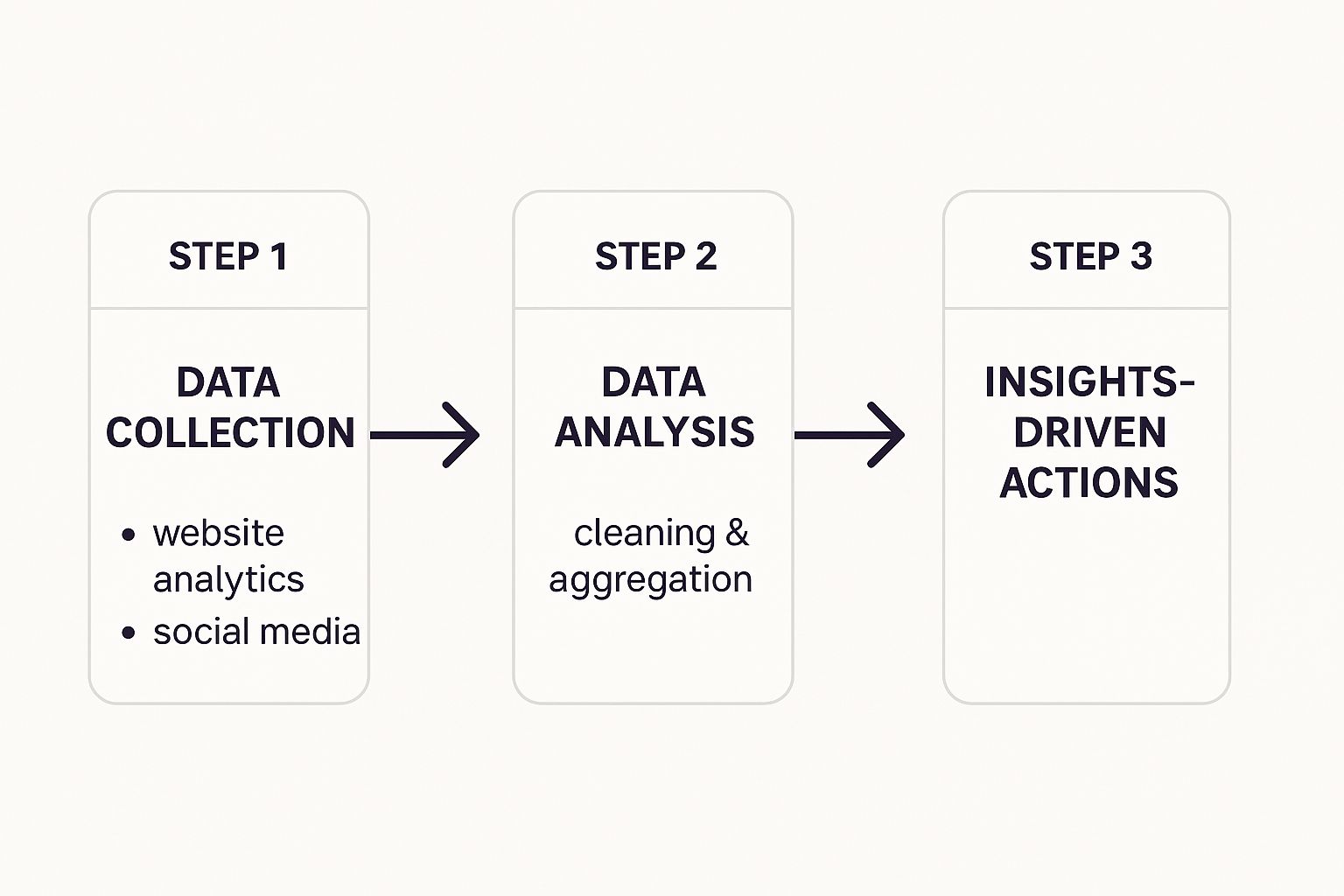
As you can see, gathering the data is just the beginning. The real power comes from pulling it all together to drive marketing that actually works.
To help you get started, here's a quick breakdown of essential data sources and what they bring to the table.
Essential Data Sources for Your Marketing Strategy
| Data Source | Key Metrics to Collect | Strategic Purpose |
|---|---|---|
| Website Analytics | Pages visited, time on site, bounce rate, conversion paths, traffic sources | Understand user intent and identify high-value content or friction points. |
| CRM | Purchase history, customer lifetime value (CLV), support tickets, sales interactions | Segment customers based on value and engagement history for targeted campaigns. |
| Email/SMS Platform | Open rates, click-through rates (CTR), unsubscribe rates, campaign engagement | Refine messaging and offers by seeing what resonates with specific audiences. |
| Social Media Analytics | Follower demographics, post reach, engagement rates, top-performing content | Tailor content strategy to platform-specific audiences and identify brand advocates. |
| E-commerce Platform | Average order value (AOV), abandoned carts, product views, purchase frequency | Trigger automated campaigns for cart recovery or recommend related products. |
This table is just a starting point, but it shows how different metrics from various platforms combine to build a more intelligent and responsive marketing strategy.
Unifying Data for a Single Customer View
Getting data from different sources is one thing. Making it all talk to each other is where the magic happens. Data silos are the enemy here, creating disjointed and often annoying customer experiences.
The ultimate goal is to create a single customer view (SCV)—one unified profile that stitches together every single touchpoint a customer has had with your brand.
Without it, you get mishaps. For instance, your email team might blast a promo offer to a customer who just had a terrible support experience logged in the CRM. That kind of disconnect kills trust.
With a single customer view, you ensure every department is operating from the same playbook. Marketing sees the support ticket, sales sees the recent purchase, and the customer receives a consistent, intelligent experience.
Getting there can be approached in a few ways:
- Direct Integrations: Many modern tools play nice together. Connecting your Shopify store to your Klaviyo account, for example, automatically enriches customer profiles with real-time purchase data.
- Integration Platforms (iPaaS): Think of tools like Zapier or Make as translators. They act as a bridge between platforms that don't have built-in connections, automating the flow of information between them.
- Customer Data Platforms (CDP): For companies with a lot of data, a CDP is the heavy-duty solution. It’s purpose-built to pull in data from all over, clean it up, and build powerful, unified profiles you can use to personalize everything.
No matter which tools you use, the principle is the same: break down the walls between your data. This central hub of clean, organized information is often called a marketing database. A well-built one is the engine that drives every other step of your data-driven journey.
Finding Actionable Insights in Your Data

Collecting data is one thing. Turning those endless spreadsheets into a clear roadmap for your next campaign? That's the real challenge. The goal here is to stop looking at numbers and start seeing the human stories hidden inside them. This is where a data-driven marketing strategy really comes to life.
You don't need a Ph.D. in data science to pull this off. It really comes down to asking the right questions and knowing where to look. We’re talking about transforming raw figures into marketing intelligence that feels intuitive and, most importantly, actionable.
Uncovering Your Most Valuable Customers Through Segmentation
Let's be honest: not all customers are created equal. Some buy once and disappear forever, while others become your biggest fans. Data segmentation is how you start telling them apart, grouping your audience by shared behaviors, not just simple demographics.
Forget only looking at age or location. The real power comes from creating segments that directly inform what you do next.
- High-Value Customers: Group users by their Customer Lifetime Value (CLV) or total spend. This is your VIP list—they get your best offers and loyalty perks.
- Recent First-Time Buyers: This group is at a crossroads. A personalized welcome email or a timely follow-up offer can be the difference between a one-time sale and a long-term customer.
- Cart Abandoners: Find everyone who added items to their cart but bailed before checkout. A simple, automated reminder can recover a surprising amount of lost revenue.
- Disengaged Subscribers: Segment users who haven't opened an email or visited your site in 90 days. A "we miss you" campaign with a compelling offer can win them back before they're gone for good.
This approach lets you have focused conversations with small groups instead of shouting one generic message at everyone. The more organized your data is, the easier this all becomes. For a deeper look at getting your data house in order, understanding data warehousing in marketing shows how a central system makes this kind of powerful segmentation a reality.
Mapping the Customer Journey to Find Friction Points
The path from "curious" to "customer" is rarely a straight line. People bounce between your website, social media, and emails before they ever pull out their credit card. Mapping this journey with your analytics data lets you see your business through your customers' eyes for the first time.
Start by tracing the most common routes people take. You might find that one specific blog post is a conversion machine or that customers who watch a product video are 50% more likely to buy. Even better, you'll find the roadblocks.
An unusually high drop-off rate on a specific checkout page isn't just a metric. It's a massive red flag telling you something is confusing or broken. That's not a failure—it's a clear, data-backed opportunity to fix your user experience and lift conversions.
By visualizing these paths, you can pinpoint exactly where users get stuck or frustrated. Fixing these friction points is often the fastest way to improve performance without spending another dime on ads.
Using Predictive Insights to Stay One Step Ahead
Looking at past behavior is essential, but the real magic happens when you use data to predict what’s coming next. This is more accessible than it sounds and can have a massive impact on keeping customers around.
One of the most practical ways to do this is by identifying customers at risk of churn. By analyzing historical data, you can build a profile of what a customer looks like right before they decide to leave.
Imagine a subscription service. Their data might show that customers who haven't logged in for 30 days and have a failed payment are 85% likely to cancel within two weeks. This isn't just an interesting stat; it's a trigger for action.
With this insight, you can build an automated workflow:
- Flag At-Risk Users: A system automatically identifies customers who fit the churn profile.
- Send a Proactive Email: That customer gets a friendly, automated email: "We miss you! Here's 20% off your next month."
- Alert Support: For high-value customers, a ticket is created for a support agent to make a personal check-in call.
This shift from being reactive to proactive is what separates good marketers from great ones. You stop just reporting on what happened and start using data to shape what will happen next.
Executing Campaigns with Data-Backed Precision
Alright, you've done the hard work of unifying your customer data and pulling out clear, actionable insights. Now it’s time for the fun part: launching campaigns that actually hit their mark. This is where your data-driven marketing strategy stops being theoretical and starts making you money.
Execution is no longer about crossing your fingers and hoping for the best. It's about deploying highly relevant experiences, all backed by what you now know about your customers. Every touchpoint, from the first ad someone sees to the content on your website, is now informed by real behavior. Instead of blasting everyone with the same message, you're delivering personalized interactions that resonate because they show you're actually paying attention.
Fueling Personalization with Real Behavior
Let's be clear: true personalization is so much more than sticking {{first_name}} in an email subject line. It’s about creating dynamic, adaptive experiences that shift based on user data in real time. This is how you make customers feel seen and understood—and that’s the secret to earning their loyalty.
What does this look like in the real world?
- Dynamic Website Content: An e-commerce site shows a returning visitor who previously browsed hiking boots a homepage banner featuring new outdoor gear. Instantly, the site feels more relevant than a generic "Welcome Back!" message.
- Targeted Email Flows: A customer buys a specific software package and is immediately entered into an automated onboarding sequence. The emails they receive offer tips and tutorials only for that product, avoiding the noise of irrelevant information.
- Smarter Ad Retargeting: Instead of just chasing every site visitor with the same ad, you get specific. The person who abandoned a cart sees an ad with a limited-time discount. The person who read three of your blog posts sees an ad promoting a related webinar.
These aren't just disconnected tactics; they weave your marketing into a cohesive, intelligent conversation with each customer. A huge piece of this precision is also building a data-driven social media posting schedule, which ensures you're maximizing your reach and engagement on those key channels.
Reallocating Your Budget with Confidence
One of the biggest wins from a data-driven approach is finally being able to invest your marketing budget with near-certainty. You can stop spreading your spend thinly across a dozen channels "just in case" and start doubling down on what truly delivers a return on investment (ROI).
This is where attribution modeling becomes your best friend. It’s simply the framework you use to give credit to the different marketing channels a customer interacts with on their way to making a purchase. Did they convert right after clicking a social media ad, or was it the email they opened three days later that actually sealed the deal?
A data-driven marketing strategy turns your marketing spend from a hopeful expense into a predictable growth engine. You move from guessing which channels work to knowing exactly where every dollar will generate the highest return.
Once you have solid performance data and an attribution model, the picture becomes incredibly clear. You might find that your paid search campaigns, while expensive, bring in customers with the highest lifetime value. On the flip side, you might see that a certain social channel generates a lot of buzz but very few actual sales—a clear signal to move that budget somewhere more profitable.
This level of precision is non-negotiable. With global advertising and marketing spend projected to hit an eye-watering $1.87 trillion in 2025, you can't afford to guess. Using data to optimize your spend is the only way to ensure your campaigns function as strategic growth levers instead of just another cost center. This financial intelligence lets you justify your budget, prove your impact, and drive real, sustainable growth.
Building a Culture of Measurement and Optimization
A data-driven marketing strategy is never really "done." It’s a living system that should get smarter with every campaign you launch and every piece of customer feedback you receive. The real magic isn't in a single, brilliant analysis, but in building a relentless culture of measurement and optimization.
This means moving past gut feelings and into a system of continuous improvement. You're essentially creating a feedback loop where the results from today’s campaigns directly inform and sharpen tomorrow’s strategies. Every launch becomes a genuine learning opportunity.
Get Honest About Your KPIs
First things first: you need to be honest about what you're measuring. It’s way too easy to get distracted by vanity metrics—numbers like social media likes or impressions that look impressive on a chart but tell you nothing about business growth. To build a true data-driven culture, you have to anchor everything to Key Performance Indicators (KPIs) that are directly tied to your bottom line.
A good KPI isn't just a number; it's a compass. It tells you if you're actually moving in the right direction.
Instead of just tracking clicks, start focusing on metrics that reveal real business impact:
- Customer Acquisition Cost (CAC): How much does it really cost you to land a new customer? This is the ultimate test of campaign efficiency.
- Customer Lifetime Value (CLV): What's the total revenue you can reasonably expect from a single customer over time? This helps you understand which segments are truly the most valuable.
- Conversion Rate by Channel: Which of your marketing channels are actually good at turning prospects into paying customers?
Setting the right KPIs completely changes the conversation. You stop asking, "How many people saw our ad?" and start asking, "How many high-value customers did that ad bring us?"
This shift ensures every team member understands how their work contributes to the bigger picture, creating alignment and a shared sense of purpose.
Embrace a Consistent Testing Process
Once your KPIs are locked in, the real work begins. The best way to make small but significant gains is through a consistent A/B testing process. Think of it as applying the scientific method to marketing, where you test small, data-backed changes to see what actually moves the needle.
Don't overthink it. Testing doesn't have to be some massive, complicated project. Start small and build momentum.
- Email Subject Lines: Does a question get more opens than a statement?
- Call-to-Action (CTA) Buttons: Does "Get Started for Free" outperform "Sign Up Now"?
- Landing Page Headlines: Does a headline highlighting a specific benefit convert better than a general one?
The trick is to change only one thing at a time. If you change both the headline and the CTA button, you’ll never know which one actually made the difference. By isolating your tests, you gather clean, reliable data you can use to make every part of your marketing funnel work just a little bit harder.
Create a Powerful Feedback Loop
This is where it all comes together. A great data-driven strategy thrives on a closed-loop system where campaign results aren't the end of the story—they're the beginning of the next one. The insights you gather from your analytics and A/B tests need to be systematically fed back into your planning process.
For example, if you discover that ads featuring customer testimonials have a 25% higher click-through rate, that’s not just an interesting tidbit. It’s a clear directive to make testimonials a central part of your next creative brief. This cycle of launching, measuring, and refining is what separates good marketing from great marketing.
This continuous learning also means looking beyond just your digital channels. The modern customer journey is a messy blend of online and offline experiences. In fact, even with digital's dominance, about 73% of internet users still discover new brands through traditional channels like TV or radio.
To truly understand performance across this mixed landscape, marketers are increasingly turning to more sophisticated methods. Exploring what marketing mix modeling is can give you a framework for measuring the combined impact of both online and offline efforts, ensuring your feedback loop captures the full picture.
By building this culture, you create an organization that is constantly learning and adapting. Your marketing doesn’t just perform; it improves with every single click, conversion, and customer interaction.
A Few Common Questions We Hear
Diving into a full-on data-driven marketing strategy is exciting, but it almost always brings up a few practical, "how does this actually work?" questions. It's one thing to get the theory, but navigating the day-to-day hurdles is where things get real.
Let's break down some of the most common challenges we see marketers run into when they start putting these ideas into action.
"How Do We Choose the Right Tools Without Breaking the Budget?"
This is a big one. Many teams assume a data-first approach requires a massive investment in complicated, expensive software. That’s rarely the case.
The key is to start with what you've got and squeeze every drop of value out of it first. You probably have access to incredibly powerful data sources that are either free or already part of your existing subscriptions.
- Google Analytics: This is the workhorse of website data, and it's completely free. Get comfortable digging into audience reports, conversion paths, and user behavior. It tells you exactly what’s happening on your site.
- Built-in CRM Analytics: Most CRMs, even the more affordable ones, have solid reporting features baked right in. Use them. Segment your customers by purchase history, engagement level, or lead source.
- Native Social Media Insights: Every major social platform—from Meta to LinkedIn—gives you a goldmine of data on follower demographics and content performance at no extra cost.
Only after you’ve pushed these free resources to their limits should you even think about looking for new tools. When that time comes, focus on solving your single biggest pain point. Is it connecting different data sources? A cost-effective tool like Zapier might be all you need. Is it a lack of sophisticated segmentation? Maybe it’s time to explore a more specialized email platform.
The best tech stack isn't the most expensive one. It’s the one that solves your specific problems without getting in the way. Start small, prove the ROI with what you already have, and then build a business case for any new spending.
"What About Data Privacy and Compliance?"
Let's be clear: data privacy is completely non-negotiable.
Regulations like GDPR in Europe and CCPA in California aren't just best-practice suggestions; they are serious legal requirements with hefty penalties. Making sure you're compliant isn't an afterthought—it's the foundation of any trustworthy, data-driven strategy.
First up, transparency is everything. Your privacy policy needs to be easy to find and written in plain English. It should clearly spell out what data you collect and why you're collecting it.
Next, consent has to be explicit and freely given. Users must actively opt-in to things like email newsletters or cookies. Those sneaky pre-checked boxes just don't cut it anymore.
Finally, remember that you are the custodian of your customers' data. That means implementing strong security measures to protect it from breaches. This isn't just an IT problem; it's a core marketing responsibility that directly impacts customer trust.
"How Do We Get Buy-In from Leadership?"
Getting the C-suite to invest time and resources in a data-driven shift means you have to speak their language. And that language is ROI and business growth.
Forget talking about click-through rates or bounce rates. They care about Customer Acquisition Cost (CAC) and Customer Lifetime Value (CLV).
The best way to win them over is with a small, focused pilot project that has a clear, measurable goal. For example, pick a single, high-traffic landing page and set out to improve its conversion rate through A/B testing.
- Establish the Baseline: Show leadership the page's current conversion rate.
- Run the Test: Launch a new version of the page with changes backed by user data or analytics insights.
- Report the Results: Present the lift in conversions. But don't stop there. Translate that lift into what it actually means for the business.
When you can walk into a meeting and say, "This small, data-driven test generated an extra $5,000 in sales last month," you’re no longer asking for a leap of faith. You're presenting a proven, scalable model for growth that's impossible to ignore.
Ready to build a marketing strategy that delivers measurable results? Frozen Crow Inc. offers a free marketing audit to identify your biggest opportunities. Let our experts provide a data-driven assessment to help you boost conversions, optimize your ad spend, and achieve sustainable growth. Get your free audit and start making smarter marketing decisions today!


