


November 17, 2026
10 Data Driven Marketing Strategies to Scale in 2025
In today's hyper-competitive market, intuition and guesswork are no longer enough to build a successful brand. The marketers who thrive are those who harness the power of information, transforming raw numbers into actionable insights. This shift towards evidence-based decision-making is the core of data-driven marketing. By leveraging customer behaviors, engagement metrics, and market trends, businesses can move from broadcasting generic messages to creating highly personalized, resonant experiences that drive conversions and build lasting loyalty.
This article explores 10 powerful data driven marketing strategies that can help you unlock exponential growth, optimize your budget, and gain a decisive competitive edge. We will provide a step-by-step look into each strategy, complete with real-world examples and practical tips to help you implement them effectively. To truly unleash the power of your data and effectively communicate insights to stakeholders, consider exploring the best free data visualization tools that can help translate complex datasets into clear, compelling visuals. Whether you're refining your current approach or building a new one from scratch, these strategies will provide a roadmap for turning data into your most powerful marketing tool.
1. Customer Segmentation & Personalization
At its core, this is a foundational data-driven marketing strategy where you stop treating your audience as a monolith. Instead, you use customer data to divide them into distinct groups, or segments, based on shared characteristics. These can include demographics, browsing behavior, purchase history, or psychographic traits. The goal is to move beyond one-size-fits-all messaging and deliver highly relevant, personalized experiences that resonate with each specific segment.
This strategy is powerful because relevance drives engagement. When a customer feels understood, they are far more likely to convert. For example, Netflix’s recommendation engine, which personalizes content suggestions for millions of users, is a key driver of its user retention. Similarly, Amazon attributes a significant portion of its revenue to its sophisticated product recommendation system, which analyzes past purchases and browsing data to suggest relevant items.
How to Implement This Strategy
- Start with Broad Segments: Don't try to create dozens of micro-segments at once. Begin with foundational groups like new customers, repeat purchasers, and high-value customers.
- Utilize Progressive Profiling: Gradually collect data over time through forms and on-site interactions rather than asking for everything upfront. This respects the user experience while enriching your profiles.
- Systematically Test Elements: A/B test your personalization efforts. Does a personalized subject line outperform a generic one? Does showing products based on past browsing history increase click-through rates?
- Ensure Data Hygiene: Regularly clean and update your customer data to ensure your segments remain accurate and effective. Inaccurate data leads to flawed personalization and a poor customer experience.
2. Predictive Analytics for Customer Behavior
This advanced data-driven marketing strategy involves using historical data, statistical algorithms, and machine learning techniques to forecast future outcomes. Instead of reacting to customer actions, predictive analytics allows you to anticipate them. This means identifying which leads are most likely to convert, which customers are at risk of churning, and what products a segment will want next, enabling proactive and highly efficient marketing decisions.

This proactive approach provides a significant competitive advantage. For instance, Uber’s dynamic pricing model uses predictive analytics to anticipate ride demand based on time, location, and historical events. Similarly, Starbucks uses it to analyze transaction data and weather patterns to predict the likelihood of a customer purchasing a specific item, which then informs inventory and personalized offers through its mobile app.
How to Implement This Strategy
- Start with Clear Questions: Begin by defining the business outcome you want to predict. For example, "Which customers are most likely to make a repeat purchase in the next 30 days?"
- Ensure Data Quality: Your predictions are only as good as your data. Ensure you have clean, comprehensive, and relevant historical data from multiple sources like your CRM, website analytics, and sales records.
- Focus on Actionable Predictions: The goal isn't just to predict but to act. Focus on models that provide clear insights you can translate into marketing campaigns, such as identifying high-value prospects for a targeted ad spend.
- Test and Refine Models: Start with simpler models and test their predictions against actual outcomes. Continuously refine your algorithms as you collect more data to improve accuracy over time.
3. Attribution Modeling & Multi-Touch Analysis
This is a sophisticated data-driven marketing strategy that moves beyond simplistic, last-click credit. It involves tracking and assigning value to the various marketing touchpoints a customer interacts with along their path to conversion. Instead of giving 100% of the credit to the final ad or link they clicked, multi-touch analysis provides a holistic view, revealing how channels like social media, email, and organic search work together to influence a final decision.
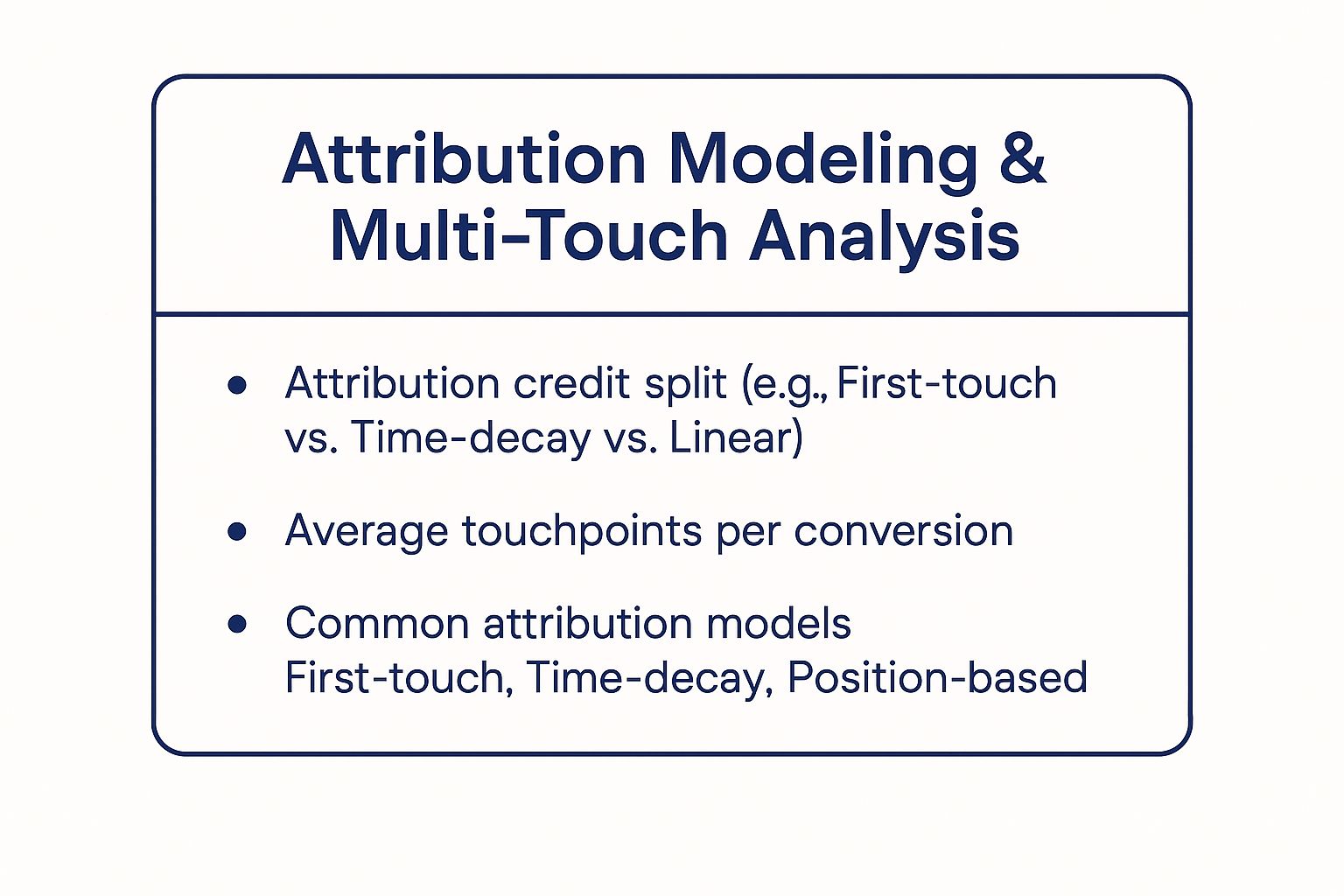
The power of this strategy lies in its ability to justify and optimize marketing spend. For instance, a B2B company like Salesforce can use its own multi-touch attribution tools to see that while a demo request came from a direct search, the initial awareness was driven by a LinkedIn ad and nurtured through a series of emails. This prevents them from incorrectly cutting the budget for top-of-funnel activities that are crucial for generating leads.
How to Implement This Strategy
- Start with Simpler Models: Before diving into complex algorithmic attribution, begin with foundational models like First-Touch, Linear, or Time-Decay to understand the basic impact of different channels.
- Ensure Comprehensive Tracking: Implement robust tracking across all potential touchpoints, from ad clicks and social media interactions to email opens and website visits. Use tools like Google Analytics or Adobe Analytics to consolidate this data.
- Align Models with Business Goals: Choose an attribution model that fits your sales cycle. A short, impulse-buy cycle might work well with a last-touch model, while a long B2B sales process needs a model that credits early-stage interactions. By accurately assigning credit, you can better calculate your true marketing ROI.
- Validate and Test: Regularly review your attribution data and test its assumptions. Use incrementality testing (lift studies) to confirm whether a channel is genuinely driving conversions or just getting credit for conversions that would have happened anyway.
4. Real-Time Marketing Automation
This is a dynamic data-driven marketing strategy that leverages automated workflows to deliver immediate, contextually relevant messages based on customer actions. Instead of scheduling campaigns far in advance, this approach uses real-time data triggers like a website visit, a cart abandonment, or an external event to engage customers at the most opportune moment. The core objective is to capitalize on a user's current intent and provide an instant, personalized experience that guides them toward conversion.

The power of this strategy lies in its immediacy and relevance. For instance, when a customer browses a specific product category, Sephora can trigger real-time recommendations for related items via email or on-site pop-ups. Similarly, Domino's Pizza Tracker provides live updates, turning a mundane waiting period into an engaging brand experience. These instant, helpful interactions build trust and significantly improve the customer journey, making it a cornerstone of modern data driven marketing strategies. Even smaller operations can see huge benefits; you can explore more about marketing automation for small business on frozencrow.com.
How to Implement This Strategy
- Map Key Customer Touchpoints: Before building any workflow, identify critical moments in the customer journey where a timely, automated message could have the most impact, such as post-purchase or after a support ticket is closed.
- Test Workflows Thoroughly: Always run comprehensive tests on your automation sequences before a full launch. A broken link or incorrect personalization token in an automated message can damage customer trust.
- Set Frequency Caps: Protect your audience from message fatigue by implementing rules that limit how often an individual can receive automated communications within a specific timeframe.
- Monitor and Optimize Performance: Regularly review the metrics of your automated campaigns, such as open rates, click-through rates, and conversions. Use this data to refine your triggers, timing, and content for better results.
5. Lookalike Audience Targeting
This sophisticated targeting strategy moves beyond manual segmentation by using machine learning to find new customers. Lookalike audience targeting analyzes your existing high-value customer data (a "seed audience") to identify and reach new people on platforms like Facebook or Google who share similar characteristics, behaviors, and digital footprints. It automates the process of finding your next best customer, expanding your reach to users with a high probability of conversion.
This approach is one of the most effective data-driven marketing strategies for scalable growth. Instead of guessing which interests or demographics to target, you are leveraging your first-party data to guide advertising platforms. For instance, Dollar Shave Club famously used Facebook Lookalike Audiences built from its existing subscriber list to rapidly expand its customer base, reaching millions of new, highly relevant users. Similarly, Shopify merchants often use Google's "Similar Audiences" to find new shoppers who behave like their past purchasers, significantly improving ad spend efficiency.
How to Implement This Strategy
- Use High-Value Seed Audiences: Don't use your entire customer list. Create a seed audience from your most valuable segments, such as repeat purchasers, high-LTV customers, or recent converters for the best results.
- Test Different Audience Sizes: Platforms allow you to choose the "match percentage" (e.g., 1%, 5%, 10%). Start with a smaller, more precise audience (1%) for higher relevance and test broader audiences as you scale.
- Combine with Other Targeting: Layer lookalike audiences with additional interest or behavioral targeting to further refine your reach. For example, target a lookalike of your purchasers who are also interested in a complementary product category.
- Regularly Refresh Your Data: Customer behavior changes. Refresh your seed audiences regularly (e.g., every 30-90 days) with new customer data to ensure the machine learning algorithm is working with the most current information.
6. Dynamic Pricing and Offer Optimization
This advanced data-driven marketing strategy moves beyond static price tags. It involves using real-time market data, competitor pricing, demand patterns, and individual customer behavior to automatically adjust prices and promotional offers. The core objective is to maximize revenue and profitability by dynamically finding the optimal price point for different segments, market conditions, and even inventory levels.
This strategy is highly effective because it aligns price directly with perceived value and market reality at any given moment. For instance, Amazon famously adjusts millions of prices daily based on demand and competition, while Uber's surge pricing algorithm optimizes driver supply with rider demand. Similarly, airlines like Delta have perfected this model for decades, using sophisticated algorithms to maximize revenue for every seat on a flight.
How to Implement This Strategy
- Start with Less Sensitive Products: Begin testing your dynamic pricing models on products or services that are less price-sensitive to gauge customer reaction without significant risk.
- Set Clear Price Boundaries: Establish firm upper and lower price limits (floor and ceiling prices) to prevent extreme fluctuations that could alienate customers or damage your brand perception.
- Monitor Customer Sentiment: Keep a close watch on customer feedback, reviews, and satisfaction metrics. A spike in negative sentiment could indicate your pricing adjustments are too aggressive.
- Prioritize Transparency: Where possible, be transparent about why prices might fluctuate, such as for "peak hours" or "limited availability." This can help manage customer expectations and maintain trust.
7. Customer Lifetime Value Optimization
This advanced data-driven marketing strategy shifts focus from short-term gains, like a single conversion, to the long-term profitability of each customer. Customer Lifetime Value (CLV) is a predictive metric that estimates the total revenue a business can reasonably expect from a single customer account throughout the entire relationship. By optimizing for CLV, marketers can make smarter decisions about acquisition spending, retention efforts, and product development.
This approach is transformative because it forces a holistic view of the customer journey. For instance, Amazon Prime is a masterclass in CLV optimization; the annual fee is less about immediate profit and more about creating a loyal ecosystem where customers spend more frequently and across more categories over many years. Similarly, the Starbucks Rewards program uses data to encourage repeat visits and higher spending, directly increasing the lifetime value of its members. This is one of the most powerful data driven marketing strategies for sustainable growth.
How to Implement This Strategy
- Track Cohort Analysis: Group customers by their acquisition date (e.g., all customers acquired in Q1) and track their spending over time. This helps you understand how CLV is trending and whether your retention efforts are working.
- Invest Strategically in Acquisition: Use predictive models to identify channels and campaigns that bring in customers with a higher potential CLV. This allows you to justify a higher initial acquisition cost for more valuable long-term relationships.
- Segment by Value: Create specific retention programs, exclusive offers, or loyalty tiers for your highest-value customer segments to ensure they remain engaged and loyal.
- Balance Acquisition Costs: Constantly measure your Customer Acquisition Cost (CAC) against the predicted CLV. A healthy business model ensures that the lifetime value is significantly higher than the cost to acquire that customer.
8. Cross-Channel Data Integration
This advanced strategy involves breaking down data silos to unify customer information from all touchpoints into a single, comprehensive profile. Instead of viewing interactions on your website, mobile app, social media, and in-store visits as separate events, you consolidate them. This creates a cohesive, 360-degree view of each customer's journey, enabling truly consistent messaging and coordinated marketing efforts across every channel.
The power of this approach lies in creating a seamless customer experience. When your systems are integrated, a customer's in-store purchase can trigger a relevant email, or an abandoned online cart can lead to a targeted social media ad. For example, Sephora's Beauty Insider program masterfully links online browsing, app activity, and in-store purchases to a single profile, allowing for hyper-personalized recommendations and rewards that feel consistent no matter how the customer shops. This is one of the most effective data driven marketing strategies for building loyalty.
How to Implement This Strategy
- Start with High-Impact Sources: Begin by integrating the two or three channels that hold your most valuable customer data, such as your CRM and e-commerce platform, before expanding.
- Establish Data Governance: Create clear policies for how data is collected, stored, and used across the organization to ensure consistency, privacy, and security.
- Invest in Identity Resolution: Use tools or processes to accurately match customer data points from different sources to a single individual, even if they use different emails or devices.
- Prioritize Data Synchronization: Ensure your systems update in real-time or near-real-time. A delay can result in sending a promotion for an item a customer just purchased, creating a poor experience.
9. Behavioral Trigger Marketing
This precision marketing strategy moves beyond static campaigns to deliver messages based on what a user does or doesn't do. Behavioral trigger marketing uses real-time data to automatically send targeted communications in response to specific customer actions, such as abandoning a cart, visiting a pricing page, or failing to log in for a week. The core idea is to engage customers at the exact moment they are most receptive, making the interaction feel timely and relevant rather than intrusive.
This is one of the most effective data driven marketing strategies because it capitalizes on demonstrated intent. A classic example is the abandoned cart email from retailers like ASOS, which recovers potentially lost revenue by reminding a shopper of their interest. Similarly, Duolingo uses trigger-based notifications to encourage users to maintain their learning streak, a key factor in habit formation and long-term user retention. SaaS platforms like Intercom also use this to trigger onboarding messages when a new user tries a specific feature for the first time.
How to Implement This Strategy
- Map Critical Behavioral Touchpoints: Identify key actions in the customer journey that signal intent or disengagement. This could be anything from downloading a whitepaper to not opening your last three emails.
- Set Appropriate Timing Delays: Sending a message instantly can feel robotic or pushy. Test different delays, such as waiting one hour for a cart abandonment email, to find the sweet spot.
- Implement Frequency Capping: To avoid overwhelming your audience, set limits on how many triggered messages a single user can receive within a specific timeframe.
- Monitor and Refine: Pay close attention to engagement metrics, unsubscribe rates, and customer feedback. If a trigger is leading to high opt-outs, adjust the messaging, timing, or the trigger itself.
10. A/B Testing and Experimentation Framework
This is a systematic, data-driven methodology for removing guesswork from your marketing. It involves creating two or more versions of a single marketing element (like an email subject line, a landing page headline, or an ad creative) and showing them to different segments of your audience to determine which one performs better. This scientific approach allows you to make evidence-based decisions that incrementally improve campaign performance over time.
This strategy is fundamental to optimization because it provides quantitative proof of what works and what doesn't. For example, Google famously tested 41 different shades of blue for its ad links to find the one that generated the most clicks, a change that reportedly increased annual revenue. Similarly, Airbnb constantly tests its booking flow to reduce friction and increase conversions. This framework turns marketing into a science, ensuring every change is a step toward better results.
How to Implement This Strategy
- Test One Variable at a Time: To get clear, unambiguous results, only change one element between your control (version A) and your variation (version B). This isolates the impact of that specific change.
- Ensure Statistical Significance: Use a large enough sample size to be confident that your results aren't due to random chance. Most A/B testing tools will calculate statistical significance for you.
- Focus on High-Impact Elements: Prioritize tests that can significantly affect your key metrics, such as headlines, calls-to-action (CTAs), and form fields. These are core components of conversion rate optimization tips.
- Document Everything: Maintain a detailed log of every test you run, including your hypothesis, the results, and your learnings. This creates an invaluable internal knowledge base for future campaigns.
Data-Driven Marketing Strategies Comparison
| Strategy | Implementation Complexity 🔄 | Resource Requirements ⚡ | Expected Outcomes 📊 | Ideal Use Cases 💡 | Key Advantages ⭐ |
|---|---|---|---|---|---|
| Customer Segmentation & Personalization | High – Requires data infrastructure and maintenance | High – Data platforms and analytics tools | Increased engagement, conversion, and customer lifetime value | Targeted marketing, enhancing customer experience | Highly personalized messaging, improved ROI |
| Predictive Analytics for Customer Behavior | High – Complex ML models and data quality needed | High – Large datasets and AI expertise | Proactive marketing, churn reduction, accurate forecasting | Anticipating customer needs, resource optimization | Early risk detection, optimized campaign timing |
| Attribution Modeling & Multi-Touch Analysis | Very High – Technical and integration challenges | High – Tracking systems and analytics platforms | Accurate ROI measurement, better budget allocation | Multi-channel marketing performance analysis | Holistic conversion insights, reduced last-click bias |
| Real-Time Marketing Automation | High – Complex rule setup and data integration | Medium to High – Automation tools and data feeds | Immediate, relevant customer engagement, better conversion | Trigger-based campaigns, scalable personalization | Timely interactions, efficient use of marketing resources |
| Lookalike Audience Targeting | Medium – Requires quality seed audiences and platform use | Medium – Platform-dependent (e.g., Facebook, Google) | Higher conversion rates, scalable customer acquisition | Expanding reach based on existing high-value customers | Efficient targeting, lower acquisition cost |
| Dynamic Pricing and Offer Optimization | High – Advanced algorithms and monitoring needed | High – Real-time data and pricing tools | Maximized revenue and profit margins, optimal pricing | Retail, travel, service pricing optimization | Revenue maximization, quick market responsiveness |
| Customer Lifetime Value Optimization | High – Complex modeling and long-term data analysis | Medium to High – Predictive analytics and retention tools | Increased long-term profitability and retention | Maximizing customer value over time | Better budget allocation, sustainable growth |
| Cross-Channel Data Integration | Very High – Integration and governance complexity | High – Unified data platforms and APIs | Comprehensive customer view, consistent messaging | Breaking data silos, coordinated marketing efforts | Enhanced personalization, complete journey visibility |
| Behavioral Trigger Marketing | Medium to High – Tracking and rule management required | Medium – Automation and behavioral data platforms | Increased conversion via timely, relevant messages | Cart abandonment, inactivity re-engagement | High message relevance, scalable automation |
| A/B Testing and Experimentation Framework | Medium – Setup and statistical knowledge required | Medium – Testing platforms and traffic volume | Data-driven decisions, continuous campaign improvement | Optimizing marketing elements (emails, ads, pages) | Reduced guesswork, measurable performance gains |
Putting Your Data to Work: Your Next Steps
The journey from traditional marketing to a truly data-driven approach is a significant but rewarding transformation. We've explored ten powerful data driven marketing strategies, from the granular insights of A/B testing and behavioral triggers to the broad strategic vision offered by predictive analytics and Customer Lifetime Value (CLV) optimization. Each of these strategies represents a fundamental shift: moving away from guesswork and assumptions and toward decisions backed by concrete evidence and customer behavior.
The core takeaway is that data is not just a collection of numbers; it's the voice of your customer. By integrating data across channels, you gain a holistic view of the customer journey. By implementing attribution modeling, you understand which touchpoints truly drive conversions. And by leveraging real-time automation and dynamic personalization, you can respond to customer needs at the exact moment of intent, creating experiences that feel uniquely tailored and highly relevant.
Creating a Culture of Data-Driven Decision Making
Adopting these strategies is more than a technical implementation; it's a cultural shift. It requires fostering an environment where curiosity is encouraged, and experimentation is the norm. The most successful organizations build a framework where marketing teams are empowered to test hypotheses, analyze results, and iterate quickly.
Your next steps don't require you to implement all ten strategies at once. Instead, focus on a phased approach:
- Assess Your Current State: Begin with a data audit. What information are you already collecting? Where are the gaps in your cross-channel data integration? Identifying your starting point is crucial.
- Prioritize for Impact: Which strategy aligns best with your immediate business goals? If your goal is to improve customer retention, focusing on CLV optimization and personalized segmentation is a logical first step. If you're focused on acquisition, lookalike audience targeting and A/B testing your landing pages are high-impact initiatives.
- Start Small and Iterate: Choose one or two strategies to master. For instance, launch a simple A/B test on your email subject lines or set up a basic behavioral trigger for cart abandonment. These early wins will build momentum and demonstrate the value of a data-first mindset, creating a virtuous cycle where each campaign generates new insights that fuel the next.
The true power of data driven marketing strategies lies in this continuous loop of learning and optimization. It’s about building a smarter, more efficient marketing engine that not only adapts to market changes but anticipates them, securing a durable competitive advantage. This iterative process ensures that your marketing efforts become progressively more effective, driving sustainable growth and maximizing your return on investment.
Ready to turn these strategies into measurable results but unsure where to begin? At Frozen Crow Inc., we specialize in helping businesses harness the power of their data to build and execute high-performance marketing campaigns. Contact us today for a free marketing audit and let's create a custom, data-driven roadmap to accelerate your growth.


