


August 20, 2026
Boost Your Business with Data Driven Marketing Solutions
Let's be honest—the term "data-driven" gets thrown around so much it often feels like just another empty buzzword. But what does it actually mean?
At its core, the concept is simple. It's about making marketing decisions based on hard evidence, not guesswork. Think of it like a skilled chef tasting and adjusting a recipe as they go, rather than just blindly following a cookbook.
So, What Are Data Driven Marketing Solutions, Really?
Data-driven marketing solutions are simply the tools and strategies that let you act like that chef. They help you systematically collect and analyze customer data to guide every single marketing move you make. It’s not about hoarding mountains of information; it’s about listening to the stories your customers are telling you with every click, purchase, and interaction.
Turning Clicks into Conversations
The real goal here is to stop assuming. Instead of thinking you know what your audience wants, you use data to find out what they actually need, prefer, and struggle with. This is how you craft messages that truly connect.
It all boils down to a few key ideas:
- Listen to Behavior: Every website visit, email open, or social media like is a piece of feedback. Smart solutions capture this feedback to build a clear picture of the customer's journey.
- Inform Decisions: Raw data is useless until it’s turned into real insights. These insights should guide how you spend your budget, what content you create, and who you target.
- Drive Personalization: Once you have a solid data foundation, you can create experiences that feel personal. This can be as simple as a customized email or as sophisticated as a website that changes based on a user's past behavior.
A truly data-driven culture is one where curiosity and evidence beat opinion and convention every time. It’s about asking, "What does the data say?" before you ask, "What do we think?"
The Real-World Business Impact
At the end of the day, this is all about getting tangible results. It's not a secret that businesses using data-driven strategies report a five to eight times higher ROI on their marketing spend. Why? Because they stop wasting money on tactics that don’t work and double down on what does.
It's a continuous cycle: gather data, analyze it for insights, act on those insights, and then measure the results to do it all over again, but better. This constant loop of improvement is what sets successful modern marketers apart. For a deeper dive into these concepts, check out these Data Driven Marketing Strategies That Drive Profit.
This isn't just a fleeting trend; it’s a fundamental shift in how businesses connect with people.
The Four Pillars of a Winning Data Strategy
Building a truly effective data-driven marketing machine is a lot like building a house. You can't just toss up a roof and hope it holds; you need a solid foundation and a well-designed frame. A winning data strategy rests on four pillars that all work together. Get one wrong, and the whole structure becomes wobbly.
Think of these pillars as the blueprint for marketing that actually works. When they’re all in sync, you build something that drives real, sustainable growth.
Pillar 1: Data Collection and Management
This is your foundation. Before you can dream of analyzing customer behavior or personalizing an email, you have to get your hands on the raw materials—your data. This means gathering information from every single touchpoint where a customer interacts with your brand.
But this isn't a "more is more" game. It's about collecting the right data ethically and, just as importantly, organizing it so it's clean, accessible, and ready to use.
- Website Analytics: Tools like Google Analytics help you track user behavior—what pages they visit, how long they stay, and the paths they take to convert.
- CRM Data: Centralizing customer info from platforms like Salesforce gives you a unified view of purchase history, support tickets, and communication logs.
- Social Media Insights: Monitoring mentions, engagement, and sentiment across your social channels tells you what people really think about your brand.
- Transaction Records: This is the hard data on what customers buy, how often, and how much they spend. It’s a goldmine for spotting purchasing patterns.
A messy foundation guarantees a weak structure. Good data management ensures your information is accurate and ready for the next step.
Pillar 2: Analytics and Insights
With the foundation poured, it's time to put up the frame. This is where you turn all those raw, scattered data points into a coherent story. The analytics pillar is all about finding the "why" behind the numbers.
It's the shift from simply knowing what happened to understanding why it happened and what you should do about it. You're connecting the dots to find trends and opportunities that you'd never spot just by looking at the surface.
An insight isn't just a piece of data; it's a discovery that challenges your assumptions and points you in a new direction. It’s the moment a report becomes a strategic advantage.
For example, your analytics might reveal that customers who watch a product demo video are 50% more likely to buy. That’s a powerful insight that immediately tells you where to put your content and ad budget. This process is what turns regular marketing into truly intelligent data driven marketing solutions.
Pillar 3: Personalization and Targeting
Now that the frame is up, you can start putting up the walls and adding the interior finishes. This pillar is where you act on your insights to create customer experiences that feel relevant and genuinely helpful.
This goes way beyond sticking a first name in an email subject line. We're talking about tailoring your messaging, offers, and even your website content to an individual’s specific needs and behavior. Done right, it makes customers feel understood, not just targeted.
This is where data-driven marketing really flexes its muscle. The impact is huge—research shows that effective personalization can lift revenue by 5-15% and improve marketing efficiency by 10-30%. If you want to dig into the numbers, you can learn more about data-driven marketing technologies and see the financial benefits for yourself.
Pillar 4: Measurement and Optimization
Finally, you install the home's essential systems—the electrical and plumbing that keep everything running. This last pillar creates a continuous feedback loop, ensuring your strategy doesn't just work once, but keeps getting better.
It’s about setting clear key performance indicators (KPIs), constantly checking your campaigns against those numbers, and making small, smart adjustments to improve your results. It's the scientific method, but for marketing.
The table below breaks down how these four pillars work together to form a complete data-driven marketing framework.
Four Pillars of Data Driven Marketing
| Pillar | Purpose | Key Tools & Technologies |
|---|---|---|
| Data Collection | To gather raw customer information from all touchpoints in a clean, organized manner. | CRM Systems (Salesforce, HubSpot), Web Analytics (Google Analytics), Social Media Platforms, Transactional Databases |
| Analytics & Insights | To analyze raw data to uncover patterns, trends, and the "why" behind customer behavior. | Business Intelligence (BI) Tools (Tableau, Power BI), Data Warehouses (BigQuery), Customer Data Platforms (CDP) |
| Personalization | To use insights to deliver tailored messages, offers, and experiences to individual customers. | Marketing Automation (Marketo), Email Marketing Platforms (Mailchimp), Personalization Engines, A/B Testing Tools |
| Measurement | To track performance against KPIs and create a feedback loop for continuous improvement. | Analytics Dashboards, Attribution Modeling Software, Conversion Rate Optimization (CRO) Tools (Optimizely) |
By systematically building and maintaining each of these pillars, you create a marketing engine that not only performs but also learns and adapts over time.
This infographic gives a great visual summary of the benefits you can expect from a well-oiled data strategy.
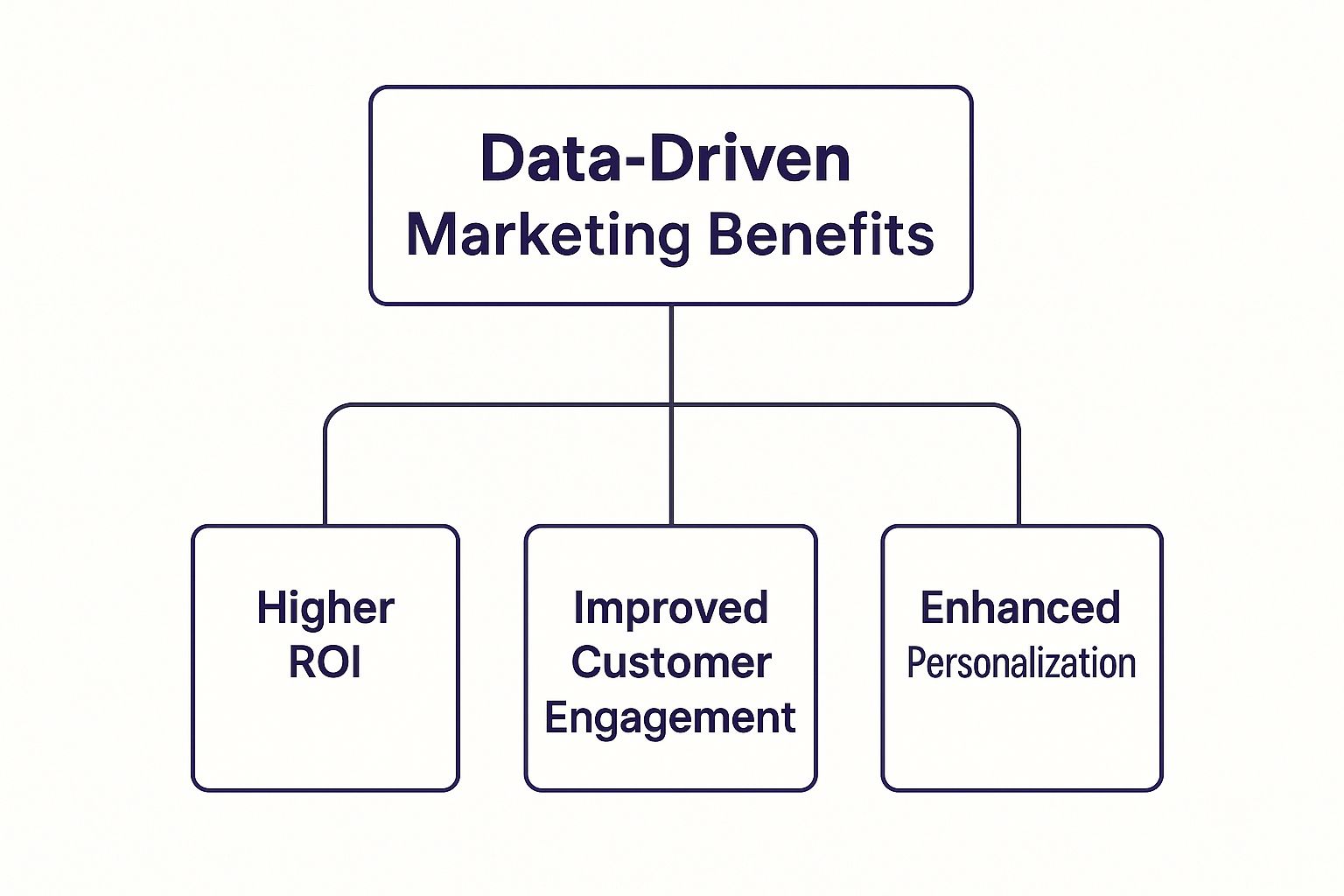
As the diagram shows, these efforts tie directly to a higher ROI, deeper engagement, and a better customer experience. When you master this final pillar, your marketing machine is always running at its best, constantly adapting to new data and a changing market.
How AI Transforms Marketing Solutions

If data is the fuel for modern marketing, then Artificial Intelligence (AI) is the high-performance engine turning that fuel into incredible speed and precision. AI isn't some far-off concept anymore; it's the real-world technology behind the most effective data driven marketing solutions available today. It chews through massive datasets at a scale and speed that no human team could ever hope to match.
Think of it like this: a human marketer is a diligent librarian, carefully reading and categorizing books one by one. AI is like a supercomputer that reads the entire library in a split second, understands the hidden connections between every single book, and even predicts which one you'll want to read next. This is what lets businesses get ahead of customer needs instead of just reacting to them.
The growth here is absolutely staggering. The AI market in data-driven marketing is expected to jump from $47.32 billion in 2025 to over $107.5 billion by 2028. On top of that, the generative AI market—the tech powering automated creativity—is projected to hit a massive $356.05 billion by 2030. It’s clear this is no longer a "nice to have." You can dig into more marketing statistics about AI to see the full picture.
Predictive Analytics: Forecasting Customer Behavior
One of the most powerful things AI brings to the table is predictive analytics. This is where algorithms sift through past customer data—purchase history, browsing habits, engagement patterns—to make an educated guess about what a customer will do next. It’s the difference between looking in the rearview mirror and having a GPS that shows you the road ahead.
For an e-commerce store, this is a game-changer. Predictive analytics can flag customers who are at a high risk of churning (leaving your brand). An AI model might notice a user hasn’t bought anything in 90 days but recently browsed a competitor’s site. That's a signal for the marketing team to jump in with a targeted "we miss you" offer before that customer is gone for good.
But it's not just about stopping bad things from happening. It also helps you spot golden opportunities, like predicting which leads are ready to convert or which existing customers are primed for an upsell.
Hyper-Personalization at Massive Scale
We all know personalization is key, but AI takes it to a whole new level. Traditional personalization might mean dropping a customer's first name into an email. AI-powered hyper-personalization means tailoring the entire customer journey for each person, in real time.
Just look at a streaming service’s recommendation engine. It doesn’t just suggest movies because you liked one action film. It analyzes thousands of data points:
- Viewing History: What you've watched, re-watched, or quit halfway through.
- Time of Day: Your habit of watching comedies on weeknights and dramas on weekends.
- Device Usage: Watching short clips on your phone but full-length movies on your TV.
- Similar User Profiles: What people with taste like yours also enjoyed.
Based on all this, the AI builds a homepage that feels like it was made just for you. This is a true one-to-one marketing experience, delivered to millions of people at once—something only AI can pull off.
AI enables marketers to stop broadcasting a single message to a large audience and start having a unique, relevant conversation with every single customer, automatically and continuously.
Automated Campaign Optimization
Finally, AI is completely changing how campaigns are managed. Forget the old "set it and forget it" mindset. AI algorithms can monitor how a campaign is doing in real time and make automatic tweaks to squeeze out the best possible results. This process, often called programmatic advertising, is at the heart of many modern data driven marketing solutions.
Imagine you're running a digital ad campaign across a dozen different platforms. An AI system can:
- Monitor Performance: It keeps an eye on click-through rates, conversion costs, and engagement for every single ad.
- Reallocate Budget: It automatically pulls money from underperforming ads and funnels it to the ones getting the best ROI.
- Optimize Targeting: It refines your audience on the fly, zeroing in on the demographics that are responding the best.
What you get is a self-improving system that's constantly learning and adapting. The result? A much more efficient ad spend, higher conversion rates, and way less manual work for your team. AI essentially becomes a tireless campaign manager that works 24/7 to make sure every dollar is spent perfectly.
Using Social Media for Powerful Data Insights
Let's be honest, social media platforms aren't just for sharing photos and updates anymore. They are living, breathing ecosystems packed with consumer data. Every like, share, comment, and follow is a direct signal telling you what your customers actually care about.
For any business that’s serious about data driven marketing solutions, these platforms are goldmines of strategic intelligence. It’s time to move beyond vanity metrics and start listening to the conversation. Each interaction is a breadcrumb leading you toward content that resonates, products that excite, and a real-time understanding of how your brand is perceived.
From Likes to Leads
The real magic happens when you stop looking at all social media as one big blob. Each platform is a unique window into a specific slice of your audience, and each offers a different kind of insight.
- LinkedIn for B2B Precision: For B2B, this is the place to be. You can see industry trends unfold, analyze the job titles of your followers, and track company engagement. This is how you sharpen your ideal customer profile and start talking directly to decision-makers.
- TikTok for Trend Spotting: Think of TikTok as a real-time barometer for pop culture. By watching trending sounds, challenges, and user-generated content, you get a direct line into what’s capturing the attention of younger audiences.
- Instagram and Facebook for Consumer Behavior: These platforms are overflowing with rich, qualitative data. Comments, DMs, and group discussions reveal lifestyle preferences, brand loyalties, and what communities are buzzing about.
The goal isn't just to collect data points. It's to connect them into a coherent story about your audience. Social media provides the raw dialogue; your job is to listen for the narrative.
When you understand what each platform is telling you, you can turn all that social noise into a clear competitive advantage.
Turning Chatter into Strategy
By ethically tapping into this data, you can fine-tune every part of your marketing. Spotting engagement patterns shows you which content pillars are your winners, so you can double down on what’s working. Sentiment analysis tools can act as an early warning system, flagging potential PR issues or highlighting what your customers absolutely love about you.
And the scale is just massive. By 2025, it’s estimated that 5.24 billion people—roughly 64% of the world's population—will be on social media every day. For B2B marketers, LinkedIn's 1.1 billion members make it an essential channel, with 40% of them calling it their most effective platform for finding high-quality leads. And with 1.5 billion monthly users, TikTok has quickly become a go-to source for consumer trend data.
To really get a handle on this, you need the right tactics and tools. For instance, leveraging the top influencer gifting platforms can help track campaign performance and see how new audiences respond in real-time. By putting the right strategies in place, you turn passive scrolling into active intelligence. This ensures your data driven marketing solutions aren't just seen, but actually felt by your audience.
Learning from Real World Success Stories

Theory is one thing, but the real magic of data driven marketing solutions happens when you see them in the wild. Looking at how top companies put these ideas into practice gives us a clear roadmap for what actually works. These stories show how turning raw numbers into smart decisions creates real business value, from dreaming up new content to keeping customers for life.
Let’s dive into three very different examples. We'll see how a streaming service, a huge online retailer, and a B2B software company each used data to crack a unique problem and get some pretty incredible results.
How a Streaming Giant Greenlights Hits with Data
Imagine you’re a global streaming service about to bet hundreds of millions of dollars on a new show. How do you know it’ll be a hit? For decades, Hollywood ran on gut feelings and past successes—a risky bet in a world of on-demand everything.
This company's answer was to build one of the most sophisticated data driven marketing solutions the entertainment industry has ever seen. They didn’t just use data to recommend shows; they used it to decide what shows to make in the first place.
They looked at billions of tiny interactions to get the big picture:
- Completion Rates: Which shows did people binge from start to finish? That’s a huge signal of serious engagement.
- Genre Combinations: They found weirdly specific overlaps. For instance, people who loved a certain political drama also happened to be fans of a specific director's films.
- Casting Analytics: Data showed which actors had a built-in audience with key demographics, taking the guesswork out of casting.
This completely changed their content strategy. By piecing together this massive data puzzle, the company could confidently approve an entire series, knowing a built-in audience was already waiting. This data-first approach slashed financial risk and led to one global hit after another.
They stopped guessing and started listening to what viewers' actions were telling them. A creative gamble turned into a calculated investment, proving data could be just as powerful as a Hollywood producer's intuition.
Making E-commerce Retargeting Genuinely Helpful
A major online retailer had a classic headache: abandoned shopping carts. Their first attempts at retargeting were clunky and generic. They’d just show people the exact same product they’d already decided against, which felt more annoying than helpful.
So, they built a dynamic retargeting system that was less like a pushy salesperson and more like a helpful shopping assistant. This new system dug deep into behavioral data to figure out what a customer really wanted.
It analyzed all sorts of user signals in real-time:
- Browsing History: If you looked at five different pairs of running shoes, the ads wouldn't just show you the last pair you clicked on.
- Related Products: Instead, it would show you a curated mix of similar shoes—maybe a different brand, a better price, or a new color.
- Purchase Funnel Stage: Someone who abandoned a full cart got a different ad (maybe a shipping reminder) than someone who just browsed a category.
The results were immediate. Instead of feeling "creepy," the ads actually became a useful part of the shopping journey. This data-driven personalization led to a huge jump in conversion rates from their retargeting campaigns and a solid lift in customer lifetime value.
Focusing a B2B Sales Team with Lead Scoring
A fast-growing B2B software company was drowning in leads. They were generating thousands of them, but the sales team was completely swamped, wasting time on leads that went nowhere while hot prospects fell through the cracks. They needed a way to find the needle in the haystack.
Their solution was a smart, data-based lead scoring model. This system automatically assigned points to every new lead based on who they were and what they did, letting the sales team know exactly who to call first.
The model pulled in data from a few key places:
- Demographic Data: Points were given for things like job title, company size, and industry—matching their perfect customer profile.
- Behavioral Data: The system tracked engagement, giving higher scores to people who downloaded a whitepaper, visited the pricing page, or watched a demo video.
- Engagement Frequency: A lead who came back to the site three times in a week was clearly more interested than someone who visited once a month ago.
This was a game-changer. The sales team could instantly see which leads were "sales-ready" and focus their energy where it would count. This led to a 30% increase in sales productivity, shorter sales cycles, and a much better ROI for the marketing team, who could finally prove they were delivering truly qualified leads.
Building Your Own Data-Driven Marketing Playbook
Jumping into data-driven marketing can feel like trying to drink from a firehose. With so much information out there, it's easy to get lost in "analysis paralysis" before you even start. But here’s the secret: you don’t need to do everything at once.
The smart approach is to build a simple, actionable playbook that grows right alongside your business. Think of it less like a rigid instruction manual and more like a flexible game plan. By breaking down a massive project into manageable steps, you can build momentum and see real results, fast—avoiding the classic mistake of buying expensive tools without a clear strategy.
Start with Your Business Objectives
Before you touch a single data point, you have to ask one question: What are we actually trying to achieve? Without a clear destination, data is just noise. Your business goals are the compass for your entire strategy, making sure every move you make is a purposeful one.
Are you trying to:
- Increase customer lifetime value by 15%?
- Knock 20% off your customer acquisition cost?
- Improve lead-to-conversion rates from a specific channel?
Get specific. Define measurable objectives first. This focus ensures your data-driven marketing solutions are there to solve real business problems, not just to generate fancy dashboards.
Identify and Unify Key Data Sources
Once you know where you're going, it's time to gather your maps. This means figuring out where your most valuable customer information actually lives. For most businesses, this data is scattered across a bunch of different systems, creating a messy, fragmented picture of the customer journey.
Start by listing your main data sources:
- Website Analytics: Tools like Google Analytics show you what users are doing on your site.
- CRM System: Platforms like Salesforce or HubSpot track your customer interaction history.
- Transaction Data: Your e-commerce platform reveals what people are buying and when.
- Social Media Insights: Native analytics give you a direct line into audience engagement and sentiment.
The goal at the start isn't to perfectly integrate everything. It's just to identify the most critical sources that connect back to your business goals. Just unifying your CRM and website data can unlock some seriously powerful insights.
Select the Right Technology Stack
With your goals and data sources mapped out, now you can choose your tools. It’s tempting to chase the newest, most complex software, but the best tech is the one that fits what you need today and can scale with you tomorrow. You don't buy a race car when you just need a reliable daily driver.
A solid foundational stack usually includes:
- A Customer Data Platform (CDP): To pull data from all your sources into a single, clean customer profile.
- An Analytics Tool: To visualize what's happening and spot important trends.
- A Marketing Automation Platform: To actually act on those insights with personalized campaigns.
Start small. Many of the most powerful tools out there offer free or low-cost plans to get you started.
The right tech stack doesn’t just collect data; it makes that data actionable. It should empower your team to move from insight to execution without unnecessary complexity or friction.
Cultivate a Data-First Team Culture
Tools and tech are only half the battle. A truly data-driven strategy needs a cultural shift—one where curiosity and hard evidence are valued more than assumptions and gut feelings. Encourage your team to ask, "What does the data say?" in every single meeting.
This means training your people to get comfortable with analytics. It also means creating an environment where testing new ideas and learning from failures isn't just accepted, but actively celebrated.
Start Small, Test, and Iterate
Finally, the most important step is to just begin. Don't wait for the perfect system or the perfect dataset. Pick one business objective, launch a small, measurable test, and see what happens.
Did changing your email subject line based on past purchases increase open rates? Awesome. Now apply that learning and test something else.
This cycle of testing, learning, and optimizing is the real engine behind all successful data-driven marketing solutions. It creates a continuous feedback loop that drives steady, meaningful improvements, building a powerful marketing machine one small win at a time.
Got Questions About Data-Driven Marketing?
Jumping into data-driven marketing can feel a little like trying to read a foreign language at first. It's totally normal to have a few questions when you start trying to connect raw numbers to real-world strategy. We'll tackle some of the most common ones we hear from businesses just starting out.
Getting these basics cleared up is the first step to building confidence and moving forward with a solid plan. Let's dig in.
Data-Driven vs. Data-Informed: What’s the Difference?
A lot of people throw these terms around like they’re the same thing, but they actually represent two very different ways of thinking. Figuring out which one fits your team will shape how you use the insights you gather.
Data-driven marketing is like letting a GPS call every single turn. The data itself dictates the next move, often without a human getting involved. Think of an e-commerce site that automatically sends a discount code to someone who abandoned their shopping cart. The data—the abandoned cart—directly drove the action.
Data-informed marketing, on the other hand, treats data more like a trusted advisor than a drill sergeant. The analytics and reports are a huge piece of the puzzle, but the final call comes down to human experience, creativity, and good old-fashioned gut instinct. A marketer might see data showing that engagement is tanking on a certain social platform. They’ll take that insight, mix it with their knowledge of the brand's voice, and then decide how to pivot.
The real difference is whether data is the only decision-maker or just one of several important factors. Honestly, the most successful strategies find a balance, using hard data to inform and empower human creativity.
Do I Need a Huge Budget to Get Started?
This is a big one. There's a myth floating around that you need an enterprise-level budget to even think about data-driven marketing solutions. That couldn't be more wrong. You can start making smarter, data-backed decisions today, probably with tools you already have.
The trick is to start small and let your wins fund your growth.
- Start with the Free Stuff: Google Analytics is an absolute powerhouse, and it costs nothing. It’ll tell you where your traffic is coming from, what pages people love, and how they’re navigating your site.
- Use What You've Got: Your email marketing platform and your social media accounts all have their own built-in analytics. These are goldmines for understanding audience engagement and content performance, and you're already paying for them (or they're free).
Once you see a return from these early efforts, you can take that money and reinvest it into more advanced tools. It’s all about letting the small victories pay for the next big move.
How Do I Handle Data Privacy and Compliance?
In an era where everyone is (rightfully) concerned about their data, privacy isn’t just a legal hoop to jump through—it's the bedrock of trust with your customers. Regulations like GDPR and CCPA have put firm rules in place for how companies can collect, store, and use customer information.
Navigating this comes down to one thing: being ethical. Be transparent about what data you’re collecting and why you need it. Make sure your methods are fully compliant with the law, and always give users a clear, easy way to control their own information. At the end of the day, the trust you build with your audience is the most valuable asset you'll ever have.
Ready to build a marketing strategy that delivers real, measurable results? The team at Frozen Crow Inc. specializes in creating custom data-driven marketing solutions that align with your business goals. Get your free marketing audit today!


