


August 20, 2026
Conversion Optimization Consulting That Drives Real Growth
So, what is conversion optimization consulting, really?
At its core, it's about hiring a specialist to analyze your website's performance and make smart, data-driven changes that convince more visitors to become customers. Think of them as a performance coach for your digital storefront, ensuring every click has a purpose and every visitor gets a clear, compelling reason to buy or sign up.
What Conversion Optimization Consulting Really Means
Imagine your website is a real-world shop. You're spending good money on ads to get people through the door, but for some reason, most of them browse for a minute and then walk right back out. This is the classic "leaky bucket" problem, and it’s frustratingly common.
Conversion optimization consulting is the process of bringing in an expert to find and plug those leaks.
These consultants don't operate on gut feelings or what they think will work. They use a methodical, almost scientific, approach. They dive deep into your data, observe how real users behave on your site, and run controlled experiments to figure out exactly what changes will nudge more visitors to take the actions you care about.
It's About Value, Not Just Volume
One of the biggest mistakes we see is the belief that more website traffic automatically equals more money. While getting people to your site is half the battle, a CRO consultant’s main job is to maximize the value of the traffic you already have. It's all about making your marketing spend work smarter, not just harder.
Instead of just throwing more money at ads, a consultant helps you:
- Get inside your customer's head by analyzing how they navigate your site and what they’re trying to accomplish.
- Pinpoint the friction points in your sales funnel that are causing people to give up and leave.
- Smooth out the user experience (UX) to build trust and make it incredibly easy for people to convert.
This shift in focus is a game-changer. Forrester Research found that companies prioritizing CRO can see revenue growth rates up to 1.6 times higher than their peers. That's not a small difference. It highlights a massive opportunity for businesses willing to refine their customer journey.
Simply put, conversion optimization consulting blends psychology, data analysis, and user-focused design to drive measurable business growth.
A Data-Driven Approach to Growth
The whole process usually kicks off with a detailed Conversion Rate Optimisation Audit to identify the biggest weaknesses and hidden opportunities. Consultants bring a whole toolkit to the table, using things like heatmaps, session recordings, A/B testing, and analytics reviews to build evidence-based ideas for improvement.
For example, a consultant might form a hypothesis that changing a "Sign Up" button's color from blue to orange will grab more attention and increase clicks. But they won't just change it and hope for the best. They'll test it on a portion of your audience to see if it actually makes a difference before rolling it out to everyone.
This disciplined approach ensures every tweak is a deliberate step toward better results and a higher conversion rate. If you want to dive deeper, check out our guide on what is a conversion rate in marketing.
A good consultant doesn't just look at one or two pages; they examine the entire customer journey to find opportunities for improvement.
Key Areas a CRO Consultant Focuses On
Here’s a quick breakdown of the digital assets and experiences that a CRO consultant will typically dig into.
| Area of Focus | Business Goal | Common Tactic |
|---|---|---|
| Landing Pages | Increase lead generation or sales from specific campaigns. | A/B testing headlines, calls-to-action, and forms. |
| Homepage | Improve user navigation and communicate value proposition. | Clarifying messaging and simplifying the user path. |
| Checkout Process | Reduce cart abandonment and increase completed orders. | Removing unnecessary steps and adding trust signals. |
| Website Forms | Boost form submissions for leads or sign-ups. | Simplifying fields and improving error messaging. |
| Mobile Experience | Ensure a seamless journey for users on phones and tablets. | Optimizing page speed and making buttons touch-friendly. |
Ultimately, a CRO consultant's job is to apply a structured, evidence-based process to every critical touchpoint where a visitor might drop off, ensuring more of them complete the journey to becoming a paying customer.
Why Invest in a Conversion Rate Expert?
It’s tempting to see hiring a conversion rate expert as just another expense. But I’ve found it’s one of the highest-impact investments you can make in your business. It's the shift from simply buying traffic to actually getting the most out of every single visitor you've already paid for.
Think of your marketing budget like an engine. You can keep pouring more fuel (ad spend) into it, but if that engine is sputtering and inefficient, you’re just burning cash. A conversion optimization consultant is the master mechanic who comes in and fine-tunes that engine, making sure every drop of fuel pushes you forward.
Get More from Your Existing Traffic
The most powerful, immediate benefit is making your current marketing spend work harder. A lot harder.
Let's say you spend $5,000 on ads to bring 10,000 people to your site. If your site converts at 1%, you walk away with 100 customers. But what if an expert helped you double that conversion rate to 2%? Suddenly, you have 200 customers from the exact same ad spend.
You’ve just doubled your marketing ROI without spending another dime on ads. This is the heart of conversion optimization consulting—plugging the leaks in your sales funnel so you stop wasting the traffic you worked so hard to get. It’s all about finding out exactly where people are getting stuck and dropping off.
Tools like Google Analytics give us a bird's-eye view, pointing out pages that get tons of traffic but have shockingly high exit rates. Those are the low-hanging fruit, the prime targets for optimization.
Beyond a One-Time Sales Bump
The real magic of conversion optimization isn't just about a quick sales lift. The work creates compounding returns that strengthen your entire business over the long haul.
- You'll Understand Your Customers on a Deeper Level: A good consultant goes beyond analytics. They use tools like heatmaps and session recordings to see why people are clicking (or not clicking). These insights are gold, informing everything from your product roadmap to your marketing copy.
- You'll Increase Customer Lifetime Value (CLV): By creating a smoother, more intuitive user experience, you build trust. A great first impression turns one-time buyers into loyal, repeat customers who are far more valuable to your business.
- You'll Build a Culture of Continuous Improvement: A great consultant won’t just hand you a report and vanish. They'll help instill a data-driven, test-and-learn mindset in your team, empowering them to make smarter decisions long after the project is over.
A conversion rate expert doesn’t just chase conversions; they uncover deep truths about your customers. By understanding user intent and friction points, they build a better experience that naturally leads to sustainable growth.
A Strategic Partnership for Growth
Ultimately, bringing in a conversion rate expert is about building a more resilient and profitable business. They offer an objective, expert perspective that your internal team—often too close to the product to see its flaws—might miss. They challenge assumptions with cold, hard data and replace guesswork with a proven scientific method.
This structured approach means every change to your website is a calculated move toward better performance. It transforms your online presence from a simple brochure into a highly efficient, automated sales machine that works for you 24/7. The insights you gain become a serious competitive advantage, helping you outmaneuver rivals by simply understanding and serving your audience better than they do.
Inside the CRO Consulting Playbook
So, what does a conversion optimization consultant actually do? It's far from guesswork or just spitballing creative ideas. Their work follows a structured, scientific method designed to get real, repeatable results. It's a disciplined process that turns raw data into a clear roadmap for growth.
Think of a consultant as a detective showing up to a crime scene—in this case, your underperforming website. They don't just start moving things around. First, they meticulously gather clues, dust for fingerprints, and analyze the evidence to understand exactly what’s going wrong. It all starts with a deep, unbiased investigation.
This methodical approach to conversion optimization consulting is what ensures every single recommendation is backed by real user behavior, not just someone's opinion. Let's pull back the curtain on the three core phases of their playbook.
Phase 1: Discovery and Data Audit
The first step is always to get a firm grip on reality. A consultant will immerse themselves in your business, asking the tough questions: Who is your ideal customer? What problem are they trying to solve? What's the number one goal of this specific page or user flow?
From there, they dive into the data—both quantitative and qualitative. This isn't just a quick glance at Google Analytics. It's a full-blown audit using a whole suite of specialized tools.
- Analytics Deep Dive: They'll scrutinize your data to find high-traffic pages that are bleeding visitors, uncover exactly where users are dropping off in your checkout funnel, and pinpoint any sneaky technical issues.
- User Behavior Analysis: This means using heatmaps to see where people click, scroll maps to see how far down the page they actually get, and session recordings to watch anonymous user journeys unfold in real-time. It's like looking over their shoulder.
- Qualitative Feedback: They'll also gather insights through customer surveys, user testing sessions, and on-page feedback polls to understand the "why" behind all the numbers.
This audit builds a complete picture of what’s working, what isn’t, and where the biggest opportunities for a quick win are hiding.
An experienced consultant doesn’t look for problems to fit their favorite solutions. They let the data reveal the true friction points that are costing you customers and revenue every single day.
The visual below shows how this expert analysis plugs the leaks in your digital strategy, turning wasted effort into retained value.
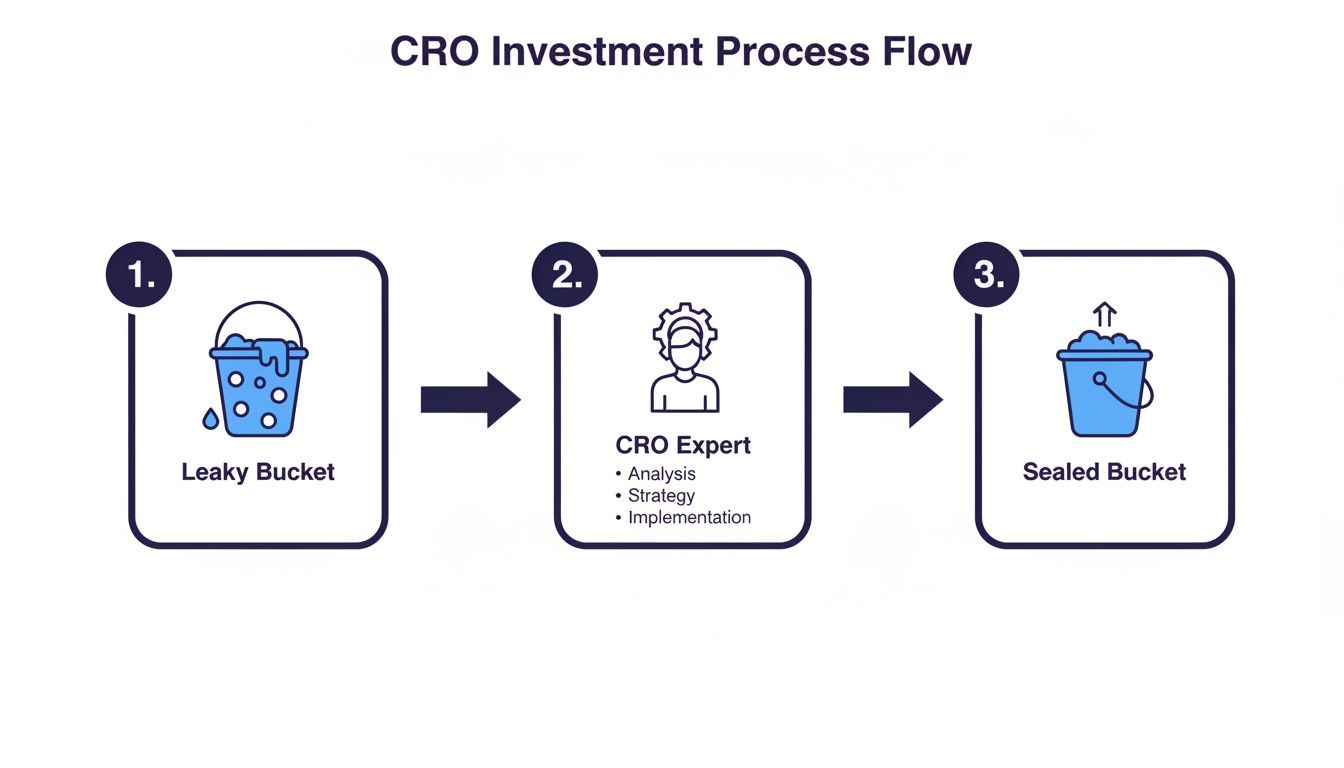
This process transforms a "leaky bucket" business—one that's losing potential customers left and right—into a sealed, efficient system where every marketing dollar is maximized.
Phase 2: Hypothesis and Strategy
With a mountain of data collected, the consultant shifts from investigator to strategist. This is where they connect the dots, forming educated, data-backed hypotheses about what changes will actually improve conversions. A strong hypothesis is never a vague idea; it’s a specific, testable statement.
For example, instead of saying, "Let's make the homepage better," a real hypothesis would sound like this: "Changing the main headline from 'Innovative Software Solutions' to 'Get Your Invoices Paid 2x Faster' will increase demo requests because it clearly states a tangible benefit." See the difference?
From these hypotheses, the consultant builds a prioritized testing roadmap. They don't try to fix everything at once. Instead, they rank potential tests based on their expected impact, how confident they are in the hypothesis, and how easy the change is to implement. This focuses your resources on the changes most likely to move the needle. A huge part of this strategy is to find ways to optimize the user experience to boost conversions, making sure the entire journey feels smooth and intuitive for the customer.
Phase 3: Testing and Implementation
This is where the rubber meets the road. Using A/B testing software, the consultant runs controlled experiments. They show the original version of a page (the "control") to one group of your visitors and the new version (the "variation") to another.
The test runs until it reaches statistical significance—a fancy way of saying there's enough data to be confident the results aren't just a fluke. If the new version wins, it becomes the new baseline, and the process starts all over again. If it loses, that’s still a win! The learning is incredibly valuable because it tells the consultant what doesn't work for your audience. For a deeper dive, you can learn more about our website conversion rate optimization strategies in our dedicated guide.
The tangible outputs from this whole process—the deliverables you should expect to see—typically include:
- A Comprehensive CRO Audit Report: A detailed breakdown of all the findings from the discovery phase, complete with clear data visuals.
- A Prioritized Testing Roadmap: A strategic plan that outlines exactly which tests will be run, in what order, and why.
- Performance Dashboards: Clean, easy-to-read reports that track test results and your overall conversion metrics over time.
This iterative loop of auditing, hypothesizing, and testing is the engine of continuous improvement that drives real, sustainable growth.
How CRO Consulting Is Priced (And Which Model Is Right for You)
When you decide to bring in a conversion optimization pro, one of the first things you'll talk about is money. It’s a strategic investment, not just a cost, and it’s important to understand how consultants structure their fees so you can find a partner who aligns with your goals.
There's no one-size-fits-all price tag, just like there's no magic bullet for fixing a website. The pricing models are designed to fit different business needs, whether you're looking for a quick fix or a long-term growth partner.
It's a hot field for a reason. Businesses are waking up to the power of optimization, and the demand for sharp, data-driven expertise is exploding. The global consulting industry is on track to hit $1.06 trillion by 2025, with strategy consulting—a close cousin to CRO—growing at 9.9% annually. This shows a clear trend: companies are more than willing to pay for expertise that delivers a real impact. You can dig into the growth of the consulting industry on consultingsuccess.com if you're curious.
So, let's break down the three most common ways you'll see CRO services priced.
The Monthly Retainer
This is the most common setup for businesses that are serious about continuous, long-term improvement. You pay a flat fee every month for an agreed-upon scope of work, which almost always includes ongoing analysis, A/B testing, and strategy calls.
Think of it as having a dedicated CRO expert on your team, but without the hassle and cost of hiring a full-time employee. This model builds a real partnership. The consultant gets to know the ins and outs of your business, which allows them to build a growth engine that gets smarter and more effective over time.
- Best For: Businesses with steady traffic that want to build a true culture of data-driven optimization.
- Pros: Predictable monthly budget, a constant stream of tests, and a deep strategic relationship.
- Cons: It's a marathon, not a sprint. You need to commit for the long haul to see the best results.
The Project-Based Fee
A project-based fee is exactly what it sounds like: a one-time price for a single, clearly defined job. This could be anything from a full-blown CRO audit of your entire site to redesigning a leaky checkout flow or optimizing a handful of critical landing pages.
This model is perfect if you have a specific, isolated problem you need solved now. It’s a clean, straightforward deal where you know the exact cost and what you're getting from day one.
A project-based fee is like calling in a specialist for a targeted operation. It's ideal for tackling a known issue, like high cart abandonment, with a focused, intense effort designed to deliver a specific fix.
The Performance-Based Model
Sometimes called a hybrid model, this approach directly links the consultant’s pay to the results they generate. It usually involves a smaller base fee plus a cut of the extra revenue their optimization work brings in.
This one is incredibly attractive because it puts you and the consultant on the same team—they only make more money if you make more money. It’s a huge vote of confidence from the consultant, showing they believe they can deliver a tangible return. The catch? You need rock-solid tracking and analytics to make it work.
- Best For: Companies with high traffic and sales volume where you can clearly measure the financial impact of a conversion lift.
- Pros: Very little upfront risk and a direct connection between what you pay and the value you get.
- Cons: Can be tricky to set up and requires bulletproof analytics to attribute results correctly.
Figuring out the right model really comes down to your business goals, your traffic levels, and whether you're looking for a long-term partnership or a short-term fix. Once you understand these options, you can have a much more productive conversation with a potential consultant and structure a deal that actually fuels your growth.
How to Hire the Right CRO Consulting Firm

Choosing a partner for conversion optimization is a high-stakes decision. This isn't just about hiring a vendor to run a few tests. It’s about finding a strategic ally who will dig deep into your business and help steer its growth.
The right firm becomes an extension of your team, bringing a much-needed objective, data-first perspective to the table. The wrong one? That can lead to a drained budget, wasted time, and results that go nowhere.
The key is to look past flashy sales pitches. You need to find a true partner who is genuinely invested in your success. That means having a structured vetting process where you ask the right questions and know exactly what to look for.
Vet Their Track Record and Industry Fit
First things first: scrutinize their past work with a critical eye. Don't just settle for a list of impressive logos on their website. Ask for detailed case studies that actually relate to your business model and industry.
An agency that’s a rockstar for e-commerce fashion brands might not have a clue where to start with a B2B SaaS company. This industry-specific experience is non-negotiable.
Think about it—average website conversion rates vary wildly. We're talking 2.5-5.2% in financial services versus a massive 1.7-10.8% range for B2B services. A consultant with deep expertise in your niche already knows these benchmarks. They know which strategies are most likely to work, saving you from a generic, one-size-fits-all approach. You can get more details on industry-specific conversion rates on roastmyweb.com.
A great CRO firm doesn't just show you "before and after" screenshots. They walk you through the why—the data that led to their hypothesis, the challenges they faced during testing, and the specific, measurable impact their work had on the client's bottom line.
Evaluate Their Process and Communication Style
Every firm has its own methodology, and you need one that aligns with your team's workflow. Ask them to walk you through a typical engagement, from the initial audit all the way to how they report on results. A transparent, structured process is the hallmark of a professional operation.
Pay close attention to how they communicate. Will you get a dedicated point of contact? How often can you expect updates? A strong partnership thrives on clear, consistent communication. If they can’t clearly explain their process to you now, they definitely won’t be able to do it when they’re in the middle of your project.
You can find some related advice in our guide on how to hire a marketing agency, which covers many of the same core principles.
A Quick Checklist for Vetting CRO Partners
To make your decision process a bit easier, we've put together a checklist. Use this during your evaluation to compare potential firms and make sure you're covering all the important bases. It helps you stay objective and focused on what truly matters for your business.
Vetting Your CRO Consulting Partner Checklist
| Evaluation Criterion | What to Look For | Red Flags to Avoid |
|---|---|---|
| Industry Experience | Relevant case studies and client testimonials in your specific niche. | Vague success stories or experience in completely unrelated industries. |
| Methodology | A clear, documented process for research, hypothesis, testing, and analysis. | A "secret sauce" they can't explain; a process that seems disorganized. |
| Team Expertise | Direct access to experienced strategists, analysts, and UX designers. | The sales team is impressive, but the actual project team is junior-level. |
| Communication Plan | A dedicated point of contact and a regular cadence for meetings and reports. | Unclear communication channels or infrequent, generic updates. |
| Tool Stack | Proficiency with modern analytics and A/B testing tools (e.g., Google Analytics, VWO). | Reliance on outdated tools or a lack of technical depth. |
| Focus on ROI | A clear connection between their activities and your business's bottom line. | An overemphasis on vanity metrics like traffic instead of revenue or leads. |
Picking the right partner is about more than just their portfolio; it's about finding a team whose process and communication style feel like a natural fit for yours.
Key Questions to Ask Potential CRO Partners
When you finally get on a call, being prepared with insightful questions can tell you a lot about a firm’s expertise and strategic thinking. Generic questions get generic answers. Go deeper to find a partner who thinks like a business owner, not just a technician.
Here are a few essential questions to get the conversation started:
- "How do you define and measure a successful engagement?" Their answer should go beyond just "increasing conversions." Look for them to talk about ROI, customer lifetime value, and how their work aligns with your big-picture business goals.
- "Can you share an example of a test that failed and what you learned from it?" This is a great test of their honesty and commitment to learning. Failure is a normal part of testing, and a mature firm will see it as a valuable source of insight.
- "What will you need from my team to be successful?" A great consultant knows CRO is a team sport. Their answer should outline what they need, like access to data, internal knowledge, and points of contact.
- "Which tools are in your tech stack and why did you choose them?" This reveals their technical know-how and shows if they invest in best-in-class software for analytics, testing, and user behavior analysis.
By focusing on their experience, process, and strategic mindset, you can move beyond the sales pitch and find a conversion optimization consulting firm that will be a true catalyst for your company's growth.
Preparing for a Successful CRO Partnership
You've vetted the candidates, reviewed the case studies, and finally picked the right conversion optimization consulting firm. The hard part is over, right? Not quite.
A great partnership isn't just about hiring an expert; it's about setting them up to win from day one. The initial onboarding phase is everything. How you prepare your team and your digital assets can mean the difference between a consultant who hits the ground running and one who spends the first month just trying to find the right login credentials.
A little prep work now sets the stage for a smooth, efficient, and much more profitable journey ahead.
Create a Clear Internal Structure
Before your consultant even gets their first email from you, it's time to get your own house in order. A CRO engagement is a team sport, and a lack of clear roles on your side can quickly lead to bottlenecks and crossed wires.
First, designate a single primary point of contact. This person is the consultant's go-to—the one who answers questions, provides feedback, and wrangles other departments. This simple step stops the consultant from getting pulled in ten different directions and keeps communication clean and consistent.
Next, identify who your internal experts are. Pull in key people from marketing, sales, product, and development who can offer insights. Your consultant brings the CRO playbook, but you bring the deep, invaluable knowledge of your customers and your business. The real magic happens when those two things come together.
The best CRO partnerships happen when a client treats the consultant like an extension of their own team. It's a true collaboration where your business knowledge and their optimization expertise combine to build a powerful engine for growth.
Grant Access to Essential Tools and Data
Your consultant can't fix what they can't see. To kick off the discovery and audit phase, they'll need access to all your core analytics and user behavior platforms. Delays here are the number one reason partnerships get off to a sluggish start.
Get ahead of the game by preparing logins and granting permissions before your first official meeting. Here’s a quick checklist:
- Website Analytics: This is non-negotiable. Provide full admin access to your Google Analytics, Adobe Analytics, or whatever you use.
- A/B Testing Software: If you already have a tool like VWO, Optimizely, or the old Google Optimize, make sure they have full access.
- Heatmap and Session Recording Tools: Platforms like Hotjar or Microsoft Clarity are goldmines for understanding user behavior.
- Website CMS and Tag Manager: Your consultant will need access to your Content Management System (like WordPress or Shopify) and Google Tag Manager to deploy tracking scripts and launch experiments.
Align on Goals and Define Success Metrics
Finally, walk into that first meeting ready to talk business goals. A good consultant doesn't just care about your conversion rate; they want to know what you’re really trying to achieve. Are you looking to generate more qualified leads? Boost customer lifetime value? Reduce churn?
Work together to translate those big-picture goals into specific, measurable Key Performance Indicators (KPIs). This makes sure everyone is on the same page and rowing in the same direction. When you set clear expectations from the get-go, you build a shared vision and a transparent way to measure the impact of your investment. It’s the foundation of every great partnership.
Your Top Questions About CRO Consulting, Answered
Jumping into conversion optimization consulting is a big decision, and it’s smart to have questions. It's an investment, after all. You're probably wondering about the timeline, what it costs, and what kind of results you can realistically expect. Let's clear the air and tackle the most common questions we hear.
How Long Does It Take to See Results?
It's tempting to look for a quick fix, and while some simple "quick wins" might pop up in the first month, the real, meaningful results from CRO typically start showing up within 3 to 6 months.
Why the wait? It’s not about slowness; it’s about being thorough. A good consultant starts by digging deep into your data with an audit. From there, they build hypotheses and run A/B tests. For those tests to be worth anything, they need to run long enough to gather enough data to prove a result wasn't just a lucky guess.
Think of it like tuning a high-performance engine, not just getting an oil change. A real pro isn't there for a one-off fix. They're building a system for continuous improvement that delivers growth that builds on itself over time.
Is My Business Too Small for CRO Consulting?
This is a common worry, but company size isn't the most important factor—website traffic is. The magic number to aim for is at least 1,000 unique monthly visitors on the pages you want to improve. That's usually enough data to run tests that give you reliable answers.
But what if you're not there yet? A consultant can still be a game-changer. They’ll just start with a different playbook:
- Heuristic Analysis: This is basically an expert review. They’ll use established usability principles to spot the obvious roadblocks on your site.
- UX Improvements: Small, smart changes to the user journey based on proven best practices can make a huge difference.
- Qualitative Feedback: They'll use surveys, user interviews, and feedback polls to figure out why people aren't converting, straight from the source.
For startups and small businesses, CRO is especially powerful. You've worked hard and spent money to get every single visitor. Optimization helps you make the most of them.
What Is the Difference Between SEO and CRO?
Fantastic question. People mix these two up all the time, but they're actually two halves of a powerful whole.
Think of your website as a brick-and-mortar store. SEO is all your marketing—the billboards, ads, and great location that get people to walk through your front door. It’s all about attracting traffic.
CRO is what happens once they're inside. It’s the smart store layout, the helpful signs, the clear price tags, and the easy checkout line that convinces them to actually buy something.
- SEO (Search Engine Optimization): Gets more of the right people to your site.
- CRO (Conversion Rate Optimization): Gets more of those people to take action on your site.
You absolutely need both for a winning strategy. There's no point driving thousands of people to a store where they get lost and leave, and a perfectly designed store is useless if nobody can find it. They're two sides of the same growth coin.
Ready to turn more of your website visitors into loyal customers? At Frozen Crow Inc., we specialize in data-driven conversion optimization consulting that delivers measurable results. Stop guessing and start growing with a strategy built for your unique business goals. Book your free marketing audit with us today!


