


October 13, 2026
Your Content Marketing Strategy Template
A content marketing strategy template is really just a framework. It’s a reusable guide for creating, publishing, and managing everything you put out there. The whole point is to make sure every single piece of content actually supports your business goals, speaks to the right people, and gets you results you can actually measure.
Think of it as the strategic roadmap you’ll use to build a powerful and consistent brand.
Building Your Content Marketing Foundation

Before you even dream of filling in a template, you have to pour the concrete. A template without a solid strategy behind it is just another document collecting digital dust. But a template driven by a real strategy? That’s a growth engine.
It’s essential to get a handle on what is content marketing strategy at its core before you start building.
So many businesses fall into the trap of creating content just for the sake of it. They churn out blog posts and social media updates with no clear purpose, then wonder why nothing’s happening. This is such a common pitfall. In fact, research shows that even among marketers with a documented strategy, only 29% feel it’s highly effective. The problem usually boils down to a massive disconnect between their content activities and actual business outcomes.
Start with Your Business Objectives
Your content goals need to be a direct reflection of your bigger business objectives. Stop aiming for vague targets like "more traffic" and start tying your content directly to tangible, financial outcomes. This simple shift in perspective is what turns content from a cost center into a revenue driver.
If you’re not sure where to start, here are a few goal-setting frameworks to get you thinking:
- For Lead Generation: "Increase marketing qualified leads (MQLs) from our blog by 20% in the next quarter." This is specific, measurable, and has a deadline.
- For Customer Retention: "Reduce customer churn by 5% over the next six months by creating a series of onboarding video tutorials and a monthly customer success newsletter."
- For Brand Authority: "Secure three high-authority backlinks each month by publishing original research reports and data-driven articles."
See the difference? Each of these goals has a clear business impact. They don’t just guide what you create; they give you a clear benchmark for success. This focus is also a huge part of learning how to build brand awareness that actually works.
Craft Detailed Audience Personas
You can't create content that resonates if you don't have a crystal-clear picture of who you're talking to. Audience personas are your cheat sheet—semi-fictional profiles of your ideal customers, built from real data and market research. The key is to go way beyond basic demographics.
A truly useful persona needs to include:
- Job Title and Responsibilities: What does their 9-to-5 actually look like? What kind of pressure are they under?
- Pain Points and Challenges: What problems are keeping them up at night? What’s standing in the way of their goals?
- Motivations and Goals: What does success look like for them, both in their career and personally?
- Content Consumption Habits: Where do they go for information? Are they reading blogs, listening to podcasts, watching videos, or attending webinars?
A well-developed persona should feel like a real person. When you sit down to write, you're not writing for a faceless crowd. You're writing for "Marketing Manager Michelle," who is stressed about proving the ROI of her campaigns to her boss. That empathy is the secret sauce for creating content that genuinely connects.
With these two foundational pieces in place—clear business objectives and a deep understanding of your audience—your content marketing strategy template transforms into a seriously powerful tool. It’s no longer a simple checklist. It becomes your strategic blueprint for attracting, engaging, and converting the right people, every single time.
Developing Your Content Ideation Engine

Even a world-class strategy falls flat without a steady stream of compelling ideas. Let's be honest, random brainstorming sessions and just hoping for inspiration to strike won't cut it long-term. To consistently produce content that actually moves the needle, you need a repeatable system—an ideation engine—that churns out relevant topics your audience is genuinely looking for.
This engine is the beating heart of your content marketing strategy template. It’s what transforms a static document into a dynamic plan, making sure every idea is intentional, backed by data, and perfectly aligned with what your audience needs.
Forget throwing spaghetti at the wall. We’re going to build a structured approach that guarantees a backlog of valuable content topics, all grounded in real user behavior and what your competitors are up to.
Uncovering What Your Audience Really Wants
The best content ideas almost always come directly from your audience. Your job isn't to guess what they want to know; it's to listen to what they're already asking. This is where keyword research becomes your secret weapon—it’s a direct line into their minds, revealing the exact words and phrases they use when looking for answers.
Using SEO tools, you can discover not just high-volume keywords, but the specific questions, problems, and comparisons your audience is thinking about. That data is pure gold.
For example, a SaaS company might find their audience isn't just searching for "project management software." They're getting way more specific:
- "best project management tool for small creative teams"
- "how to track freelance hours in Asana vs Trello"
- "project management software with budget tracking"
Each of these is a rich topic just waiting to be turned into a blog post, a detailed comparison guide, or a quick video tutorial. They signal clear intent, which makes them perfect fuel for your content engine.
The real goal of keyword research isn't just to find popular terms. It's about understanding the intent behind the search. Every query tells a story about a user's problem, and your content should be the solution.
Building Authority with Topic Clusters
Once you've got a solid list of keywords, it's time to organize them using the topic cluster model. This is a powerful SEO strategy that involves creating a main "pillar" page for a broad topic, then surrounding it with more detailed "cluster" articles that cover specific subtopics. This structure tells search engines you're an authority on the subject.
Think of it like a book: the pillar page is the table of contents, and the cluster pages are the individual chapters, each diving deep into a specific element.
Here’s how that might look for a financial advisory firm targeting young professionals:
- Pillar Page: The Ultimate Guide to Investing for Beginners
- Cluster Content 1: What Are ETFs and How Do They Work?
- Cluster Content 2: A Simple Guide to Understanding Roth IRAs
- Cluster Content 3: How to Build a Diversified Portfolio with $1,000
- Cluster Content 4: Common Investing Mistakes Young Professionals Make
This approach does two things really well: it organizes your content logically for your audience and it boosts your SEO by creating a tight network of internal links. It’s a smart, structured way to turn broad ideas into a cohesive content plan.
Finding Opportunities with Gap Analysis
Your competitors are an incredible source of content ideas—especially when you look at what they aren't doing. A content gap analysis is all about studying competitor content to find topics they've either overlooked or haven't covered in enough depth.
Start by identifying your top three to five direct competitors. Then, pop their domains into an SEO tool to see what keywords they rank for that you don't. Right away, this can reveal valuable topics you're completely missing out on.
You can also do this manually by just browsing their blogs and resource centers. Keep an eye out for:
- Weak Content: Can you create a more comprehensive, better-researched, or more engaging version of an existing post?
- Unanswered Questions: Scan the comment sections on their articles. What follow-up questions are readers asking? Goldmine.
- Missing Formats: Are they only writing blog posts? This could be your chance to create videos, infographics, or even a podcast on similar topics.
This process ensures your ideation engine isn’t just spinning its wheels. It’s producing content that fills a genuine void in the market, giving you a clear competitive advantage. By systematically finding these gaps, you can create the content that stands out and captures an audience nobody else is talking to.
Crafting a Powerful Distribution Blueprint

Look, you can create the most brilliant piece of content the world has ever seen, but if nobody sees it, did it even happen? The old "if you build it, they will come" mindset is a surefire way to fail in content marketing. What truly separates content that drives results from content that disappears is a deliberate, multi-channel distribution plan.
This blueprint is a non-negotiable part of any serious content marketing strategy template. It’s the engine that gets your hard work in front of the right eyeballs at the right time. Without a solid plan to get it out there, you're just publishing into a void.
Understanding Your Distribution Channels
Your distribution strategy will almost always be a mix of three core channel types: owned, earned, and paid. Each has a specific job to do, and the magic usually happens when you get them working together. Leaning too heavily on just one can leave you exposed.
-
Owned Media: This is your home turf—the channels you have complete control over. Think your company blog, email newsletters, and your main social media profiles. The huge plus here is you dictate the message and the experience. The catch? Building that audience from the ground up takes time and a ton of consistency.
-
Earned Media: This is basically digital word-of-mouth. It’s the guest posts on industry blogs, features in online magazines, shout-outs from influencers, and organic social shares. Earned media is incredibly powerful for building authority, but you can't force it. It's unpredictable, and you have far less control over the final message.
-
Paid Media: This is where you pay to get in the game. We're talking social media ads, search engine marketing (SEM), and sponsored content. The massive advantage is speed and precision. You can put your content in front of a hyper-specific audience almost instantly. The downside, of course, is the cost. You need to watch your budget like a hawk to make sure you're getting a positive ROI.
A smart distribution plan doesn't just pick one; it orchestrates them. For instance, you could use paid ads to give a new blog post an initial push, which helps it get seen and shared, ultimately leading to some valuable earned media.
The Art of Content Repurposing
Putting together a high-quality pillar piece—like a massive guide or an original research report—is a serious investment. The single biggest mistake you can make is to hit "publish," share it once, and then move on. If you want to maximize your reach without burning out your team, you have to master repurposing.
Think of your big article as the sun. From that one core piece, you can spin off dozens of smaller "planets," each one tailored for a different channel and a different segment of your audience. This is how you amplify your message and squeeze every last drop of value out of your best work.
For example, a single 2,000-word blog post can be sliced and diced into:
- A 10-tweet thread pulling out the key stats and takeaways.
- A sharp-looking infographic for Pinterest and LinkedIn.
- A series of short-form videos for TikTok and Instagram Reels.
- A slide deck for SlideShare.
- Key quotes turned into clean, branded graphics for social media.
This approach is all about meeting your audience where they already are, in the format they prefer. Someone scrolling Instagram isn't likely to click a long article link, but they'll definitely stop for a 30-second video that gets the main point across.
The goal of repurposing isn't just to recycle content. It's about intelligently repackaging your core ideas into native formats that feel natural on each platform, dramatically increasing the odds of engagement.
Building Your Distribution Workflow
To make this all systematic, your content marketing strategy template should have a distribution checklist for every major piece of content you produce. This takes the guesswork out of it and turns distribution into a repeatable, scalable process.
This isn't just a nice-to-have anymore; it's the standard. Recent data shows that 90% of organizations now have a content marketing strategy, and their own websites are the number one distribution channel. And with 78% of businesses planning to invest more in video, repurposing becomes absolutely critical.
Your workflow might also include a paid promotion step. For example, using targeted ads to push a new case study to a specific professional audience can be a fantastic way to generate high-quality leads. Once they've visited your site, you can keep the conversation going. To really nail this, it helps to understand what is retargeting advertising and how it brings interested prospects back into your world.
By building a powerful and repeatable distribution blueprint, you ensure every ounce of effort you put into creating content delivers the maximum possible impact. It's the final, crucial step that turns your content from a simple publication into a strategic business asset.
Bring in the Bots: Weaving AI and Modern Tools into Your Workflow
Let's be honest—the days of cranking out content entirely by hand are long gone. To keep up with the relentless demand for great content, you have to work smarter, not just harder. This is where modern tools and AI become your secret weapons, turning the content grind into a streamlined, creative powerhouse.
The goal isn't to replace your team's creativity, but to amplify it. Think of these tools as a support system that eats up the repetitive, soul-crushing tasks. This frees up your people to focus on what actually matters: strategy, storytelling, and building real connections with your audience. This isn't just a nice-to-have anymore; it's how efficient teams operate.
Supercharge Your Ideation and Research
Before a single word gets written, the right tools can give you a massive head start. Instead of just guessing what your audience cares about, you can tap into data that spells out their exact questions and pain points.
Tools like Ahrefs or SEMrush are brilliant for deep-dive SEO research, helping you find valuable keywords your competitors are sleeping on. For a more creative spark, something like AnswerThePublic is a goldmine. It visualizes the actual questions people are typing into Google about your topics, handing you an endless supply of relevant ideas.
This combo of hard data and real-world questions ensures your content plan is built on a solid foundation of what people actually want, not just what you think they want.
Your New Creative Partner Is an AI
Artificial intelligence is completely changing the game for content creation. It's a seismic shift, with data showing that over 80% of marketers are already using AI tools to get more done and be more creative.
AI assistants are fantastic for breaking through writer's block or sketching out initial drafts. You could use an AI to spit out five different blog post headlines or to boil down a dense research paper into a few key bullet points. This shaves hours off the initial grunt work, letting you jump straight into refining the content with your unique human perspective. There's a whole ecosystem of powerful AI tools for content creators out there that can seriously upgrade your workflow.
The trick is to treat AI as a collaborator, not an autopilot. Use it to generate ideas, structure your thoughts, and do the heavy lifting. But always, always bring your own expertise, brand voice, and critical thinking to the final piece.
You can even find specialized AI for specific jobs. If you're running paid campaigns to support your content, a dedicated AI ad writer can help you craft punchy ad copy that perfectly matches your content's message.
Before you choose a tool, think about where you need the most help. Some tools are great for brainstorming, while others excel at drafting or optimizing.
Choosing the Right AI Tool for Your Content Stage
| Content Stage | Recommended AI Tool | Primary Function |
|---|---|---|
| Ideation & Research | AnswerThePublic, AlsoAsked | Uncovering audience questions and topic clusters. |
| Drafting & Outlining | Jasper, Copy.ai | Generating first drafts, headlines, and outlines quickly. |
| Editing & Polishing | Grammarly, Hemingway Editor | Improving clarity, grammar, and readability. |
| Optimization & SEO | Surfer SEO, MarketMuse | Analyzing top results and optimizing content for search. |
| Promotion & Copywriting | Anyword, Peppertype.ai | Crafting social media posts, ad copy, and emails. |
Matching the tool to the task ensures you're getting the most out of the technology without getting overwhelmed.
Keep Your Content Pipeline From Turning Into Chaos
With ideas flying and drafts in motion, you need a central command center to keep everything organized. This is where project management software is non-negotiable. Tools like Trello, Asana, or ClickUp let you see your entire content pipeline at a glance, from raw idea to published piece.
You can set up a simple visual workflow with columns for each stage:
- Idea Backlog: A parking lot for all your brainstormed topics.
- In Progress: What the team is actively writing, designing, or recording.
- In Review: Content ready for editing and feedback.
- Ready to Publish: Approved content locked and loaded in the schedule.
This kind of visual system gives everyone on the team clarity, smashes bottlenecks, and makes sure no brilliant ideas get lost in a random spreadsheet. It’s what turns your content marketing strategy template from a static document into a living, breathing system.
This diagram breaks down the classic trade-off between owned, earned, and paid media, looking at control, cost, and reach.
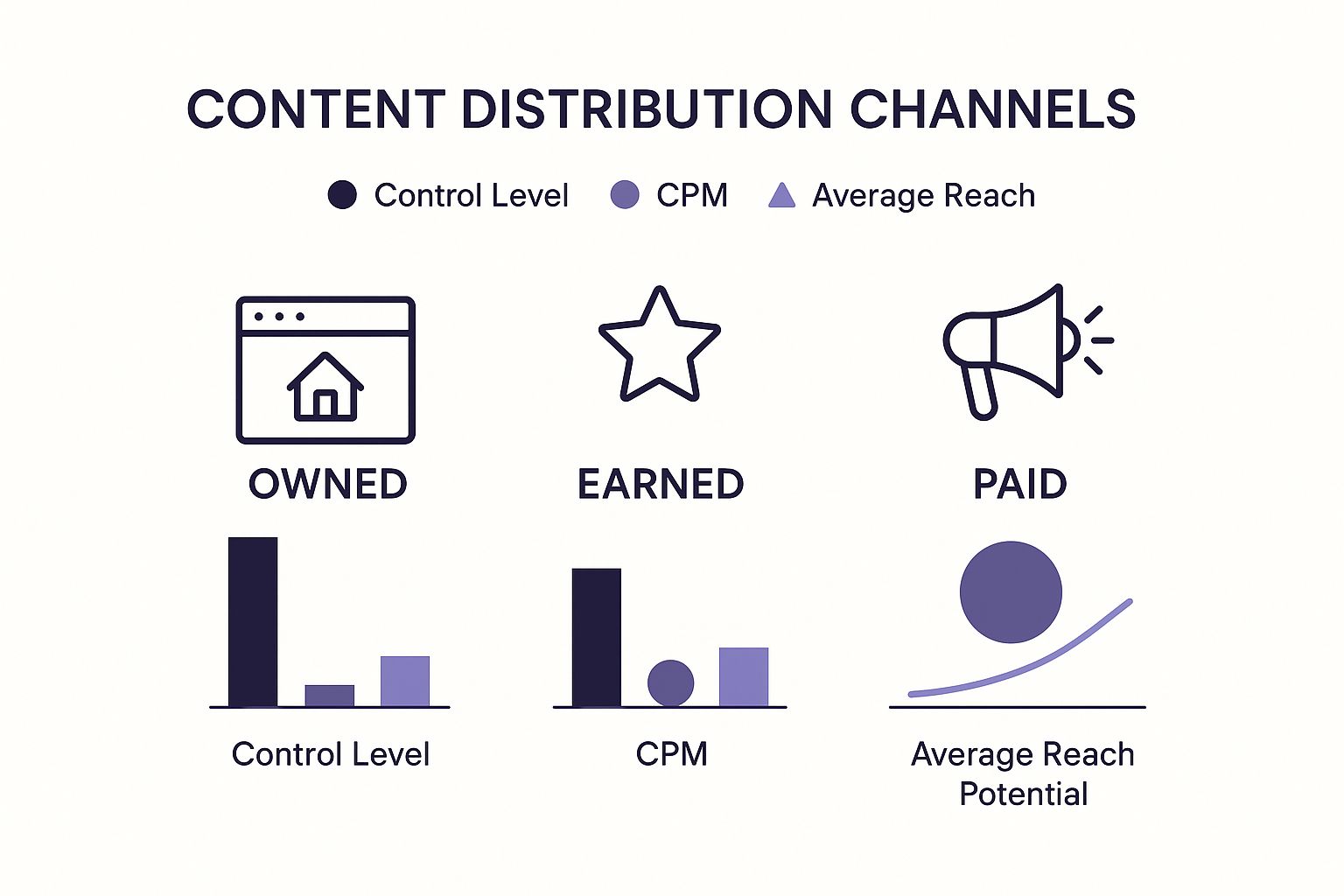
It’s clear that while you have total control over your owned media, paid channels are the fastest way to get in front of a huge audience. This just reinforces the need for a smart, balanced strategy.
Time to Measure What Matters (and Optimize Everything)
A content strategy without measurement is just expensive guesswork. You can pour hours into building the perfect content marketing strategy template, but if you aren’t watching what happens after you hit “publish,” you’re basically flying blind. This last step is what separates the pros from the amateurs—it’s about using hard data to prove your content is actually moving the needle for the business.
This isn’t about chasing vanity metrics like likes or page views. It’s about creating a powerful feedback loop: measure what happened, learn from it, and then do more of what works. This is how a static document transforms into a dynamic growth engine that gets smarter with every piece of content you ship.
First, What Does "Success" Actually Look Like?
Before you even glance at an analytics dashboard, you need to be crystal clear on what success means for each piece of content. Your goals—the ones you set way back at the beginning—dictate your Key Performance Indicators (KPIs). Trying to track everything at once is a classic recipe for getting overwhelmed.
It's all about alignment. A blog post meant to build brand awareness has a completely different job than a case study designed to close a deal. They need to be judged differently.
Here’s a simple way to think about connecting KPIs to your goals:
- Goal: Brand Awareness. You’re trying to expand your reach and get on people's radar. That means you should be watching metrics like organic traffic, keyword rankings, social media shares, and backlinks. These prove you're reaching new audiences and building authority.
- Goal: Lead Generation. Now, the focus shifts to action. You need to track the conversion rates on your calls-to-action (CTAs), the raw number of new leads coming in, and your cost per lead. This is where content starts making you money.
- Goal: Customer Engagement. Is your content building a loyal following? You'll find out by measuring time on page, pages per session, comments on blog posts, and your email newsletter open and click-through rates.
Picking the right KPIs gives you an honest, unfiltered look at what's working and what’s falling flat. No more guessing.
Your Go-To Analytics Toolkit
Good news: you don't need a massive budget to track performance like a pro. A few powerful—and often free—tools can give you all the insight you need. Your workhorse here will almost certainly be Google Analytics (GA4).
With GA4, you can go way beyond simple traffic counts and start to really understand user behavior. Jump into the user engagement reports to see which articles are actually holding people's attention. Check the user acquisition reports to see which channels (organic search, social, direct) are sending you the best visitors. This data tells you exactly where to double down.
Don’t just look at what content is performing well; you have to dig into why. Is it the format? The topic's depth? The killer headline? Spotting these patterns is the secret to replicating your wins instead of just getting lucky.
Beyond GA4, you absolutely need to be using Google Search Console. It’s non-negotiable for understanding your organic search performance. It shows you the exact search queries bringing people to your site and highlights opportunities to improve your rankings. And for social, just use the native analytics inside each platform—they offer a ton of data on reach, engagement, and audience demographics.
Building a System for Optimization
Data is completely useless if it just sits in a dashboard. The final piece of the puzzle is creating a repeatable process for reviewing your analytics and turning those numbers into action. This isn’t something you do "when you have time." It needs to be on the calendar. Schedule a monthly or quarterly content performance review and stick to it.
During these reviews, ask yourself a few critical questions:
- Which content formats are killing it? If you notice your short video tutorials are getting way more engagement than your long-form blog posts, it’s probably time to shift some resources.
- What topics does our audience love? Find your top-performing topic clusters. Can you go deeper on them? Create a follow-up piece? Build them out into a pillar page?
- Where are people getting stuck or leaving? Hunt for pages with high exit rates. This is a huge red flag that the content isn't delivering on its promise or the CTA is weak. Now you have a clear target for improvement.
This continuous cycle—analyze, identify, adjust—is the real secret to a content strategy that lasts. It guarantees your plan never gets stale and consistently delivers results you can take to the bank.
Answering Your Top Questions
Getting a content marketing strategy off the ground always brings up questions. It's totally normal. After all, you're building a system meant to drive real growth, and there are a lot of moving parts. Let's tackle some of the most common hurdles I see people run into.
How Often Should I Actually Update My Content Strategy?
This is a big one. People often treat their strategy like a stone tablet—created once and then forgotten. That's a huge mistake. Your strategy needs to be a living, breathing document.
A full, top-to-bottom review once a year is a great starting point. This is when you can sync your content goals with your new annual business objectives and make any big-picture shifts. But don't just set it and forget it for 365 days. You should be doing lighter quarterly check-ins, too. These are your chance to dig into performance data and make smaller, tactical adjustments without blowing up the whole plan.
And of course, sometimes you have to throw the schedule out the window. If a major market shift happens, a new competitor pops up, or you launch a game-changing product feature, you need to revisit your strategy immediately. Being agile is your biggest advantage.
The worst thing you can do is let your strategy gather dust. Regular, data-informed tweaks are what keep your content sharp and effective. An outdated strategy is almost as bad as having no strategy at all.
What's the Biggest Mistake Most People Make?
I see this one all the time. The single most damaging mistake is creating content that's all about what the company wants to say, instead of what the audience is desperate to hear. It’s an inside-out approach that explains why so much content just falls flat.
The root of this problem? A serious lack of deep audience research.
To avoid this trap, every single piece of content you plan has to start with a genuine customer problem or question. Build your entire content machine around solving their specific challenges. If you do that, you'll never run out of ideas that actually resonate.
Can a Small Business Really Use This Template on a Tight Budget?
Absolutely. This framework isn't just for massive companies with endless resources. It’s designed to scale. The key for a small business is to stop trying to do everything at once. You have to be surgical.
Here’s how you make it work:
- Go after a hyper-specific niche. Don't try to be everything to everyone. Pick a small, clearly defined audience and own it.
- Focus on one or two core content pillars. Instead of being a jack-of-all-trades, become the undisputed expert on a very narrow set of topics.
- Master a single distribution channel. Find out where your specific audience actually spends their time and dominate that one platform before you even think about expanding.
For a small business, quality will always, always trump quantity. And don't forget about the wealth of free tools out there for keyword research, analytics, and social scheduling. They can make a small budget go a very long way.
At Frozen Crow Inc., we specialize in turning these strategic frameworks into real-world growth. If you're ready to build a content engine that drives measurable results, let's talk. Explore our integrated digital marketing services at https://frozencrow.com.


