


August 20, 2026
Building an Email List: 7 Tactics to Grow Your Audience (building an email list)
Let's cut to the chase: if you're not building an email list, you're building your business on rented land. Social media is great, but algorithms change on a whim, and your reach can disappear overnight. Your email list? That's yours. It's a direct, unfiltered line to your audience, and frankly, it's one of the most powerful assets for sustainable business growth you'll ever have.
Why An Email List Is Your Most Valuable Business Asset

Before we get into the "how-to," let's nail down the why.
Think of your social media following like renting an apartment. The landlord—the platform—can change the rules, hike the rent, or even kick you out without much warning. An email list, on the other hand, is like owning the whole building. You call the shots.
This ownership gives you stability and a clear path to profit. You're no longer at the mercy of some algorithm update that tanks your engagement. When you launch a new product or have something important to share, you can speak directly to people who asked to hear from you. That creates a reliable engine for your business.
A Direct Line to Your Audience
An email list isn't just a spreadsheet of contacts; it's a community you build one person at a time. This direct connection is a game-changer.
- Unfiltered Communication: Your message lands right in their inbox. No fighting the chaotic noise of a social feed.
- Deeper Personalization: You can segment subscribers based on what they've bought, what they've clicked, or what they're interested in. This lets you send hyper-relevant content that actually resonates.
- Higher Engagement: These people have already raised their hands. They're not cold leads; they're warm prospects who are far more likely to engage with what you have to say.
Unmatched Return on Investment
Let's talk numbers, because they don't lie. Email marketing consistently crushes almost every other digital channel when it comes to ROI.
Marketers are on track to make around $42 for every $1 spent in 2025. That’s an insane return, and it’s why 42% of them call email their single most effective channel. This isn't just another marketing task to check off a list; it’s a core business strategy.
Owning your email list means you control the conversation. You're not borrowing an audience from a tech giant; you're building a relationship on your own terms.
To really get this right from the start, you need a solid foundation. You can dig deeper into proven strategies for building email lists that truly grow your business. Stop thinking of it as list-building and start thinking of it as building a lasting, profitable asset.
Choosing The Right Tools For Sustainable Growth
Let's get one thing straight: your email list is only as good as the technology running it. Picking the right Email Service Provider (ESP) is one of those foundational decisions that pays dividends for years. Think of it less like buying software and more like bringing on a key digital partner for your business.
Your ESP is the engine behind the curtain—it handles the sending, manages your subscribers, and tells you what’s working. Without a solid provider, even the most brilliant email in the world can land in a spam folder. A smart choice now saves you from massive migration headaches down the road.
What To Look For In An Email Service Provider
When you start browsing ESPs, it's easy to get overwhelmed by a tsunami of features. My advice? Ignore the noise. Instead of chasing the platform with the longest feature list, focus on what actually moves the needle when you're just starting out.
Here's the stuff that really matters:
- Ease of Use: Your time is gold. You need a platform with an intuitive drag-and-drop editor and a clean dashboard. The goal is to spend your time creating, not wrestling with clunky software.
- Scalability and Pricing: Find a provider that can grow with you. Many offer free or cheap plans to start, but do your homework. Check what it will cost when you hit 1,000, 5,000, and 10,000 subscribers. You don't want to get punished for your own success with a sudden price hike.
- Automation Capabilities: This is non-negotiable. At a bare minimum, you need the ability to set up an automated welcome sequence. It’s how you guarantee every new subscriber gets a warm, consistent welcome without you lifting a finger.
- Segmentation and Tagging: As your list grows, you’ll realize not everyone wants to hear the same thing. A good ESP lets you "tag" subscribers based on their interests or where they signed up, allowing you to send much more relevant (and effective) emails.
The best ESP isn't the one with the most bells and whistles; it's the one that fits your business right now and has a clear path for where you're headed. Don't pay for enterprise-level complexity when you just need small-business simplicity.
Comparing Popular ESPs For Small Businesses
To make this real, let's look at a few popular choices from the perspective of a small business or e-commerce store. Each has its own vibe and is a better fit for different people.
| Platform | Best For | Key Strength | Potential Drawback |
|---|---|---|---|
| Mailchimp | Beginners and businesses wanting an all-in-one tool. | Extremely user-friendly interface and great branding. | Can become expensive as your list grows. |
| ConvertKit | Creators, bloggers, and course sellers. | Powerful segmentation and automation workflows. | More focused on creators, less on e-commerce. |
| Constant Contact | Small local businesses and non-profits. | Excellent customer support and event marketing tools. | The interface can feel a bit dated for some. |
See? There's no single "best" platform. An e-commerce brand just getting started might love Mailchimp's simplicity. A freelance writer building a community would probably get more out of ConvertKit's powerful tagging system.
Staying Compliant From Day One
Finally, we have to talk about the legal stuff. Building an email list comes with a few rules, mainly governed by regulations like GDPR in Europe and the CAN-SPAM Act in the U.S. Don’t let the acronyms scare you; the basics are pretty simple.
Here’s what you absolutely must do to stay on the right side of the law:
- Get Explicit Permission: Never, ever add someone to your list without their clear consent. A simple checkbox on your sign-up form that is not pre-checked is the gold standard here.
- Include Your Physical Address: The CAN-SPAM Act requires a valid physical postal address in every marketing email. This usually just lives in your email footer.
- Provide a Clear Unsubscribe Link: Every email has to have an obvious, one-click way to unsubscribe. Any reputable ESP handles this for you automatically.
Following these rules isn't just about avoiding fines—it's about building trust. When people know you respect their inbox, they’re far more likely to stick around. Getting your tech and your ethics right from the start are the twin pillars of a list that lasts.
Creating Lead Magnets People Actually Want
Let's be honest: at the heart of building an email list is a simple trade. Someone gives you their email, and you give them something valuable in return. That "something" is your lead magnet, and making it genuinely irresistible is how you go from a handful of subscribers to a thriving list.
Forget about that dusty, generic "free ebook" that's been sitting on your desktop for years. A truly effective lead magnet doesn't try to solve every problem. Instead, it offers a laser-focused solution to a specific pain point your ideal customer is wrestling with right now. It’s all about immediate value, not just more information.
Pinpoint Your Audience's Biggest Struggles
Before you even think about creating something, you have to get inside your audience's head. What’s keeping them up at night? What’s that one annoying, tedious task they wish could just disappear? Your lead magnet needs to be the answer to one of those questions.
Think less like a marketer and more like a problem-solver.
- Imagine you're a food blogger. Your audience's problem isn't just "what should I cook?" It's more specific: "I have a weird mix of ingredients in my fridge and zero inspiration." The perfect solution? A "5-Day Pantry Challenge" checklist that helps them create amazing meals with what they already have.
- Or maybe you're a marketing consultant. Your clients aren't short on ideas; they're drowning in them. The real struggle is the overwhelm of planning. The fix? A "Monthly Content Planning Template" in a Google Sheet that brings order to their chaos.
That small shift—from a broad offer to a specific tool—is what separates a lead magnet that gets ignored from one that gets thousands of sign-ups. If you're looking for a starting point, check out these 23 lead magnet ideas for some solid inspiration.
Your lead magnet shouldn't feel like a bribe. It should feel like an incredible gift—a shortcut, a template, or a moment of clarity that makes your new subscriber's life noticeably easier.
This focus on providing real value is exactly why email isn't going anywhere. In 2024, 53% of SMB owners still lean on email marketing as their main tool for bringing in and keeping customers. And with 60% of consumers saying they prefer to hear from businesses via email, a killer lead magnet is your best first impression.
Crafting High-Value Lead Magnet Formats
Once you've nailed down the problem you're going to solve, it's time to pick a format. The best one is whatever delivers the solution as quickly and efficiently as possible. Your audience is busy. Give them a quick win.
Here are a few high-impact formats that work way better than a basic PDF:
- Checklists: These are perfect for breaking down an intimidating process into simple, manageable steps. Think something like, "The 10-Point SEO Audit Checklist for New Websites."
- Templates: People love templates because they save time. This could be anything from a spreadsheet to a Canva design or even pre-written email scripts. For example, "5 Cold Outreach Email Templates That Actually Get Replies."
- Curated Toolkits: Save your audience hours of painful research by compiling a list of the best resources for a specific job. An example could be, "The Ultimate Toolkit for Launching a Podcast on a Budget."
- Mini-Courses or Workshops: A short series of videos or emails that teach one specific, valuable skill. Something like, "A Free 3-Day Video Course on Mastering Google Analytics 4."
- Webinars: A live or pre-recorded training that goes deep on a single topic, often with a live Q&A. A great example is, "How to Double Your E-commerce Sales with Facebook Ads."
The real secret here is alignment. Your lead magnet shouldn't just solve a random problem; it should be a natural first step toward your paid products or services. A web designer offering a "Website Launch Checklist" is perfectly setting the stage to sell their full design services to subscribers who realize they're in over their heads.
When you create a resource that people actually want and use, you aren't just building an email list. You're building a foundation of trust from the very first click.
Designing Opt-In Forms That Convert Visitors Into Subscribers
You’ve got a brilliant lead magnet ready to go, but it’s completely useless without a powerful gateway. That gateway is your opt-in form.
Honestly, the design and placement of this little box are often the difference between a trickle of new subscribers and a flood. It's that critical moment where a casual visitor decides if they trust you enough to hand over their email address. Think of it as the bridge between their curiosity and their commitment.
This isn't just a technical step; it's a crucial piece of your marketing that needs to be compelling, clear, and totally frictionless.
The journey from casual visitor to engaged subscriber is a short but vital one. This is the simple, powerful exchange you're creating: your valuable magnet is offered through a well-designed gateway (your opt-in form) to welcome a new subscriber.
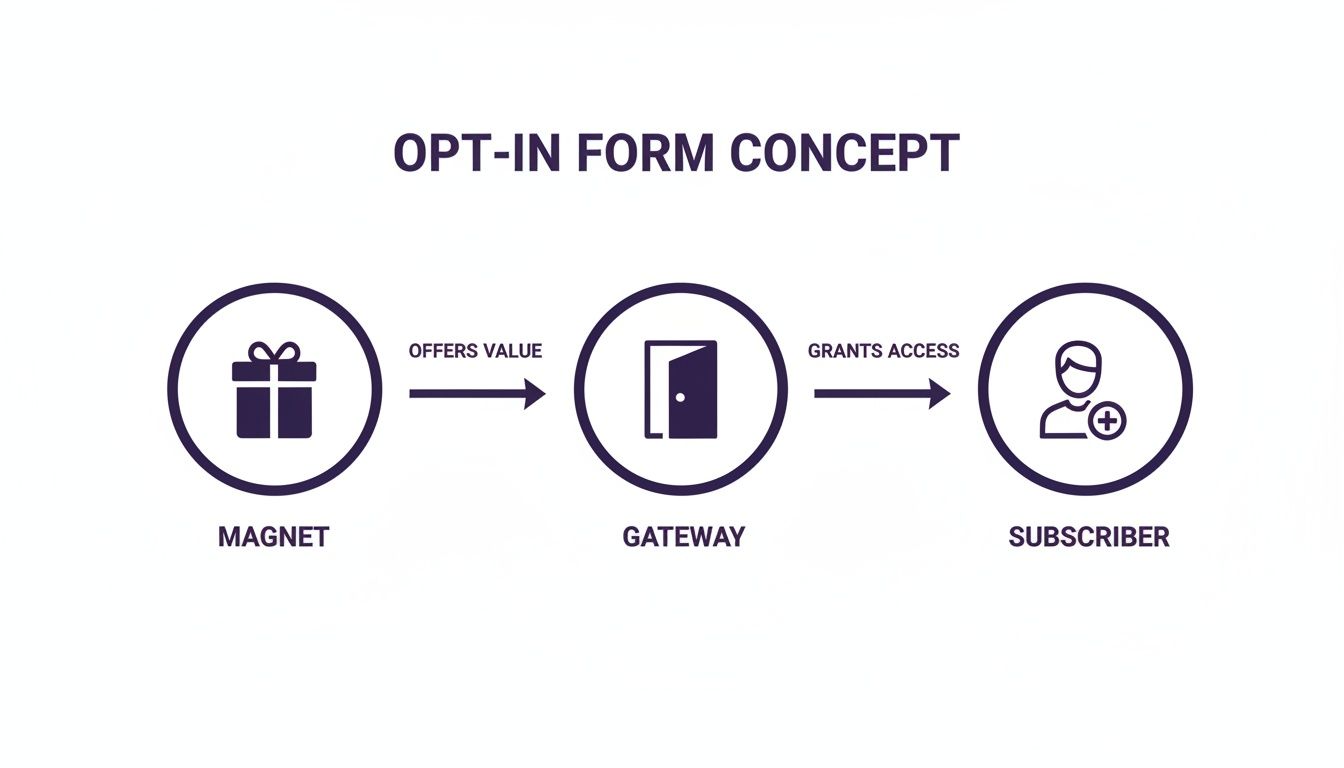
The takeaway here is that the form is the essential connection between your offer and your audience. Getting it right is a high-stakes part of building your list.
Choosing The Right Type Of Opt-In Form
Not all opt-in forms are created equal. Far from it. The type you choose should depend entirely on your goal and where the user is in their journey on your site. Deploying the right form in the right place is how you maximize sign-ups without driving your visitors crazy.
Here are the most effective types in your arsenal:
- Embedded Forms: These are placed right inside your content, like at the end of a blog post or in your website's footer. They're less intrusive but also less visible, making them best for capturing readers who are already hooked on what you have to say.
- Pop-Up Forms: These demand attention by appearing over the page content. I know, I know—they can be disruptive, but they are also incredibly effective when used thoughtfully. You can set them to trigger after a user has been on the page for 30 seconds, scrolls down 50%, or shows exit intent.
- Welcome Mats: This is a full-screen pop-up that appears the moment a visitor lands. It’s an aggressive strategy, for sure, but it can be a powerhouse for a major campaign or a truly irresistible offer because it guarantees visibility.
The goal isn't to be as loud as possible; it's to be as helpful as possible. Your form should appear at the moment a visitor is most likely to be thinking, "This is great, I want more."
Opt-In Form Type Comparison for Maximum Conversion
Choosing the right opt-in form is a strategic decision that balances visibility with user experience. This table breaks down the most common types to help you decide which one fits your specific goal, whether it's capturing highly engaged readers or maximizing visibility for a major campaign.
| Form Type | Best Use Case | Conversion Potential | User Experience Impact |
|---|---|---|---|
| Embedded Form | Within blog posts, footers, sidebars. | Lower | Low (Non-intrusive) |
| Pop-Up (Timed/Scroll) | After a user shows engagement (e.g., 30s on page). | High | Medium (Can be disruptive) |
| Exit-Intent Pop-Up | When a user's cursor moves to leave the page. | Very High | Low (Catches them on the way out) |
| Welcome Mat | Promoting a major launch or flagship offer. | Very High | High (Aggressive, can be annoying) |
| Slide-In Box | Appears in the corner as the user scrolls. | Medium | Low (Less intrusive than a full pop-up) |
Ultimately, the best approach is often a mix. An embedded form in your blog posts combined with a well-timed exit-intent pop-up can cover all your bases without overwhelming your visitors.
Design Best Practices For High Conversions
A clunky, confusing, or untrustworthy-looking form will absolutely kill your conversion rates, no matter how great your lead magnet is. Simplicity and clarity are your guiding principles here.
I’ve seen this go wrong a thousand times. Focus on these core elements to create a form that actually works:
- A Compelling Headline: Your headline must scream value. Instead of "Subscribe to Our Newsletter," try "Get Your Free 5-Day Pantry Challenge Checklist." The visitor needs to know exactly what they're getting.
- Minimal Form Fields: Every extra field you ask for creates friction and gives someone a reason to bail. For a lead magnet, all you really need is an email address. Asking for a first name is fine for personalization, but seriously question adding anything more.
- A Powerful Call-to-Action (CTA): The button text matters more than you think. "Submit" is boring and uninspired. Use action-oriented language that reinforces the value, like "Send Me the Checklist!" or "Get Instant Access."
- Clear, Concise Copy: Use a short sentence or a few bullet points to remind the visitor of the key benefit. What specific, painful problem does your lead magnet solve? Spell it out.
The Power Of A Dedicated Landing Page
While pop-ups are great for your existing website traffic, a dedicated landing page is an absolute must for traffic from external sources like social media ads or partnerships. This is a single-purpose page with one job and one job only: get a visitor to sign up for your lead magnet.
You do this by removing all other distractions—the navigation menu, sidebars, links to other posts—everything. A good landing page features your compelling headline, benefit-driven copy, a visual of the lead magnet (like a mockup), and your opt-in form. That’s it.
This focused approach is remarkably effective. Beating the odds is tough; the average website subscription rate hovers around a meager 1.95%. To get ahead, you need to be proactive. Tools like exit-intent pop-ups and timed pop-ups can boost conversions by as much as 3 to 5 times compared to passive, embedded forms. You can dig into more of this by reading the full research on email statistics.
Finally, don't just set it and forget it. Always be testing. A simple A/B test can reveal powerful insights. Try changing your headline, your CTA button color, or the image you use. You'd be surprised what a difference small tweaks can make, turning your opt-in forms into a reliable engine for growth over time.
Alright, you've done the hard work. You’ve crafted an irresistible lead magnet and set up a killer opt-in form. But even the best engine won't run without fuel. Now, it's time to open up the floodgates and get the right eyeballs on your offer.
Driving traffic isn't about just blasting your link into the void and hoping something sticks. It’s a methodical game of placing your sign-up forms directly in the path of people already looking for what you have. We'll walk through the exact on-site and off-site plays you need to build a steady flow of your ideal subscribers.
Make Your Website Your #1 Lead Source
Your website is your home turf—the first and most obvious place to start. Anyone already browsing your content has raised their hand and shown interest. Your only job is to make it incredibly simple for them to take that next step.
Don't treat all your website visitors the same. Think strategically. Where does your best traffic actually go? Your most popular blog posts are absolute goldmines. Got an article on "10 Tips for Beginner Gardeners" that pulls in thousands of views every month? You’d be crazy not to embed a sign-up form for your "Free Vegetable Planting Calendar" right in the middle of it.
Here are a few prime spots to place your forms:
- Homepage: Put a clear call-to-action (CTA) for your main lead magnet right "above the fold" where no one can miss it.
- Blog Posts: Drop an embedded form at the end of every relevant post. I'm also a big fan of slide-in forms that appear as someone scrolls down—they catch the eye without being too aggressive.
- About Page: People land here because they're curious about the person or brand behind the scenes. It's the perfect moment to invite them into your community.
- Website Footer: Sure, the conversion rate is lower here, but it acts as a permanent, site-wide safety net to catch anyone who's ready to join.
A huge mistake I see is plastering the same generic offer everywhere. Dive into your analytics, find your top-performing pages, and make them work harder by placing a super-relevant opt-in right where your most engaged people are already hanging out.
Turn Your Social Media Profiles into Lead Magnets
Social media isn't just for posting updates; it's a powerful channel for driving highly targeted traffic to your landing pages. You need to shift your thinking and integrate list-building into your entire social strategy.
Start with the basics: your bio. Every single platform, from Instagram to LinkedIn to X (formerly Twitter), gives you a link. Stop wasting that precious real estate on your homepage. Point it directly to your lead magnet's landing page and turn every profile visitor into a potential subscriber.
Beyond just the bio link, get proactive:
- Create dedicated posts that sell the benefits of your lead magnet. Use sharp visuals or short videos to give people a sneak peek of what they're getting.
- Use the platform's features. Instagram Stories with a "link sticker" are perfect for this. So are pinned posts on Facebook and X that constantly point traffic to your sign-up page.
- Run targeted ads. You don't need a massive budget. Even $5-$10 a day can bring in a surprising amount of traffic if you nail the targeting. For instance, a marketing consultant could run ads for their "Content Planning Template" and target people who follow major marketing influencers. It's a simple, effective play.
Tap into Other People's Audiences
Sometimes the fastest way to grow your audience is to borrow someone else's. By teaming up with complementary, non-competing brands or influencers, you can expose your lead magnet to a fresh, perfectly-aligned group of people.
The joint webinar is a classic for a reason. Imagine a fitness coach who focuses on nutrition partnering with a yoga instructor. They co-host a free webinar on "Creating a Mindful Morning Routine." Both promote it to their audiences, collect emails from everyone who signs up, and agree to share the final list. Win-win.
A few other ideas to get you started:
- Guest Blogging: Write an amazing article for another site in your niche. Your only "ask" is to link back to your lead magnet in your author bio.
- Newsletter Swaps: Find another creator with a list of a similar size and vibe. Agree to promote each other’s free resources in your next newsletter.
- Podcast Interviews: Get booked as a guest on a podcast your ideal subscribers listen to. When the host asks where people can find you, mention your free resource as the best next step.
By mixing these on-site and off-site strategies, you build a resilient system for building an email list. You're not reliant on any single source of traffic. This diversification is what creates a steady, sustainable flow of new subscribers, turning your list from a simple contact sheet into the powerful business asset it was always meant to be.
Nurturing Your List From Day One

Getting someone to subscribe is just the handshake. It’s the start of the conversation, not the end. That moment they hit "submit" is your single best chance to make a real impression, but it's a window that so many businesses completely miss.
The very first email a new subscriber gets is easily the most important one you’ll ever send them. Your only job right then is to deliver on your promise and set the tone for the entire relationship. This is where a simple, automated welcome sequence becomes your most valuable asset.
Crafting An Effective Welcome Sequence
A welcome sequence is nothing more than a pre-written series of emails that automatically goes out to new subscribers. It’s your opportunity to introduce yourself, hand over your lead magnet, and let them know what's coming next—all without you having to lift a finger after the initial setup.
Keep that first email incredibly simple and focused:
- Deliver the Goods: Your subject line should be a dead giveaway, like, "Here's your [Lead Magnet Name]!" Inside, make the download link impossible to miss.
- Say a Genuine Thank You: They just trusted you with their email address. Acknowledge that. A little appreciation really does go a long way.
- Set Expectations: Briefly tell them what kind of stuff you'll be sending and when. Something as simple as, "Look out for my weekly marketing tips every Tuesday," does the trick.
The primary job of your first email is to build trust by delivering on your promise instantly. This single action proves you're reliable and sets a positive tone for all future communication.
The Power Of Simple Segmentation
Once your list starts to grow, you'll quickly notice that not everyone is interested in the same thing. Blasting the exact same message to your entire list is a surefire way to get a ton of unsubscribes. This is where segmentation comes into play.
Segmentation just means splitting your list into smaller, more relevant groups. You don't need some complex, multi-layered system to get started. Just begin by tagging subscribers based on how they joined your list.
- Source Tagging: Did they sign up for your "Beginner's SEO Checklist" or your "Advanced Google Ads Template"? Slap a tag on them so you know.
- Interest-Based Content: Down the road, you can send SEO tips to that first group and paid ad strategies to the second.
This simple move ensures your content actually matters to the person reading it. When subscribers feel like you're sending them stuff they care about, they see your emails as a resource, not just more inbox clutter. It's a small step that can make a huge difference in engagement and solidify that new relationship from day one.
Got Questions About List Building? We've Got Answers.
As you start pulling all these pieces together, a few questions inevitably pop up. I've heard them all over the years, and getting the right answers from the get-go can save you a ton of headaches and help you build momentum much faster.
Let's clear up some of the most common ones.
Is My List Big Enough?
Everyone obsesses over the size of their list, but honestly, it’s the wrong metric. Quality will always, always beat quantity.
A small but mighty list of 1,000 true fans who actually open, read, and click your emails is infinitely more valuable than a bloated list of 10,000 strangers who ignore you or, worse, mark you as spam. Your goal isn't just to get more people; it's to attract the right people.
How Often Should I Actually Email People?
There's no single magic number here—it really depends on your audience and your industry. But if you're just starting out, once a week is a solid baseline. It keeps your brand top-of-mind without becoming inbox wallpaper.
What’s far more important than the exact schedule is simply being consistent. Whether you decide on weekly, bi-weekly, or a monthly digest, stick with it. You're training your subscribers to expect and even look forward to hearing from you.
Don’t be afraid to experiment a little. You might discover a specific segment of your audience loves getting daily tips during a big launch, while another group just wants a monthly recap. Keep a close eye on your open rates and unsubscribe numbers—they'll tell you everything you need to know.
So, Can I Just Buy an Email List to Speed Things Up?
I'll make this simple: No. Never, ever, ever buy an email list.
Think about it. Those people never asked to hear from you. Emailing them is a fast track to violating their trust and breaking regulations like GDPR and CAN-SPAM.
Beyond the legal and ethical mess, purchased lists are almost always garbage. They're packed with dead email addresses and people who have zero interest in what you do. This leads to a cascade of problems:
- Sky-high bounce rates that absolutely wreck your sender reputation with providers like Gmail and Outlook.
- Awful open and click-through rates because, well, they have no idea who you are.
- A huge spike in spam complaints, which can get your entire email account shut down.
Building your list the right way—organically—takes more time and effort upfront. But it’s the only way to create a real, tangible asset that will actually grow your business.
Ready to turn these insights into a real-world strategy? The team at Frozen Crow Inc. lives and breathes this stuff. We can help you build a data-driven plan to attract a high-quality email list that delivers actual growth. Find out how our integrated digital marketing services can connect you with the right audience. Discover more at https://frozencrow.com.


