


August 20, 2026
Unlock Growth With the benefits marketing automation Advantage
At its core, marketing automation is about doing more with less. It's designed to supercharge your efficiency by taking repetitive tasks off your plate, creating personalized experiences for every single customer, and ultimately, making a real impact on your revenue. Think of it as a force multiplier, giving a small team the power and reach of a massive marketing department.
What Is Marketing Automation and Why Does It Matter?
Let's be real: you can't personally email every person who visits your website. You can't track what they're interested in and send them the perfect follow-up at just the right time. Not manually, anyway. It's an impossible task for any human.
This is exactly the problem marketing automation solves. It's not about replacing marketers—it’s about giving them superpowers.
Picture marketing automation as the digital conductor for your marketing orchestra. It makes sure every instrument—your emails, social media, lead nurturing, and customer lists—plays together in perfect harmony. Instead of you running around trying to cue everyone, you build automated "workflows" that trigger based on what your customers actually do.
The Power of Automated Workflows
A workflow is just a simple sequence of actions that you set up once and then let run on its own.
For instance, when someone new signs up for your newsletter, a workflow can kick into gear and:
- Instantly send a personalized welcome email. No waiting.
- Wait three days, then follow up with a list of your most popular blog posts.
- Tag the user based on the links they click, automatically sorting them into interest groups for future campaigns.
This all happens in the background, 24/7, without you lifting a finger. You create the rules, and the system executes them perfectly every time. This frees up your team to focus on what humans do best: strategy, creative thinking, and building real relationships—not getting buried in admin work.
The real magic here is scalable personalization. Automation lets you treat a thousand customers with the same individual care and attention you'd give to just one. That's how you build loyalty and drive sales.
For small businesses, this is a total game-changer. We get into the specifics in our guide on marketing automation for small business.
And if you're in e-commerce? Applying these principles is non-negotiable. For a deeper look at practical strategies, this guide on Ecommerce Marketing Automation That Actually Grows Your Store offers some excellent, real-world insights for turning automation into growth.
How Automation Actually Drives Your Marketing ROI
Let's stop talking about marketing as a cost center and start treating it like what it is: a predictable, measurable profit driver. While saving time is a nice perk, the real power of marketing automation is its direct impact on your bottom line. This isn’t just a tool for convenience; it’s a revenue engine humming away behind the scenes.
Think of your sales funnel like a leaky bucket. You can try to plug every hole by hand, but as you scale, it’s a losing battle. Marketing automation acts like a self-repairing system, spotting leaks—like abandoned carts or leads that have gone quiet—and automatically deploying the right patch to keep customers moving forward.
This system turns would-be losses into real, measurable gains, fundamentally changing the math on your marketing spend.
From Cost to Investment
The financial upside here isn't just theory—it's proven. What if you could put one dollar into a marketing system and get $5.44 back in revenue? That’s the reality for businesses that get this right.
Industry data shows that companies see an average 544% return on investment (ROI) over a three-year period with marketing automation. This isn't some far-off dream. Most firms get their initial investment back in less than six months.
This infographic paints a clear picture of how automation gives you back your most valuable resource: time.
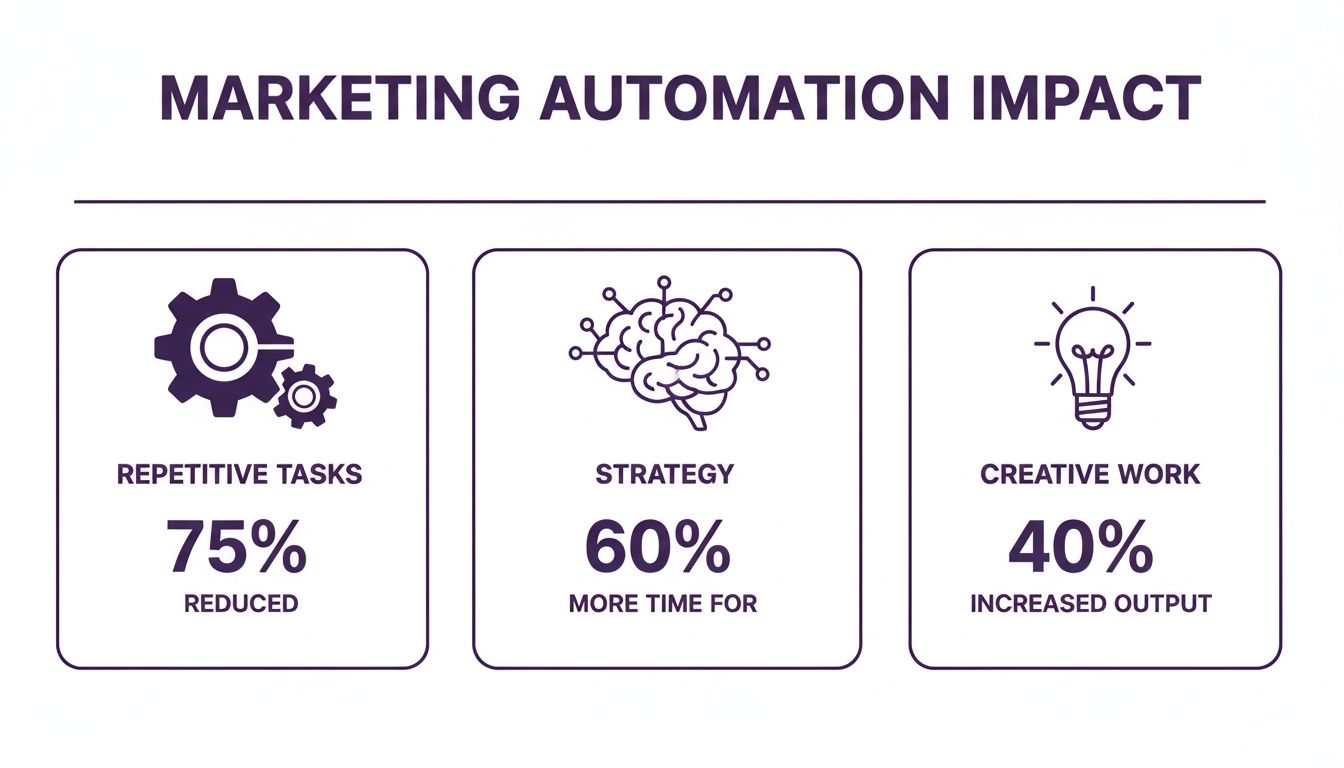
When the machine handles the repetitive stuff, your team is free to focus on the strategic and creative work that actually grows the business.
The Mechanics of Making More Money
So, how does this all translate into actual dollars? Marketing automation makes the biggest splash in a few key areas that directly pad your revenue and profitability. It finally connects the dots between your effort and the results.
Here are two of the most powerful examples:
Abandoned Cart Recovery: A customer fills their cart but gets distracted and leaves. Instead of that sale just vanishing, an automated workflow kicks in. It sends a series of timely reminders, maybe with a small discount or a few customer reviews to nudge them over the finish line. This simple, hands-off action can recover a huge chunk of otherwise lost revenue.
Lead Nurturing Sequences: Someone downloads an e-book but isn't quite ready to buy. Automation starts a "drip" campaign, sending them helpful articles, case studies, or webinar invites over the next few weeks. This builds trust and keeps your brand top of mind. When they are finally ready to pull the trigger, you're the first one they think of.
These touchpoints aren't random; they're timed strategically to make the biggest impact, turning lukewarm interest into sales-ready leads without anyone on your team lifting a finger.
By the Numbers: Quantifying the Impact
The data speaks for itself. When you put these systems in place, the financial benefits become clear pretty quickly.
Marketing Automation ROI Snapshot
| Metric | Average Uplift/Result |
|---|---|
| Sales Productivity | 14.5% Increase |
| Marketing Overhead | 12.2% Reduction |
| Lead Generation | 451% Increase in Qualified Leads |
| Conversion Rates | Up to 53% Higher |
| Return on Investment | 544% Average ROI (over 3 years) |
These aren't just vanity metrics; they represent real money saved and real revenue generated, all stemming from a more intelligent, automated approach.
Lowering Your Customer Acquisition Cost
At the same time, automation is working to bring down your Customer Acquisition Cost (CAC). By sending better-quality leads to your sales team and converting more of them, you simply spend less time and money to win each new customer. Your sales reps become way more effective because they're only talking to people who've already been warmed up.
Here’s a quick breakdown of how automation cuts costs:
- Smarter Targeting: You stop burning cash on broad audiences and instead focus your ad spend on segments that show real buying intent.
- Efficient Lead Handling: Automated lead scoring bubbles the hottest prospects to the top, so your sales team’s time is never wasted on dead ends.
- Better Retention: Personalized follow-ups and loyalty campaigns keep your current customers happy, which reduces churn and the constant need to find new ones.
To really get the most out of all this, you have to keep measuring and optimizing. For a deeper dive into the specific strategies that work, check out this guide on the ROI of marketing automation. It solidifies why this technology should be a core part of any smart growth plan.
Boost Team Efficiency and Reclaim Valuable Time
Beyond the flashy ROI numbers, one of the most immediate and tangible wins from marketing automation is the gift of time. It acts as a force multiplier for your team, absorbing the repetitive, manual tasks that kill both productivity and morale. This isn't just about getting things done faster; it's about fundamentally changing what your team has the bandwidth to work on.
Think about a typical marketer's day without any automation. It's a mad dash of manually posting to social media, exporting and importing email lists, and desperately trying to follow up with new leads before they go cold. The whole day gets eaten up by tedious execution, leaving almost no room for the creative, strategic thinking that actually drives growth.
Now, imagine that same day with marketing automation humming in the background. The system is handling all the busywork, freeing up your team to focus on high-impact activities.

Automating the Daily Grind
This is where the magic happens—when you can delegate the monotonous but critical tasks to your software. Instead of constantly reacting to a never-ending to-do list, your team gets to be proactive. They can plan ahead and let the system handle the moment-to-moment execution.
Here are a few ways this shift plays out in the real world:
- Social Media Management: Forget logging into five different platforms every day. You can sit down once and schedule an entire month of content. The platform takes care of posting everything at the best times for each network.
- Email List Segmentation: No more manually sorting contacts based on what you think they're interested in. Automation tags and segments them in real-time based on their actual behavior, like which pages they visit or what links they click.
- Lead Handoffs: When a lead hits a certain score, the system can instantly create a task in your CRM and ping a sales rep. No more leads slipping through the cracks—just speedy, consistent follow-up, every single time.
This isn't a "set it and forget it" situation. It’s about building intelligent systems that run reliably in the background. Your team’s job evolves from doing the work to designing the workflows that get the work done. The result is a more scalable, less stressful environment where people can truly shine.
Reinvesting Time Into High-Value Activities
When your team isn't bogged down by all that administrative drag, their energy gets redirected to the work that genuinely needs human intelligence and creativity. It's no surprise that 43% of marketers who adopt automation do so specifically to optimize their overall strategy.
By automating the execution, you empower your team to focus on strategic planning, creative development, and building genuine customer relationships. It transforms their role from task-doer to business-builder.
All that reclaimed time can be poured into things like:
- Strategic Planning: Actually digging into campaign results, spotting new market opportunities, and mapping out a better customer journey.
- Creative Content Development: Writing compelling blog posts, designing eye-catching visuals, and producing videos that connect with your audience.
- Customer Interaction: Engaging with your community on social media, gathering real feedback, and building the kind of brand loyalty that lasts.
Ultimately, boosting team efficiency is one of the most powerful benefits of marketing automation. It’s not just about saving a few hours here and there. It’s about creating the capacity for your team to produce their best, most impactful work—and that’s the real engine behind sustainable business growth.
Deliver Personalized Experiences That Build Loyalty
In a world drowning in generic ads and one-size-fits-all emails, personalization isn’t just a nice-to-have anymore. It’s how you cut through the noise. Today's customers don’t just want you to know their name; they expect you to understand what they need and when they need it. Trying to deliver that kind of one-on-one attention manually is a losing battle as you scale, and that's precisely where marketing automation shines.
Think of marketing automation as your company’s personalization engine. It works behind the scenes to make every single customer feel seen and understood. We're talking about moving way beyond just plugging a {{first_name}} into an email. Instead, it taps into real behavioral data—like the pages someone views, the content they download, or their purchase history—to send messages that are incredibly relevant and perfectly timed.
It’s like having a great store associate who remembers every customer. They wouldn't try to sell a winter coat to someone who just bought a swimsuit. In the same way, automation makes sure your marketing speaks directly to where each person is in their own unique journey with your brand.
From Anonymous Visitors to Valued Customers
The real power here is the ability to turn a user's actions into a personalized experience, and do it at scale. The system connects the dots between what a person does and what they might want next, creating an intelligent customer journey that feels completely natural.
Let's look at how this plays out in the real world:
For an e-commerce store: A shopper spends a few minutes browsing hiking boots. They add a pair to their cart but get distracted and leave. A few hours later, an automated workflow sends a follow-up email showcasing those exact boots, maybe with a few customer reviews and a link to a guide on choosing the right hiking gear. That’s a world away from a generic "you left something in your cart" email.
For a SaaS company: A user signs up for a free trial and starts hammering one specific feature. The automation platform sees this and triggers a targeted email sequence just for them. These emails could offer advanced tips for that feature, a case study on how another company found success with it, or an invite to a webinar on a related topic.
In both cases, the message is directly tied to what the person did. The interaction feels helpful, not creepy. This kind of responsiveness is the bedrock of real, lasting brand loyalty.
We see this everywhere. Over 80% of users watch shows based on automated recommendations from platforms like Netflix, which uses viewing history to create a hyper-personalized experience. It’s proof that when you deliver relevant content, engagement goes through the roof.
The Technology Behind Personalization
So how does it all work? To pull this off, automation platforms need to plug into your different data sources to build a single, unified view of each customer. For a deeper dive on bringing all your data together, check out our guide on effective marketing data integration.
The system relies on a few key types of data to fuel its personalization engine:
- Behavioral Data: Clicks, page views, videos watched, and items added to a cart.
- Demographic Data: Things like location, job title, or company size (especially for B2B).
- Transactional Data: Past purchases, subscription status, and average order value.
By pulling all this information together, you can create dynamic segments that update in real-time. For example, you could build a segment for "customers who bought Product X in the last 90 days but haven't purchased Product Y." This lets you run highly specific cross-selling campaigns without ever having to manually pull a list.
This approach ensures your messages are always relevant to a customer's current reality. It’s the difference between shouting at a crowd and having a meaningful one-on-one conversation. As customers consistently receive content that helps them, their trust deepens. They start to transform from one-time buyers into loyal advocates who stick around and tell their friends about you. That connection is one of the most powerful benefits marketing automation delivers.
Nurture Leads and Accelerate Your Sales Cycle
This is where the real magic happens. Automation transforms the often-clunky handoff between marketing and sales into a smooth, efficient machine. Think about it: a potential customer rarely goes from casual browser to paying client in one go. There's a whole journey in between—building trust, showing value, and staying on their radar. We call this lead nurturing.
Trying to nurture dozens, hundreds, or even thousands of leads manually is a recipe for disaster. It's just not scalable. Marketing automation, on the other hand, was built for this. It lets you guide prospects along a pre-defined path, delivering the right content at just the right moment, all without anyone on your team lifting a finger. This systematic approach means no one slips through the cracks, and every lead feels like they're getting personal attention.
An automated workflow can drip out a series of educational emails, case studies, or webinar invites over several weeks or months. You’re building a genuine relationship long before they ever talk to a salesperson. That consistent, helpful communication keeps your brand top of mind, so when they’re finally ready to buy, you’re the first one they think of.
Identify Your Hottest Leads Instantly
Let's be honest: not all leads are created equal. Some are just kicking the tires, while others have their credit card in hand. The million-dollar question has always been how to tell them apart. This is where lead scoring comes in, and it's one of the most powerful features automation brings to the table.
Lead scoring is basically an automated system that assigns points to your prospects based on who they are and what they do. It’s like having a digital detective tracking every move, signaling just how interested someone really is.
Here’s a simple breakdown of how it works:
- Positive Signals (Points Added): They visit your pricing page (+10 points), download a detailed case study (+15 points), or open every single email in your nurture sequence (+5 points each). These are buying signals.
- Negative Signals (Points Subtracted): They’ve gone quiet for 60 days (-20 points), or their job title is totally wrong for your ideal customer profile (-5 points).
Once a lead's score hits a specific number—let’s say 100 points—the system automatically flags them as a "marketing qualified lead" (MQL). It can even assign them directly to a salesperson in your CRM, ready for a call.
A Shorter, More Efficient Sales Cycle
This kind of intelligence completely changes the game for your sales team. They can stop wasting hours chasing down cold leads who aren't ready to talk. Instead, they get to focus all their energy on people who have already shown clear buying intent.
This alignment creates a powerful feedback loop. Marketing delivers better, hotter leads, and sales closes deals faster because they’re talking to people who are already educated, engaged, and looking for a solution like yours.
The result? A much shorter and more profitable sales cycle. Conversations are more productive, conversion rates climb, and your whole revenue pipeline becomes more predictable. The numbers back this up: 76% of companies see a positive ROI from marketing automation within the first year, along with a 14.5% increase in conversion rates. If you want to dig deeper, Madgicx has some great insights on how these tools become profitability powerhouses.
This efficiency isn't just about saving time; it's about making sure every dollar and every minute you invest in marketing and sales delivers the best possible return. Automation is the bridge that turns your marketing efforts directly into sales success.
Your Blueprint for Getting Started With Automation
Knowing how powerful marketing automation can be is one thing. Actually making it work for your business? That's a whole different ball game. This is where the rubber meets the road.
Jumping in without a clear plan is a trap so many businesses fall into. They get sold on the shiny new tech but completely miss the foundational work that makes it all click. The goal isn't just to automate things—it's to automate the right things to hit your specific business goals.
This is your practical framework for getting it right from day one. Follow these steps, and you’ll build an automation engine that actually drives growth, frees up your team, and builds a real connection with your customers.
Start With Your Business Goals
Before you even glance at a software demo, you need to define what winning looks like for your business. The technology is just a tool; your strategy tells it what to do. Without that direction, you're just automating chaos.
Get your team together and answer these questions, honestly:
- What’s our number one objective? Are we trying to pull in more qualified leads, boost customer lifetime value, or maybe just shorten our ridiculously long sales cycle? Pick one primary goal to tackle first.
- Where are the biggest bottlenecks? Pinpoint the repetitive, soul-crushing tasks that are slowing everyone down. This is your low-hanging fruit for a quick win.
- How will we know if it’s working? Decide on your Key Performance Indicators (KPIs) now. Think conversion rates, lead-to-customer ratio, or customer churn.
Having these answers gives you a compass. Every decision you make—from the platform you pick to the first workflow you build—should point directly back to these goals. It’s the difference between buying a fancy power tool and actually knowing how to build something with it.
Choose the Right Platform for Your Needs
The market is flooded with great automation platforms, from all-in-one giants like HubSpot to more focused tools like ActiveCampaign or Marketo. The "best" platform is simply the one that fits your goals, your budget, and the tools you're already using.
Here's what to look for:
- Integration Capabilities: Your automation software has to talk to your other tools, especially your CRM. A clunky integration creates data silos, and that defeats the whole purpose.
- Scalability: Pick a platform that can grow with you. What works for a tiny startup will feel like a straitjacket in a year. Look for flexible plans and features you can unlock as you expand.
- Ease of Use: Let's be real—this stuff should be built for marketers, not developers. A clean, visual drag-and-drop builder is non-negotiable. It empowers your team to get things done without calling IT.
Think of your marketing automation platform as the central nervous system for your entire marketing operation. It connects the dots between your CRM, your website, and your content to create a seamless experience for your customers and measurable results for you.
Prepare Your Data and Processes
This is it. The single most important—and most skipped—step of the entire process. Automating a broken process just helps you fail faster. And feeding your shiny new system garbage data? You'll get garbage results. It's that simple.
Before you flip the switch, commit to a data cleanup. Standardize your contact fields, merge all those duplicate records, and get rid of stale info. This clean foundation is what allows for sharp segmentation and personalization that actually works.
At the same time, map out your current marketing and sales processes. Seriously, draw it on a whiteboard. Trace the journey a lead takes from their first click to a closed deal. This simple exercise almost always exposes cracks in the system—gaps you can fix before you hard-code them into your automation.
Getting this foundation right is critical. If you need an expert eye to audit your strategy and nail the implementation, our marketing automation consultancy services can help build that solid ground for you.
Questions We Hear All the Time
Jumping into any new system is going to bring up questions. When it comes to marketing automation, we've found that most businesses share the same handful of concerns before they're ready to make a move. Let's clear up the most common ones with some straight answers.
Isn't Marketing Automation Too Expensive for a Small Business?
Not anymore. It’s true that the big enterprise platforms can come with a hefty price tag, but the market has completely changed. Today, there's a whole range of affordable, scalable tools built specifically for small and medium-sized businesses. Most use a tiered pricing model, so you only pay for what you actually use.
The real shift is thinking of it as an investment, not an expense. When done right, automation pays for itself—often surprisingly fast—by making your team more efficient and directly boosting revenue. It’s one of the smartest investments a growing business can make.
Will This Make Our Marketing Feel Robotic?
This is probably the biggest fear we hear, but the reality is the exact opposite. Good marketing automation enables more personalization, not less. It’s all about using data to send the right message to the right person at the right time.
Think of automation as the engine that powers human connection at scale. It handles the tedious, repetitive tasks, freeing you and your team up to focus on what matters: crafting authentic, creative messages that build real customer relationships.
How Much Technical Skill Do I Actually Need?
Modern automation platforms are built for marketers, not developers. Most of the good ones have intuitive drag-and-drop editors and visual workflow builders. For day-to-day use, you won't need to write a single line of code.
Sure, the initial setup might involve a few technical steps, like connecting your website or CRM. But even then, most platforms offer great support to walk you through it. The learning curve is much gentler than you’d think, letting you get campaigns up and running quickly without needing a dedicated IT team.
Ready to see how this could work for your business, but not sure where to start? At Frozen Crow Inc., we specialize in building and managing marketing automation strategies that drive real growth. Schedule your free marketing audit today!


