


November 17, 2026
A Modern B2B SaaS Lead Generation Playbook
Let's be honest: B2B SaaS lead generation isn't just about scooping up as many email addresses as you can. It's about building a predictable engine that finds the right businesses, grabs their attention, and guides them toward your sales team. This is how you turn prospects who actually fit your Ideal Customer Profile into loyal, high-value customers.
Building Your Foundation for Predictable Growth
Before you spend a single dollar on ads or write a line of code for a landing page, you have to do the groundwork. High-growth SaaS companies don't get lucky; they build a rock-solid foundation by figuring out exactly who they're selling to. This is, without a doubt, the most critical part of the entire process.
So many companies make the classic mistake of defining their target market with broad strokes—"mid-size tech companies" or "HR departments." That's just too vague to get you anywhere. Real precision comes from building a detailed Ideal Customer Profile (ICP).
Define Your Ideal Customer Profile
An ICP is a hyper-specific, data-backed description of the perfect company you should be selling to. It goes way beyond the simple stuff like company size and industry. It digs into the real signals that show a company is ready to buy.
To build an ICP that actually works, think in layers:
- Firmographics: These are the basics. Industry, company size (both employee count and annual revenue), and where they're located.
- Technographics: What tools are they already using? Knowing if a company uses software that complements yours—or a direct competitor's—gives you critical context for your pitch.
- Buying Signals: These are the triggers that scream "we need a solution!" Think recent funding rounds, hiring sprees for specific roles (like a new VP of Sales), or even a competitor launching a new product.
Targeting companies based on these buying signals makes your outreach instantly more relevant. A company that just raised $10 million is in a completely different buying mindset than one that hasn't.
A well-defined ICP is your filter. It stops you from wasting time and money on companies that will never, ever convert. It lets you focus all your energy on the accounts with the highest potential.
Create Actionable Buyer Personas
Once you know the type of company to target, you need to understand the people inside those companies. This is where buyer personas come in. A buyer persona is basically a semi-fictional character representing your ideal customer, built from market research and real data from your current users.
The goal isn't just to list a job title. You're trying to create a character your marketing and sales teams can actually picture and talk to. A solid persona should answer questions like:
- What are their main responsibilities and day-to-day tasks?
- What are their biggest headaches and frustrations at work?
- Where do they hang out online to get information? (Think specific blogs, podcasts, or LinkedIn groups).
- What does a "win" look like in their role?
For example, your persona for a "Marketing Manager at a Series B SaaS" might reveal they're totally swamped with manual reporting and can't seem to prove ROI to their CMO. That insight is pure gold. It tells you exactly what content to create, what pain points to hit in your ad copy, and how to frame your product as the solution.
This foundational work is what turns lead gen from a guessing game into a repeatable, customer-focused model that drives predictable growth.
Building Your Multi-Channel Lead Generation Engine
Putting all your bets on a single lead generation channel is a recipe for disaster. It's like building your house on one pillar—it looks fine until a strong wind comes along. To build a resilient growth strategy, you need a multi-channel engine where different strategies work together to find prospects wherever they are.
This approach creates a predictable pipeline for your sales team. If one channel slows down, the others are there to pick up the slack.
The whole process starts with a solid foundation: understanding who you're selling to, creating a profile for them, and then building your strategy around that.
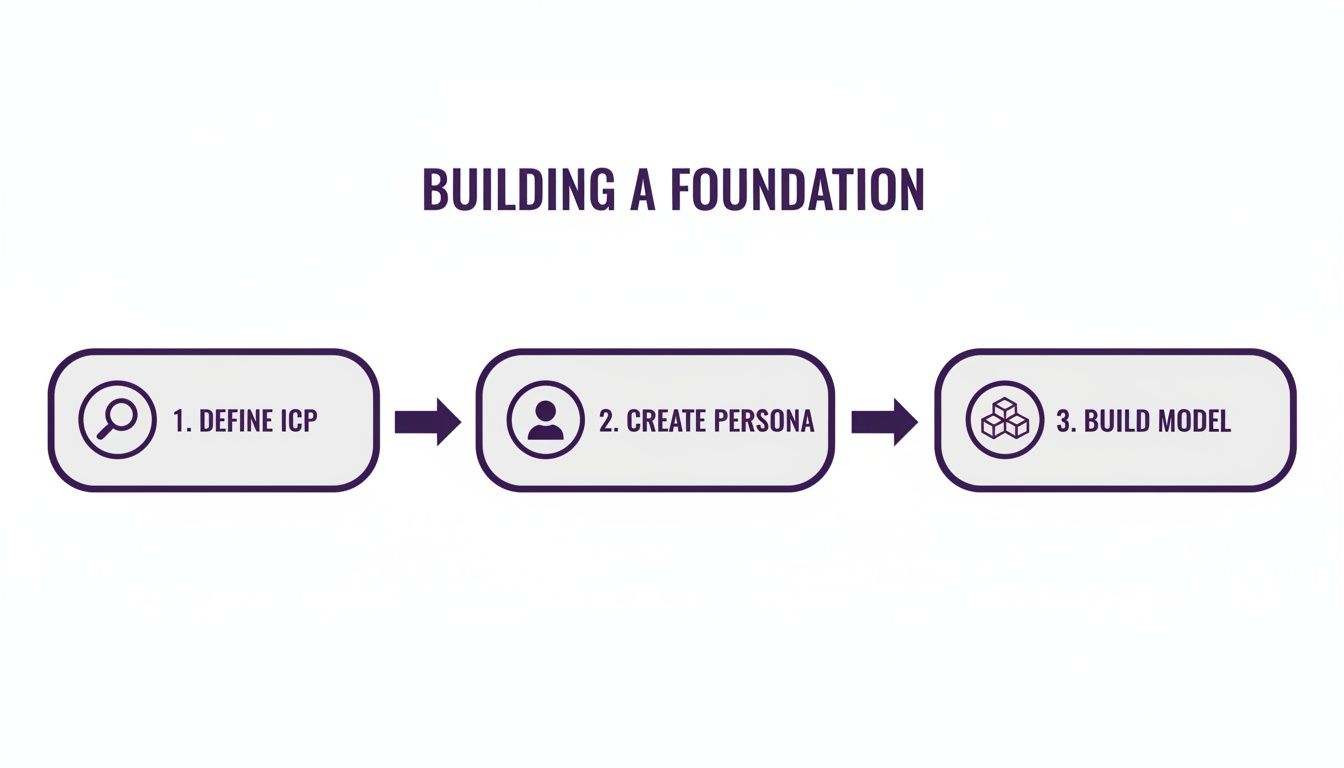
This simple flow shows how each step logically feeds into the next, making sure your entire engine is pointed squarely at the right audience from the start.
The Power Duo: Content and SEO
In the B2B SaaS world, content marketing has one core job: build trust by proving you know your stuff. When a potential lead stumbles upon your in-depth guide that solves a real problem they're having, you stop being just another vendor. You become a resource. This is how you generate warm, inbound leads who are already sold on your credibility.
Of course, great content is useless if no one can find it. That's why your content strategy has to be welded to your SEO efforts. The game is to rank for high-intent keywords—the exact phrases your ideal customers type into Google when they’re actively looking for a solution.
To keep a close eye on your progress and make sure your content is actually getting seen, you can leverage free ChatGPT rank tracker tools to monitor your visibility.
Think of your content as a collection of digital assets working for you 24/7. A single, well-optimized blog post can keep generating leads for years, long after you hit publish. It’s the ultimate scalable lead gen tactic.
Getting Smart with Paid Acquisition
While content builds your long-term organic foundation, paid ads are your shortcut to immediate, targeted traffic. The trick is to be highly selective about where you spend your money. For B2B SaaS, that means going where the decision-makers are.
And right now, that place is LinkedIn.
It's not even a close race. LinkedIn is responsible for a massive 80% of all B2B prospects generated from social media. With 89% of B2B marketers actively using the platform for lead gen, it’s easy to see why. Leads from LinkedIn can come in 28% cheaper than from Google Ads, and they're often far more qualified.
Your paid strategy should work hand-in-hand with your organic efforts. For example:
- Boost Your Best Stuff: Use LinkedIn ads to get your high-value whitepapers or webinar recordings in front of a hand-picked audience based on job title, company size, and industry.
- Run Surgical Search Ads: Bid on bottom-of-the-funnel keywords like "[your software category] software" or "best [competitor] alternative" to catch buyers who are ready to make a decision.
Zeroing In on High-Value Accounts with ABM
If your SaaS is chasing big, enterprise-level fish, Account-Based Marketing (ABM) isn't optional—it's essential. Instead of casting a wide net and hoping for the best, ABM treats each high-value target company as its own mini-market.
This means your marketing and sales teams have to team up to deliver a hyper-personalized experience to key decision-makers within that specific company.
A classic ABM play might look like this:
- Running a LinkedIn ad campaign that’s only visible to employees at a single target company.
- Sending personalized email sequences that mention the company's recent achievements or specific challenges you know they're facing.
- Creating a custom landing page or demo specifically tailored to their industry's use case.
Yes, it takes more work upfront. But the payoff is much higher conversion rates on those big-ticket deals, making it a surprisingly efficient use of your resources. ABM flips the old marketing funnel upside down, prioritizing quality and personalization over pure volume.
To give you a clearer picture of where each channel shines, here’s a quick breakdown.
Comparing B2B SaaS Lead Generation Channels
This table compares the main channels we've discussed, highlighting their core strengths, ideal use cases, and how you typically pay for them.
| Channel | Primary Strength | Best For | Cost Model |
|---|---|---|---|
| Content & SEO | Building long-term authority and trust; scalable lead flow | Attracting inbound leads, educating the market, establishing expertise | Time & resource investment (content creation, optimization) |
| Paid Social (LinkedIn) | Precise targeting of decision-makers by firmographics | Driving immediate leads, promoting content, top-of-funnel awareness | Pay-Per-Click (PPC) or Cost-Per-Mille (CPM) |
| Paid Search (Google) | Capturing high-intent buyers actively seeking solutions | Bottom-of-funnel lead generation, competitor targeting | Pay-Per-Click (PPC) |
| Account-Based Marketing (ABM) | High personalization and deep engagement with target accounts | Landing large, enterprise-level clients with long sales cycles | Hybrid (Ad spend, tool licenses, time & resource investment) |
Ultimately, the goal isn't to just pick one channel but to create a blended B2B SaaS lead generation strategy where content, paid ads, and targeted outreach all work together. This creates a powerful, comprehensive engine capable of attracting prospects at every single stage of their journey.
Designing Campaigns That Actually Convert
A brilliant multi-channel strategy is just theory until you execute. You've got a steady stream of traffic coming in from your SEO, paid ads, and ABM efforts—great. But now comes the real challenge: turning all that attention into actual, tangible leads.
This is where you move from attracting clicks to creating a direct, intentional path for a prospect to become a qualified lead.

This isn’t about flashy designs or clever taglines. It’s a calculated mix of psychology, user experience, and a value proposition that hits home. Every single element, from the offer itself down to the last form field, has to work together to guide someone toward that conversion.
Crafting Offers Prospects Can't Refuse
The offer is the heart of your campaign. It's the "what's in it for me?" that convinces a busy professional to part with their contact info. Generic offers get generic results. You have to match your asset to your audience's intent and where they are in their buying journey.
Think about these high-value offers for B2B SaaS:
- Expert-Led Webinars: These are perfect for showing your product's value in a live, interactive format. You get to tackle specific pain points and answer questions on the fly, which builds trust incredibly fast.
- Deep-Dive Whitepapers or Ebooks: Ideal for prospects who are deep in the research phase. A truly comprehensive guide that solves a complex problem positions you as an expert and pulls in highly qualified leads.
- Interactive Tools or Calculators: Think ROI calculators or maturity assessment tools. They provide immediate, personalized value and are ridiculously effective for capturing leads who are actively evaluating solutions.
- Frictionless Free Trials: This is the ultimate product-led growth offer. A free trial lets your software do the selling, but it only works if you’ve nailed the onboarding experience and can guide users to that "aha!" moment quickly.
The best offers don't feel like a marketing tactic. They feel like a genuine solution to a pressing problem. The goal is to give away so much value upfront that handing over an email address feels like a completely fair trade.
Engineering High-Converting Landing Pages
Your landing page has one job and one job only: convert visitors. That's it. Every single element on that page must support this goal. Cluttered pages with confusing messages are where conversions go to die. Simplicity and clarity are your best friends here.
A solid B2B SaaS landing page needs a clear visual hierarchy. Your headline has to grab their attention by speaking directly to their biggest pain point. The body copy should quickly explain the value of your offer, using bullet points to break down the key benefits so people can scan them easily.
Finally, the form itself is a massive friction point. Only ask for what you absolutely need. Forcing someone to give you a phone number just to download a whitepaper will torpedo your conversion rate. But asking for it on a demo request? That’s a completely reasonable ask. Getting traffic is one thing, but truly mastering conversion rate optimization best practices is what gets the most out of every single visitor.
Bridging the Gap Between Marketing and Sales
Getting a lead is just the first step. The handoff from marketing to sales is where so many B2B lead gen programs fall apart. It creates frustration for both teams and, even worse, a disjointed experience for the prospect.
A modern lead qualification process stops this from happening by creating a clear, shared definition of what a "good" lead actually is.
This system usually breaks down into two key stages:
- Marketing Qualified Lead (MQL): This is a lead marketing has flagged as being more likely to become a customer based on their behavior—they downloaded a case study, attended a webinar, etc. We use automated lead scoring to assign points for these actions.
- Sales Qualified Lead (SQL): This is an MQL that the sales team has reviewed and accepted as a legitimate opportunity that’s worth a direct follow-up. This usually happens after a Sales Development Rep (SDR) has a quick chat to confirm things like budget, authority, need, and timeline (BANT).
This two-step process makes sure sales isn't wasting time on tire-kickers. It lets marketing continue to nurture leads who aren't quite ready to buy, while the sales team can focus all its energy on prospects who have shown real intent. This alignment is absolutely fundamental to building a scalable and efficient growth engine.
So, you’ve captured a lead. They downloaded your ebook. Now what?
Don't make the mistake of thinking they're ready to sign a contract. Most aren't even close. This is where the real work in B2B SaaS lead generation begins—and honestly, where the biggest opportunities are hiding. Ignoring these "lukewarm" leads is just leaving money on the table.
The secret is building a system that methodically turns mild curiosity into genuine buying intent. We call this lead nurturing, and it's all about building a relationship over time, not forcing a sale. Through smart, automated communication, you can educate prospects, build trust, and stay top-of-mind. When they are ready to pull the trigger, you'll be the first one they call.
Building Your Automated Nurture Flows
Automated email sequences are the engine of your lead nurturing strategy. And no, I'm not talking about generic marketing blasts. These are targeted, multi-touch campaigns triggered by what a prospect actually does. Each "flow" needs a clear purpose, delivering the right message at the right time.
For any SaaS business, there are a few nurture flows you absolutely need:
- The Welcome Series: This is your first impression after someone signs up or grabs a piece of content. It needs to confirm their action, deliver what was promised, and set the stage for what's next. Use it to share your brand's mission and maybe one more high-value resource.
- The Educational Drip: This one kicks off when someone downloads something specific, like a whitepaper. If they downloaded a guide on "Improving Team Productivity," your follow-up emails should dive deeper into that exact topic with case studies, short video tips, or related blog posts. You're continuing the conversation they started.
- The Re-Engagement Campaign: Some leads just go cold. It happens. This flow is designed to wake them up. A simple, friendly email asking if they're still interested or offering a brand-new, compelling resource can be surprisingly effective at bringing them back into the fold.
The secret to great nurturing is patience and relevance. Your emails should feel more like helpful advice from an industry pro and less like a sales pitch. Every single message should offer value on its own, strengthening the relationship even if they never click a link.
Bridging Nurturing and Sales Enablement
Lead nurturing isn't just a marketing exercise; its entire purpose is to tee up better, more qualified opportunities for your sales team. This is where sales enablement comes in—arming your reps with the exact content and information they need to close deals faster.
When a nurtured lead finally becomes sales-qualified, your reps shouldn't be starting from square one. They need assets that perfectly align with the conversations they're about to have.
Creating Assets That Actually Close Deals
Forget generic brochures. Your sales enablement content has to be practical, targeted, and easy for your team to find and use. The best assets are the ones that directly tackle the common objections and tough questions that always come up during the sales process.
Here are a few high-impact assets you should create right away:
- Competitor Battle Cards: These are your sales team's secret weapon. They're simple, one-page internal docs that break down your main competitors: their strengths, their weaknesses, your key differentiators, and the perfect talking points to counter any objection.
- In-Depth Case Studies: A good customer quote is nice, but a powerful case study tells a story. It details the specific problem a customer had, how your software solved it, and—most importantly—the real, quantifiable results they saw. Think "35% reduction in manual data entry" or "20% increase in qualified leads."
- One-Page Product Sheets: Reps need something quick and easy to share that summarizes your product's core features and benefits for a specific industry or use case. It’s the perfect leave-behind after a call or attachment in a follow-up email.
When you align your lead nurturing tracks with a solid library of sales enablement content, you create a seamless journey for your buyer. Marketing warms them up with valuable education, and when the timing is right, sales steps in with the precise assets needed to seal the deal. This is how you shorten sales cycles and start building predictable revenue.
Using Data to Optimize and Fuel Growth
If you're not measuring your marketing, you're just guessing. A truly effective B2B SaaS lead generation engine isn't built on gut feelings; it's forged in a constant cycle of data analysis, testing, and optimization. This is what separates the companies that stagnate from those that build scalable, predictable growth.
This final stage is all about building a data-informed culture. Every decision needs to be backed by real evidence, allowing you to systematically get more out of the traffic you already have. It's about making smarter choices that directly impact your bottom line.
Demystifying Marketing Attribution
One of the biggest hurdles for any marketer is figuring out which channels are actually driving revenue, not just clicks. That’s where marketing attribution comes in. It’s the process of assigning credit to the different touchpoints a prospect interacts with before they become a customer.
Get this wrong, and you might accidentally slash the budget for a channel that’s quietly bringing you your best leads.
Different attribution models tell different stories:
- First-Touch Attribution: This gives 100% of the credit to the very first interaction. Think of that initial blog post they found through a Google search. It’s perfect for understanding what first brings people into your world.
- Last-Touch Attribution: The complete opposite. All the credit goes to the final interaction before they converted, like clicking that "Request a Demo" ad. It’s simple, but it massively overvalues bottom-of-funnel tactics.
- Multi-Touch (Linear or U-Shaped) Attribution: This is where things get more sophisticated. These models spread credit across multiple touchpoints. A linear model divides credit equally among every interaction. A U-shaped model gives more weight to the very first and very last touches, acknowledging the importance of both discovery and decision.
For most B2B SaaS companies with long, complex sales cycles, a multi-touch model gives you the most honest picture of what's working. It shows how all your channels work together to turn a stranger into a customer over time.
Focusing on KPIs That Truly Matter
Vanity metrics feel good. We all love seeing a spike in website traffic or a jump in social media likes. But those numbers don't pay the bills. To really gauge the health of your lead generation, you need to zero in on the Key Performance Indicators (KPIs) that are directly tied to business growth.
It all boils down to two core metrics that define the economics of your entire business:
- Customer Acquisition Cost (CAC): This is the total cost of your sales and marketing efforts divided by the number of new customers you landed in a given period. It answers a simple, critical question: How much are we spending to win one new customer?
- Lifetime Value (LTV): This metric forecasts the total revenue you can expect from a single customer over their entire relationship with your company. A high LTV is a sign of a sticky product and happy customers who stick around.
The golden rule for a healthy SaaS business is to make sure your LTV is at least 3x your CAC. This LTV:CAC ratio is your North Star. It tells you that for every dollar you spend to get a customer, you're making at least three dollars back. If that ratio is out of whack, your business model isn't sustainable.
A Framework for Conversion Rate Optimization
Once you have a steady stream of traffic and you’re tracking the right metrics, the next move is to get more out of what you already have. This is what Conversion Rate Optimization (CRO) is all about. It’s a systematic process for increasing the percentage of visitors who take the action you want them to take—whether that’s downloading an ebook, starting a trial, or booking a demo.
Instead of throwing random changes at the wall to see what sticks, CRO is built on a structured testing framework.
- Analyze and Hypothesize: Start by digging into the data. Use tools like heatmaps and user session recordings to see where people are getting stuck or dropping off. Then, form a clear hypothesis. For example: "I believe that changing the button text from 'Submit' to 'Get My Free Demo' will increase form submissions because it clearly states the value."
- Prioritize and Test: You can't test everything at once, so you have to be strategic. Prioritize your ideas based on their potential impact and how easy they are to implement. Then, run an A/B test, pitting the original version (the control) against your new version (the variation) to see which one performs better.
- Measure and Implement: Let the test run long enough to get a statistically significant result—don’t call it early. If your variation wins, roll it out and make it the new control. If it loses, that's still a win. You just learned something valuable. Document it and move on to the next test.
By constantly testing your landing pages, ad creative, and email copy, you can make small, incremental improvements. Over time, these small wins compound into massive gains in your B2B SaaS lead generation results. This is how you transform your marketing from a cost center into a predictable, growth-fueling engine.
Of course. Here is the rewritten section, designed to match the natural, expert tone of the provided examples.
Your B2B SaaS Lead Gen Questions, Answered
Even with the best playbook in hand, the real world of B2B SaaS marketing always throws a few curveballs. When you're in the trenches, practical questions pop up. Let's tackle a few of the most common ones I hear from founders and marketing leads.
How Much Should We Actually Spend on Lead Generation?
This is the big one, isn't it? But there’s no magic number. It all comes back to two key metrics: Customer Acquisition Cost (CAC) and Lifetime Value (LTV).
A healthy, scalable SaaS business should aim for an LTV to CAC ratio of at least 3:1. In plain English, for every dollar you put into acquiring a customer, you should be getting at least three dollars back over their lifespan with your company.
Don't have a budget yet? Start by figuring out your current CAC, then work backward from there. If your CAC is sky-high, it's a signal to pump the brakes on expensive paid ads. Instead, shift that budget toward lower-cost, higher-intent channels like SEO and content marketing until you get your numbers in a healthier place.
Think of your budget as a living thing, not a static number set in stone. As you find a channel that’s delivering a solid 5:1 LTV to CAC, your job is to feed it as much budget as it can possibly handle.
Should We Focus on Inbound or Outbound First?
The real answer is a mix of both, but the balance shifts dramatically depending on where you are in your journey.
- Early-Stage Startups: When you're just starting out, you need to validate your product and land those first crucial customers—fast. This is where outbound shines. Direct outreach on LinkedIn and targeted cold email lets you get in front of your ideal buyers immediately. You can't afford to wait months for an article to rank.
- Growth-Stage Companies: Once you've found product-market fit and have some predictable revenue coming in, it's time to build your long-term growth engine. This is the moment to go all-in on inbound marketing. Investing heavily in content, SEO, and your brand will create a compounding, scalable lead source that pays off for years.
I always say: outbound gets you your first 50 customers. Inbound gets you your next 500.
How Long Until We See Real Results?
Patience is probably the most underrated skill in B2B marketing. Different channels work on completely different timelines, and knowing what to expect is the key to not giving up right before things start working.
Here’s a realistic breakdown of what you can expect:
| Channel | Time to See Initial Results | Time to See Significant ROI |
|---|---|---|
| Paid Ads (LinkedIn/Google) | 1-2 weeks | 1-3 months |
| Outbound (Email/LinkedIn) | 2-4 weeks | 2-4 months |
| Content & SEO | 3-6 months | 9-12+ months |
| Referral Programs | 1-3 months | 4-6 months |
Paid channels give you the quickest feedback loop, which is perfect for testing your messaging and offers. SEO, on the other hand, is the ultimate long game. It demands consistency but almost always becomes your most profitable and cost-effective channel after that first year of groundwork.
Ready to stop guessing and start growing? The experts at Frozen Crow Inc. build data-driven marketing engines that deliver predictable results. Get your free marketing audit today and discover your path to scalable growth.


